

Biryani Franchise in India: The Fastest-Growing Food Sector (2026 Guide)
November 6, 2026
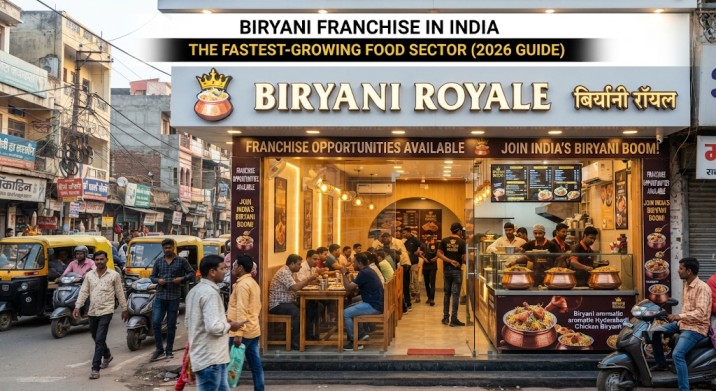
Biryani Franchise in India: The Fastest-Growing Food Sector (2026 Guide)
A biryani franchise in India can be started with ₹5–10 lakh for a delivery-focused model, or ₹25–50 lakh for a dine-in brand like Biryani By Kilo or Donne Biryani Palace. The biryani market is valued at ₹40,000 crore annually, growing at 7–8%, but only 8% of the market is organised — and organised brands are growing at 20% annually.
India orders 320 biryanis a minute through online platforms alone. Biryani is not a regional dish or a fad — it is the country’s most democratic meal, with Hyderabadi, Lucknowi, Kolkata, Malabar, and Ambur variants. This guide gives you the real costs, ROI numbers, and the brands that fit a ₹2–25 lakh budget.
One-Line Answer: What Does a Biryani Franchise Cost?
₹5–10 lakh (Badmash Biryani): Delivery-focused cloud kitchen or compact QSR. ₹2.5 lakh franchise fee, 5% royalty, 18–24 month payback.
₹10–20 lakh (Pride Kitchen): Hyderabadi biryani QSR with dine-in, takeaway, and delivery. ₹4 lakh franchise fee, 6% royalty, 1–2 year payback.
₹25–40 lakh (Biryani By Kilo): FOFO model with handi-style biryani, strong brand recall, 22-month break-even.
₹30–50 lakh (Donne Biryani Palace): Large-format outlet, ₹14 lakh franchise fee, for established high-street locations.
Why this matters to you: The ₹5–10 lakh budget is realistic for a delivery-first biryani franchise. The ₹25 lakh+ brands are dine-in formats with higher revenue ceilings but longer payback. Choose the format before you choose the brand.
Why Biryani Is India’s Most Bankable Food Franchise
₹40,000 Crore Market, Only 8% Organised
India’s biryani market is estimated at around ₹40,000 crore annually, growing at 7–8%. But only about 8% of the market is organised — the remaining 92% is unorganised, local, and regional. Organised brands are growing at around 20% annually, significantly faster than the overall market.
India Orders 320 Biryanis a Minute Online
India orders 320 biryanis a minute through online platforms alone. Biryani is the most ordered dish on food delivery apps, and the market is valued at USD 2.3–3.5 billion according to Redseer data. The delivery habit is already built — you are tapping into existing demand, not creating it.
Organised Brands Growing at 20% Annually
While the overall biryani market grows at 7–8%, organised brands are growing at around 20% annually. The organised segment is projected to grow from ₹2,800 crore to ₹7,406 crore by FY30**, increasing its share from **8% to 12%. This is the franchise opportunity: organised brands bringing consistency, hygiene, and supply-chain reliability to a market that already has massive demand.
Tier-2/3 Cities Are the New Battleground
Tier-2 to Tier-4 towns are emerging as hotbeds for biryani innovation, with local kitchens scaling up via franchise networks, tech integrations, and marketing agility. The same ₹8 lakh that buys a bare-bones metro kitchen can fund a complete Tier-2 setup with working capital buffer.
Why this matters to you: You are not entering a saturated market. You are entering the exact segment — organised biryani in Tier-2 cities — where the growth is fastest.
The 4 Biryani Franchise Formats That Fit Your Budget
Delivery-Only Cloud Kitchen (₹5–15 Lakh)
A delivery-only kitchen operating under a franchise brand. Space requirement: 200–500 sq ft. No dine-in, minimal staff. Badmash Biryani operates in this model with a ₹5–10 lakh investment, ₹2.5 lakh franchise fee, 5% royalty, and 250–500 sq ft space requirement**. Payback is estimated at **18–24 months**. Best for Tier-2/3 cities where rent is low and delivery demand is growing.
Compact QSR / Takeaway (₹10–20 Lakh)
A takeaway-focused outlet with a small seating area. Pride Kitchen operates a Hyderabadi biryani QSR with a ₹10–20 lakh investment, ₹4 lakh franchise fee, 6% royalty, and 300–1,000 sq ft space requirement**. Payback is estimated at **1–2 years**. The format supports dine-in, takeaway, and delivery.
Standard Dine-In Outlet (₹25–40 Lakh)
A dine-in biryani restaurant with seating, a broader menu, and brand recall. Biryani By Kilo operates a FOFO model with an investment of ₹25–40 lakh**, known for its handi-style biryani and strong customer recall. Best for high-footfall high-street or mall locations.
Large-Format Restaurant (₹40–50 Lakh+)
A large-format biryani restaurant with a full dine-in experience. Donne Biryani Palace operates in this segment with a ₹30–50 lakh investment and ₹14 lakh franchise fee**. Best for established operators with experience in full-service restaurants.
Comparison Table: Investment, Space, Payback
| Format | Investment | Space | Payback | Best For |
|---|---|---|---|---|
| Delivery-Only Cloud Kitchen | ₹5–10 lakh | 200–500 sq ft | 18–24 months | First-timers, low-risk entry |
| Compact QSR / Takeaway | ₹10–20 lakh | 300–1,000 sq ft | 1–2 years | High-footfall takeaway |
| Standard Dine-In | ₹25–40 lakh | 500–1,200 sq ft | 22–30 months | Strong brand recall, dine-in |
| Large-Format Restaurant | ₹40–50 lakh+ | 1,000–2,000 sq ft | 30+ months | Experienced operators |
Sources: ForeFind / Badmash Biryani (Jun 2026), ForeFind / Pride Kitchen (Jun 2026), FranchiseBazar (Oct 2025), ForeFind / Donne Biryani Palace (Jun 2026). Figures are estimates and vary by city, brand, and format.
Investment Breakdown: Where Your ₹5–50 Lakh Goes
Franchise Fee, Kitchen Equipment, Fit-Outs, Licences, Working Capital
| Cost Component | Badmash (₹) | Pride Kitchen (₹) | Biryani By Kilo (₹) |
|---|---|---|---|
| Franchise fee | ₹2.5 lakh | ₹4 lakh | On enquiry |
| Kitchen equipment | ₹2–3 lakh | ₹4–6 lakh | ₹8–12 lakh |
| Interiors / fit-outs | ₹1–2 lakh | ₹2–4 lakh | ₹8–12 lakh |
| Security deposit | ₹50,000–₹1 lakh | ₹1–2 lakh | ₹2–3 lakh |
| Working capital | ₹1–1.5 lakh | ₹1.5–2 lakh | ₹2–4 lakh |
| Total | ₹5–10 lakh | ₹10–20 lakh | ₹25–40 lakh |
Sources: ForeFind / Badmash Biryani (Jun 2026), ForeFind / Pride Kitchen (Jun 2026), FranchiseBazar (Oct 2025). Figures are estimates and vary by city and agreement.
Why this matters to you: The franchise fee is only 20–30% of the total cost. Equipment, interiors, and working capital make up the rest. A ₹2.5 lakh franchise fee with no working capital buffer is not a ₹2.5 lakh business — it is a ₹7–8 lakh business waiting to run out of cash.
ROI and Break-Even: The Real Numbers
55% Annual ROI and 22-Month Break-Even
Industry ROI comparisons place biryani franchises at ₹12 lakh average investment**, **₹55,000 monthly profit**, **₹6.6 lakh annual profit**, and a **55% annual ROI with a 22-month break-even. This places biryani ahead of pizza (56% ROI, 21 months) and ice cream (54% ROI, 22 months) on capital efficiency, while delivering higher absolute monthly profit than waffle or momo kiosks.
Why Biryani Beats Pizza and Ice Cream on ROI
Biryani’s ROI advantage comes from three factors: lower investment than pizza** (₹12 lakh vs ₹15 lakh), **higher monthly profit than ice cream** (₹55,000 vs ₹45,000), and a **delivery-first model that reduces rent dependency. A delivery-only biryani kitchen avoids the dine-in rent burden that drags down pizza and ice cream outlet economics.
Monthly Profit Scenarios
| Format | Monthly Revenue (Est.) | Net Margin | Monthly Net Profit (Est.) | Payback |
|---|---|---|---|---|
| Delivery-only biryani kitchen | ₹3–5 lakh | 12–18% | ₹45,000–₹80,000 | 18–24 months |
| Compact QSR / takeaway | ₹4–7 lakh | 12–20% | ₹55,000–₹1.2 lakh | 18–24 months |
| Standard dine-in outlet | ₹6–10 lakh | 15–22% | ₹1–2 lakh | 24–30 months |
Sources: TBWX Press (Apr 2026), ForeFind / Badmash Biryani (Jun 2026), industry estimates. Figures assume 30–35% food cost and controlled rent.
Why this matters to you: A delivery-only biryani kitchen at ₹3–5 lakh monthly revenue and 12–18% net margin can pay back the ₹5–10 lakh investment in 18–24 months. A dine-in outlet at ₹6–10 lakh revenue and 15–22% margin can pay back in 24–30 months but generates higher absolute monthly income.
Top Biryani Franchise Brands in India (2026)
Badmash Biryani (₹5–10 Lakh)
A delivery-focused biryani and North Indian cuisine franchise founded in 2019. Investment: ₹5–10 lakh**. Franchise fee: **₹2.5 lakh**. Royalty: **5%**. Space: 250–500 sq ft**. Payback: 18–24 months**. 10–20 franchise outlets. Best for first-time entrepreneurs and delivery-first operators in Tier-2/3 cities.
Pride Kitchen – Hyderabadi Biryani (₹10–20 Lakh)
A Hyderabadi biryani QSR franchise operating since 2000. Investment: ₹10–20 lakh**. Franchise fee: **₹4 lakh**. Royalty: **6%**. Space: 300–1,000 sq ft**. Payback: 1–2 years**. 20–50 franchise outlets. Best for compact QSR and takeaway formats with dine-in potential.
Biryani By Kilo (₹25–40 Lakh)
A premium handi-style biryani brand with a FOFO franchise model. Investment: ₹25–40 lakh**. Known for authentic dum biryani and strong customer recall. Best for established high-street or mall locations with dine-in demand.
Donne Biryani Palace (₹30–50 Lakh)
A Bengaluru-style biryani franchise with a ₹30–50 lakh investment and ₹14 lakh franchise fee**. Large-format outlet for established operators. Best for experienced restaurateurs with full-service experience.
Paradise Biryani (Company-Owned, Not Franchised)
India’s most iconic biryani brand, founded in 1953 in Secunderabad. Paradise operates 57+ stores** across Hyderabad, Bengaluru, Chennai, and other cities, with plans to invest **₹100 crore to add 100 new outlets**. However, all stores in India are **company-owned and company-operated** — Paradise is not currently selling individual franchises in India. It is actively evaluating international franchise opportunities but has not opened domestic franchising.
Brand Comparison Table
| Brand | Investment | Franchise Fee | Royalty | Payback |
|---|---|---|---|---|
| Badmash Biryani | ₹5–10 lakh | ₹2.5 lakh | 5% | 18–24 months |
| Pride Kitchen | ₹10–20 lakh | ₹4 lakh | 6% | 1–2 years |
| Biryani By Kilo | ₹25–40 lakh | On enquiry | On enquiry | ~22 months |
| Donne Biryani Palace | ₹30–50 lakh | ₹14 lakh | On enquiry | On enquiry |
Sources: ForeFind (Jun 2026), FranchiseBazar (Oct 2025), brand pages and industry reports. Figures are estimates and vary by city and agreement.
The Tier-2 City Advantage: Why Indore, Jaipur, and Patna Work
Lower Rent, Lower Competition, Faster Payback
Tier-2 cities like Indore, Jaipur, and Patna offer lower rent (₹10,000–₹25,000 for 200–500 sq ft), lower competition from organised biryani brands, and growing delivery demand. A delivery-only biryani kitchen in a Tier-2 city can generate ₹3–5 lakh in monthly revenue** within 6–9 months if the menu is focused and aggregator ratings stay above 4.0, generating **₹45,000–₹80,000 in monthly net profit at a 12–18% net margin.
The same ₹5–10 lakh that barely covers equipment in a metro can fund a complete Tier-2 setup with working capital buffer. Lower rent means faster break-even and higher net margin on the same revenue.
Why this matters to you: In Tier-2 cities, a ₹5–10 lakh biryani franchise can break even in 18–24 months because rent and staff costs are lower. The same investment in a metro buys more competition and higher fixed costs.
7-Point Checklist Before Choosing a Biryani Franchise
- Does the all-in investment fit my budget, or am I stretching to the last rupee?
- Is the format delivery-only, takeaway, or dine-in? Does it match my location and skills?
- What is the exact royalty — 5%, 6%, or a revenue share?
- Does the franchise fee include equipment, training, and fit-outs, or are they separate?
- Have I budgeted ₹1–1.5 lakh for working capital and 2–3 months of operating costs?
- Have I spoken to 3 existing franchisees about actual monthly revenue and net profit?
- Is the territory protected in writing, and is the FSSAI licence category correct for my turnover?
If the answer to questions 1, 3, or 5 is unclear, do not sign yet.
Final Verdict
If your budget is ₹5–10 lakh: Badmash Biryani is the realistic entry point. Delivery-focused, ₹2.5 lakh fee, 5% royalty, 18–24 month payback. Best for Tier-2/3 cities.
If your budget is ₹10–20 lakh: Pride Kitchen offers a Hyderabadi biryani QSR with ₹4 lakh fee, 6% royalty, and 1–2 year payback. Best for compact QSR and takeaway formats.
If your budget is ₹25–40 lakh: Biryani By Kilo offers a premium handi-style biryani brand with strong recall. Best for high-street or mall locations.
If you want India’s most iconic brand: Paradise Biryani is not available as a domestic franchise. It is company-owned. Do not wait for it — choose a franchisable brand that fits your budget.
See verified biryani franchise options:
View biryani franchise list on free-franchise.com →
Frequently Asked Questions (FAQ)
Which is the best biryani franchise in India for a ₹5–10 lakh budget?
Badmash Biryani is the strongest fit: ₹5–10 lakh investment, ₹2.5 lakh franchise fee, 5% royalty, 250–500 sq ft space, and 18–24 month payback. It is a delivery-focused model best suited to Tier-2/3 cities.
What is the profit margin in a biryani franchise?
Biryani franchises typically run at 12–20% net margins. Industry benchmarks show ₹12 lakh average investment, ₹55,000 monthly profit, and 55% annual ROI with a 22-month break-even. A delivery-only kitchen can generate ₹45,000–₹80,000 in monthly net profit.
How long does it take to break even in a biryani franchise?
Break-even typically takes 18–24 months for delivery-focused models and 24–30 months for dine-in outlets. Industry ROI data places biryani at 22 months average break-even, slightly longer than pizza (21 months) but with a lower investment base.
Is Biryani By Kilo a good franchise option?
Biryani By Kilo is a strong premium brand with handi-style biryani and ₹25–40 lakh investment. It is best for high-street or mall locations with dine-in demand. The higher investment means a longer payback than a ₹5–10 lakh delivery kitchen, but the brand recall is stronger.
Does Paradise Biryani offer franchises in India?
No. As of 2026, all Paradise Biryani stores in India are company-owned and company-operated. The brand is evaluating international franchise opportunities but has not opened domestic franchising. Do not wait for Paradise — choose a franchisable brand that fits your budget.
Is a biryani franchise profitable in Tier-2 cities?
Yes. Tier-2 cities like Indore, Jaipur, and Patna have lower rent (₹10,000–₹25,000 for 200–500 sq ft), lower competition, and growing delivery demand. A delivery-only kitchen can generate ₹3–5 lakh in monthly revenue and break even in 18–24 months.