South Indian Food Franchise in India: Low Competition, High Demand (2026 Guide)
November 6, 2026
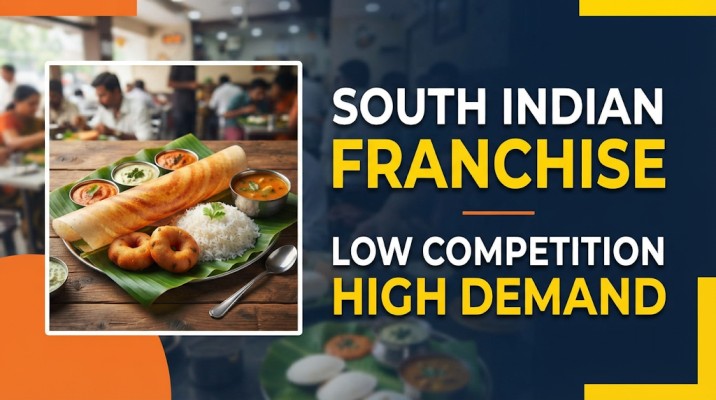
South Indian Food Franchise in India: Low Competition, High Demand (2026 Guide)
A South Indian food franchise in India can be started with ₹2–2.95 lakh for a zero-franchise-fee kiosk model like Idli Point, or ₹10–35 lakh for a QSR or dine-in format. The segment is valued at ₹12,000 crore in 2025 and is projected to reach ₹22,000 crore by 2030, growing at 10–12% CAGR — yet most cities still have far more Udupi restaurants than branded South Indian chains.
South Indian food is affordable, healthy, vegetarian, and eaten across all dayparts — breakfast, lunch, and dinner. Unlike pizza or burgers, it does not depend on a single meal occasion. This guide breaks down the real costs, the formats that fit your budget, and why the category is still under-penetrated outside Bengaluru and Chennai.
One-Line Answer: Why South Indian Is a Low-Competition, High-Demand Category
Low competition: Most Tier-2 cities have local Udupi restaurants but very few branded South Indian chains. A branded South Indian outlet in Indore or Jaipur faces far fewer organised competitors than a pizza or burger franchise.
High demand: South Indian food is the default breakfast, a quick lunch, and a light dinner. Idli, dosa, vada, and filter coffee have universal appeal across age groups and income levels.
Why this matters to you: You are not entering a saturated category. You are entering a category where demand already exists and organised supply is still catching up — especially in Tier-2 and Tier-3 cities.
Why South Indian Food Franchises Are Booming in 2026
India’s QSR Market at US$30.37 Billion
India’s quick-service restaurant (QSR) market is worth USD 30.37 billion in 2026 and is projected to reach USD 47.28 billion by 2031, growing at a 9.25% CAGR [reference:0]. South Indian food franchises are gaining attention within this market because of their low investment and high demand [reference:1].
South Indian Food Is Affordable, Healthy, and Vegetarian
South Indian food has become popular across India because it is affordable, healthy, and vegetarian** [reference:2]. Changing consumer habits favour quick, hygienic food; urban Indians now dine out about **five times per month**; and delivery platforms are expanding reach into Tier-2 and Tier-3 cities [reference:3]. Idli and dosa are suitable for all meals, which helps franchises earn throughout the day instead of only during morning hours [reference:4].
The Darshini Model Is Scaling Nationally
Bengaluru’s Darshini-style tiffin model — fast, efficient, and cost-advantaged — is expanding nationally. Mumbai has become a launchpad, with over a dozen Bengaluru-style benne dosa outlets opening in a few months. Rameshwaram Cafe’s Churchgate outlet alone serves close to 20,000 dosas and idlis daily** [reference:5]. Legacy chains are following: Banana Leaf has opened its 20th Mumbai outlet and plans 20 more across major metros [reference:6].
Why this matters to you: The format is no longer regional. What worked in Bengaluru is now working in Mumbai, Delhi, and Tier-2 cities. You are entering at a point where the model has been proven but is not yet saturated.
The 4 Franchise Formats That Fit ₹2–35 Lakh
Kiosk / Eat n Go Model (₹2–10 Lakh)
The lowest-investment format. Idli Point’s Eat n Go model requires 250–600 sq ft** and costs **₹2–2.95 lakh** with **zero franchise fee** [reference:7]. Palaram Bandi offers a similar format at ₹2–5 lakh** with **no franchise fee** and 250–500 sq ft space [reference:8]. Best for food courts, tech parks, metro stations, and dense residential markets.
Cloud Kitchen (₹3–15 Lakh)
A delivery-only kitchen operating under a franchise brand. Space requirement: 100–300 sq ft. No dine-in, minimal staff. Launchlify notes that you can start an Indian food franchise cloud kitchen from just ₹3 lakh** in **150–300 sq ft**, unlike traditional restaurants that need ₹35 lakh+ and 1,000+ sq ft [reference:9]. Break-even is typically **8–18 months** [reference:10].
QSR Counter Outlet (₹10–35 Lakh)
A takeaway-focused outlet with a small seating area. Nandri South Indian Cafe’s kiosk model starts at ₹12 lakh** for 250–350 sq ft with **15–18 month ROI** [reference:11]. Namaskara Anna offers a ₹15 lakh** investment, **₹2 lakh franchise fee**, **0% royalty**, and **12–15 month payback** [reference:12]. Mysore Tiffanys operates in the **₹18–25 lakh** range for 400–600 sq ft [reference:13].
Full-Service Dine-In (₹35 Lakh–1 Crore+)
A full restaurant with seating, a broader menu, and brand recall. Sagar Ratna operates 175+ outlets with an investment of ₹30–60 lakh** and **5–8% royalty** [reference:14]. Banana Leaf operates large-format 2,000–2,500 sq ft dine-in outlets with capex of ₹1.25–1.5 crore per store** and **24–30 month break-even** [reference:15].
Comparison Table: Investment, Space, Break-Even
| Format | Investment | Space | Break-Even | Best For |
|---|---|---|---|---|
| Kiosk / Eat n Go | ₹2–10 lakh | 250–600 sq ft | 8–18 months | First-timers, food courts |
| Cloud Kitchen | ₹3–15 lakh | 100–300 sq ft | 8–18 months | Delivery-first, low rent |
| QSR Counter Outlet | ₹10–35 lakh | 300–800 sq ft | 12–24 months | High-footfall takeaway |
| Full-Service Dine-In | ₹35 lakh–1 crore+ | 1,000–3,000 sq ft | 24–48 months | Experienced operators |
Sources: Idli Point / FranchiseBazar (Jan 2026), Launchlify (Sep 2026), Nandri / FranchiseBazar (2026), Namaskara Anna / FranchiseAlpha (2026), Mysore Tiffanys (2025). Figures are estimates and vary by city, brand, and format.
Investment Breakdown: Where Your ₹2–35 Lakh Goes
Idli Point Zero-Franchise-Fee Model (₹2–2.95 Lakh)
Idli Point operates with zero franchise fee and zero royalty** [reference:16]. The setup cost is approximately **₹2 lakh**, with a total investment of **₹2–2.95 lakh** covering setup and interiors (₹80,000–₹1.2 lakh), kitchen equipment (₹60,000–₹80,000), initial inventory (₹20,000–₹30,000), licences (₹10,000–₹15,000), and working capital (₹30,000–₹50,000) [reference:17]. This is one of the lowest entry points in the entire food franchise category.
Nandri Kiosk (₹12 Lakh)
Nandri’s kiosk model requires 250–350 sq ft** and **₹12 lakh setup cost**, with a 15–18 month ROI** [reference:18]. The franchise fee range is ₹5–10 lakh [reference:19].
Mysore Tiffanys (₹18–25 Lakh)
Mysore Tiffanys operates a FOFO model with ₹18–25 lakh investment**, **400–600 sq ft space**, and **18–24 month payback** [reference:20].
Investment Table by Format
| Cost Component | Idli Point (₹) | Nandri Kiosk (₹) | Mysore Tiffanys (₹) |
|---|---|---|---|
| Franchise fee | 0 | ₹5–10 lakh | On enquiry |
| Setup / interiors | ₹80,000–₹1.2 lakh | Included in ₹12 lakh | ₹18–25 lakh total |
| Kitchen equipment | ₹60,000–₹80,000 | Included | Included |
| Working capital | ₹30,000–₹50,000 | Separate (₹1–2 lakh) | Separate (₹1.5–2 lakh) |
| Total | ₹2–2.95 lakh | ₹12 lakh+ | ₹18–25 lakh |
Sources: Idli Point / FranchiseBazar (Jan 2026), Nandri / FranchiseBazar (2026), Mysore Tiffanys (2025). Figures are estimates and vary by city and agreement.
Why this matters to you: The Idli Point model is the cheapest branded entry into South Indian food — and it has no royalty. That means every rupee of profit after rent and staff stays with you. The trade-off is a limited menu and a smaller format.
Profit Margins and ROI: The Real Numbers
20–40% Net Margin for Well-Managed Outlets
Typical net profits of a well-managed South Indian food franchise range from 20% to 40%**, depending on format, location, and kitchen efficiency [reference:21]. This is higher than the 12–25% net margins typical in pizza or burger franchises, because South Indian food has lower raw material costs (rice, lentils, vegetables) and simpler kitchen operations.
90% Annual ROI and 12–15 Month Payback (Namaskara Anna)
Namaskara Anna reports an expected 90% annual ROI** and a **12–15 month payback period** on its ₹15 lakh model [reference:22]. Idli Point’s low investment and zero royalty structure means a kiosk with 150–200 daily customers can recover the ₹2–2.95 lakh investment in 6–10 months.
Monthly Profit Scenarios Table
| Format | Monthly Revenue (Est.) | Net Margin | Monthly Net Profit (Est.) | Payback |
|---|---|---|---|---|
| Idli Point kiosk | ₹1.5–2.5 lakh | 25–35% | ₹40,000–₹85,000 | 6–10 months |
| Nandri kiosk | ₹2.5–4 lakh | 20–30% | ₹50,000–₹1.2 lakh | 15–18 months |
| Mysore Tiffanys QSR | ₹3–5 lakh | 20–40% | ₹60,000–₹2 lakh | 18–24 months |
Sources: Industry estimates based on Launchlify (Sep 2026), Namaskara Anna / FranchiseAlpha (2026), and Mysore Tiffanys (2025). Figures assume 30–35% food cost and controlled rent.
Why this matters to you: A ₹2.95 lakh Idli Point kiosk at ₹2 lakh monthly revenue and 30% net margin can pay back the full investment in 5–6 months. No other food franchise category offers that speed of capital recovery at that investment level.
Top South Indian Food Franchise Brands (2026)
Idli Point (₹2–2.95 Lakh, Zero Franchise Fee)
A zero-franchise-fee, zero-royalty kiosk model with a simple menu of idli, dosa, vada, pongal, upma, and filter coffee. Space: 250–600 sq ft for Eat n Go, 900–1,300 sq ft for dine-in. All-day operations from 7 AM to 11 PM. Best for first-time entrepreneurs, food courts, tech parks, and metro stations. Rent should stay below 8–10% of monthly revenue for healthy unit economics [reference:23].
Palaram Bandi (₹2–5 Lakh)
A South Indian snacks, breakfast, and tiffin franchise with no franchise fee** and **250–500 sq ft** space. Operations commenced in 2025, franchising in 2026. Best for low-risk entry in South India [reference:24].
Nandri South Indian Cafe (₹10–15 Lakh)
A modern South Indian cafe and QSR with a kiosk model at ₹12 lakh** (250–350 sq ft, 15–18 month ROI) and a hybrid cafe model at **₹25 lakh** (1,000–1,200 sq ft, 15–20 month ROI). Menu includes filter coffee, gun powder idli, and fusion items like chicken keema dosa. Expanding into Indore, Bhopal, Nagpur, Raipur, and other Tier-2 cities [reference:25].
Namaskara Anna (₹15 Lakh)
An Udupi-style South Indian restaurant franchise with ₹15 lakh investment**, **₹2 lakh franchise fee**, **0% royalty**, **300 sq ft**, **90% annual ROI**, and **12–15 month payback**. Non-exclusive territory with distance protection. Best for high-street, residential, and office-zone locations [reference:26].
Mysore Tiffanys (₹18–25 Lakh)
A pure vegetarian, Sattvik South Indian franchise with a FOFO model. Investment: ₹18–25 lakh**, space: **400–600 sq ft**, payback: **18–24 months**. Site selection, training, and marketing support included [reference:27].
Sagar Ratna (₹30–60 Lakh)
India’s legacy South Indian restaurant chain, with 175+ outlets**, **40+ years of legacy**, and **5 crore customers annually**. Investment: ₹30–60 lakh** (varies by location and format). Royalty: 5–8%** of gross monthly sales. Best for prime commercial locations and experienced operators [reference:28].
Brand Comparison Table
| Brand | Investment | Franchise Fee | Royalty | Payback |
|---|---|---|---|---|
| Idli Point | ₹2–2.95 lakh | 0 | 0% | 6–10 months |
| Palaram Bandi | ₹2–5 lakh | 0 | Not disclosed | On enquiry |
| Nandri | ₹10–15 lakh | ₹5–10 lakh | Not disclosed | 15–18 months |
| Namaskara Anna | ₹15 lakh | ₹2 lakh | 0% | 12–15 months |
| Mysore Tiffanys | ₹18–25 lakh | On enquiry | On enquiry | 18–24 months |
| Sagar Ratna | ₹30–60 lakh | On enquiry | 5–8% | 24–36 months |
Sources: FranchiseBazar (Jan 2026), FranchiseAlpha (Jan 2026), Mysore Tiffanys (2025), Launchlify (Sep 2026). Figures are estimates and vary by city and agreement.
Why Low Competition Matters
Most Cities Have Udupi Restaurants but Few Branded South Indian Chains
Walk through Indore, Jaipur, or Patna and you will find local Udupi restaurants and standalone idli-dosa stalls. But you will find very few branded South Indian chains with standardised menus, hygiene protocols, and delivery-app presence. The competition is fragmented and unorganised — which is exactly the opportunity for a franchise brand. A branded outlet with consistent taste, clean interiors, and Swiggy/Zomato visibility can capture share from dozens of unbranded competitors.
The Darshini Format Is Still Under-Penetrated Outside Bengaluru
The Darshini model — fast, efficient, and built for high throughput — has scaled nationally from Bengaluru, but it is still concentrated in metros. Mumbai’s benne dosa boom is less than two years old. Tier-2 cities are almost untouched by this format. The same ₹12–15 lakh that opens a Nandri kiosk in Nagpur or Indore would buy a fraction of a metro outlet — and face far fewer direct competitors.
Why this matters to you: Low competition does not mean low demand. It means the demand exists and the organised supply has not caught up yet. That is the window a franchisee can step into.
Tier-2 City Advantage: Why Indore, Jaipur, and Patna Work
Lower Rent, Lower Competition, Faster Payback
Tier-2 and Tier-3 cities have lower entry costs for South Indian franchises [reference:29]. A mid-tier dosa franchise typically requires ₹20–40 lakh** with profitability achievable within **12–24 months** [reference:30]. But kiosk formats like Idli Point can start at **₹2–2.95 lakh** in a Tier-2 city, with rent below ₹15,000 for 250–350 sq ft. The same ₹2 lakh that barely covers equipment in a metro can fund a complete kiosk with working capital in Indore or Patna.
South Indian food has universal appeal, and Tier-2 cities are seeing rising demand for hygienic, branded vegetarian food. A Nandri kiosk in Indore or a Namaskara Anna outlet in Jaipur faces far fewer branded competitors than the same outlet in Mumbai — and pays 50–70% lower rent.
Why this matters to you: The fastest payback is not in the biggest city. It is in the city where rent is low, branded competition is low, and South Indian food demand is steady across all dayparts.
7-Point Checklist Before Choosing a South Indian Franchise
- Does the all-in investment fit my budget, or am I stretching to the last rupee?
- Is the format a kiosk, cloud kitchen, QSR, or dine-in? Does it match my location and skills?
- What is the exact royalty — 0%, 5%, or 8% — and does it apply to gross or net revenue?
- Does the franchise fee include equipment, training, and fit-outs, or are they separate?
- Have I budgeted ₹50,000–₹1.5 lakh for working capital and 2–3 months of operating costs?
- Have I spoken to 3 existing franchisees about actual monthly revenue and net profit?
- Is the territory protected in writing, and is the FSSAI licence category correct for my turnover?
If the answer to questions 1, 3, or 5 is unclear, do not sign yet.
Final Verdict
If your budget is ₹2–5 lakh: Idli Point (zero franchise fee, ₹2–2.95 lakh) or Palaram Bandi (₹2–5 lakh) are the strongest entry points. Focus on a kiosk or Eat n Go format in a Tier-2 city with high footfall and low rent.
If your budget is ₹10–15 lakh: Nandri’s kiosk model (₹12 lakh, 15–18 month ROI) or Namaskara Anna (₹15 lakh, 0% royalty, 12–15 month payback) offer a complete branded setup with better margins than a metro outlet.
If your budget is ₹18–25 lakh: Mysore Tiffanys (FOFO, ₹18–25 lakh, 18–24 month payback) offers a pure vegetarian, Sattvik menu with strong brand support.
If your budget is ₹30–60 lakh: Sagar Ratna offers a legacy brand with 175+ outlets, 5 crore annual customers, and 5–8% royalty. Best for prime commercial locations.
See verified South Indian food franchise options:
View franchise list on free-franchise.com →
Frequently Asked Questions (FAQ)
Which is the best South Indian food franchise for a ₹2–5 lakh budget?
Idli Point is the strongest fit: ₹2–2.95 lakh total investment, zero franchise fee, zero royalty, and a 250–600 sq ft Eat n Go format. Palaram Bandi also offers a ₹2–5 lakh model with no franchise fee. Both are best suited to Tier-2/3 cities.
What is the profit margin in a South Indian food franchise?
Well-managed South Indian outlets typically earn 20–40% net margins. Idli Point kiosks at ₹2 lakh monthly revenue can net 25–35% (₹40,000–₹85,000 per month). Namaskara Anna reports 90% annual ROI and 12–15 month payback.
How long does it take to break even in a South Indian franchise?
Kiosk and cloud kitchen formats break even in 8–18 months. QSR counter outlets take 12–24 months. Full-service dine-in restaurants take 24–48 months. Idli Point kiosks can recover the ₹2–2.95 lakh investment in 6–10 months in a strong location.
Why is the South Indian food segment considered low competition?
Most cities have many unbranded Udupi restaurants and local idli-dosa stalls, but very few branded South Indian chains with standardised menus, hygiene, and delivery-app presence. The organised supply has not caught up with the demand — especially in Tier-2 and Tier-3 cities.
Is a South Indian franchise profitable in Tier-2 cities?
Yes. Tier-2 cities have lower rent, lower branded competition, and steady demand for South Indian food across breakfast, lunch, and dinner. A ₹12–15 lakh kiosk or QSR format can break even in 12–18 months and generate ₹50,000–₹1.2 lakh in monthly net profit.
Do I need a chef to run a South Indian food franchise?
Not for kiosk and QSR formats. Brands like Idli Point use simple, standardised menus and premix-based preparation that can be operated by trained staff without an experienced chef. Full-service dine-in formats may require a head chef or trained kitchen team.