
Burger Franchise in Tier-2 Cities: The Most Profitable QSR Model in India (2026)
November 6, 2026
Burger Franchise in Tier-2 Cities: The Most Profitable QSR Model in India (2026)
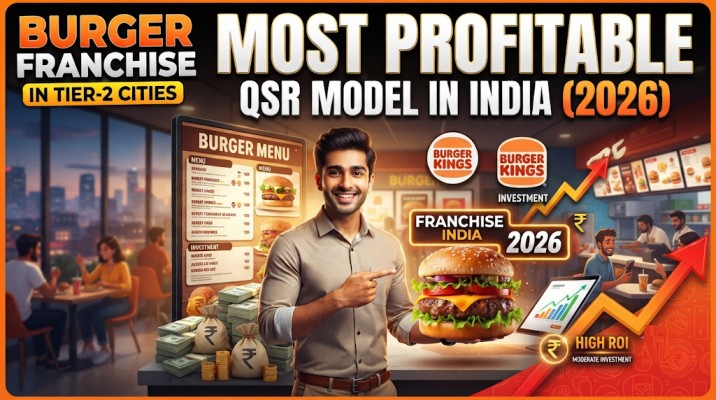
The burger franchise is the most profitable QSR model for Tier-2 cities in India because it combines low entry cost (₹7.89 lakh for a micro-QSR), high footfall potential, and rent that is 50–70% lower than metros. Micro-QSR formats break even in 8–12 months, while standard burger outlets in Tier-2 cities deliver 12–25% net margins — numbers that are increasingly hard to achieve in saturated metro markets.
India’s organised burger QSR market is valued at over US$5 billion, and the top 10 chains expanded from 1,481 outlets in 2023 to 2,018 outlets by March 2026 — a 10.9% CAGR driven largely by Tier-2 and Tier-3 cities. This guide breaks down the real costs, the three franchise models that fit your budget, and why the Tier-2 economics work better than the metro playbook.
One-Line Answer: Why Tier-2 Cities Are the Sweet Spot
₹7.89 lakh micro-QSR (PICO): 80–100 sq ft, 8–12 month payback, ₹3–4 lakh monthly revenue. The lowest-risk entry into burgers.
₹24–30 lakh operator-partner model (Burger Singh): 250–350 sq ft, 20–24 month payback, ₹1–1.5 lakh monthly net income. Best for hands-on operators.
₹30–35 lakh standard outlet (Jumboking, Biggies): 400–700 sq ft, 12–24 month payback, 12–25% net margin. Best for established high-street locations.
Why this matters to you: The “most profitable” burger franchise is not the biggest brand. It is the one whose format, rent, and payback match a Tier-2 city’s cost structure. A ₹7.89 lakh PICO in Indore can pay back faster than a ₹50 lakh metro outlet — because the rent is lower and the investment base is smaller.
Why the Burger Segment Is Built for Tier-2 Profitability
QSR Market at US$30 Billion; Burger Segment at US$5 Billion
India’s overall QSR market is estimated at around US$30 billion in 2026, while the organised burger segment alone is valued at more than US$5 billion. The burger category is no longer a metro-only product — it has become a daily affordable meal for students, families, and young professionals in smaller cities.
36% Growth in Burger Chains Driven by Tier-2/3 Cities
The top 10 burger QSR chains grew from 1,481 outlets in 2023 to 2,018 outlets by March 2026, a 10.9% CAGR. But the real story is regional: South India expanded 80.2%, East India more than doubled, and brands like Burger Singh and The Burger Company deliberately entered cities like Ayodhya, Jhansi, Azamgarh, Hathras, Mau, and Banda. Burger Singh now generates 70% of its revenue from Tier-2 and Tier-3 cities.
Lower Rent, Lower Competition, Higher Net Margins
Tier-2 and Tier-3 cities offer lower rental and operational costs, and better profit margins compared to metros. Rent in a Tier-2 city can be below ₹150 per sq ft on average, versus ₹300–₹600+ in metro high streets. Lower fixed costs mean the same monthly revenue produces a higher net margin — and a faster payback on the initial investment.
Why this matters to you: In a Tier-2 city, your rent is not competing with your profit. In a metro, rent can consume 18–25% of revenue before you pay for food, staff, or royalty. That difference is why Tier-2 outlets pay back faster.
The Three Burger Franchise Models That Fit ₹2–25 Lakh
Micro-QSR / PICO Format (₹7.89–15 Lakh)
The Burger Company’s PICO format is the benchmark: an all-inclusive investment of ₹7.89 lakh plus taxes for an 80–100 sq ft outlet. The package covers franchise fee, kitchen machinery, billing system, branding, fit-outs, launch marketing, training, and opening-day stock — no hidden costs. PICO outlets are projected to break even in 8–12 months with ₹3–4 lakh monthly revenue. This is the lowest-capital entry into a branded burger franchise.
Standard QSR / Takeaway (₹15–25 Lakh)
A takeaway-focused outlet in the 150–400 sq ft range. Investment covers equipment, interiors, franchise fee, and working capital. This format allows a broader menu and higher revenue per square foot than a micro-QSR, but requires a stronger location and more staff.
Co-Investment / Operator-Partner Model (₹24–30 Lakh)
Burger Singh’s “Owner-Partner” model allows entrepreneurs to open a dine-in outlet with ₹24 lakh investment**, while the company contributes an additional **₹20 lakh** and waives the standard franchise fee. Outlets are 250–350 sq ft with seating for 16–20. Payback is estimated at **20–24 months**. A hands-on presence is mandatory — this is not a passive investment.
Comparison Table: Investment, Space, Payback
| Model | Investment | Space | Payback | Best For |
|---|---|---|---|---|
| Micro-QSR (PICO) | ₹7.89–15 lakh | 80–100 sq ft | 8–12 months | First-timers, low-risk entry |
| Standard QSR / Takeaway | ₹15–25 lakh | 150–400 sq ft | 12–18 months | High-footfall takeaway |
| Operator-Partner (Burger Singh) | ₹24–30 lakh | 250–350 sq ft | 20–24 months | Hands-on operators, dine-in |
Sources: The Burger Company / ET Retail (2025), Burger Singh / Franchise India (2025), FranchiseBazar (2026). Figures are estimates and vary by city and agreement.
Investment Breakdown: Where Your ₹7.89–25 Lakh Goes
What the PICO Package Includes (No Hidden Costs)
The ₹7.89 lakh PICO package is genuinely all-inclusive: franchise fee, complete kitchen machinery, billing system and software, branding and fit-outs, initial launch marketing, training, and opening-day stock. The franchisee can begin operations from day one without separate equipment or software purchases. This is rare in franchising — most brands quote a “franchise fee” that excludes equipment and interiors.
The Working Capital and Rent Realities in Tier-2 Cities
Even with an all-inclusive package, you need working capital for the first 2–3 months. In a Tier-2 city, rent for an 80–100 sq ft space can be ₹10,000–₹20,000 per month**, and staff costs for 2–3 people are **₹25,000–₹40,000 per month**. Budget **₹1–1.5 lakh** as a working capital buffer, even for a micro-QSR.
Investment Table
| Cost Component | PICO (₹) | Standard QSR (₹) |
|---|---|---|
| Franchise fee + equipment + fit-out | ₹7.89 lakh (all-inclusive) | ₹10–15 lakh |
| Security deposit | ₹30,000–₹60,000 | ₹60,000–₹1.2 lakh |
| Working capital (2–3 months) | ₹1–1.5 lakh | ₹1.5–2.5 lakh |
| Licences (FSSAI, GST, trade) | ₹10,000–₹20,000 | ₹15,000–₹30,000 |
| Total | ₹9–9.5 lakh | ₹12.5–19 lakh |
Sources: The Burger Company / Restaurant India (2025), Jumboking partner data (2026), industry estimates. Figures exclude rent deposits in some cases and vary by city.
Why this matters to you: The ₹7.89 lakh headline is real, but the all-in cost including working capital is closer to ₹9–9.5 lakh. Budget for the total, not the sticker price.
Profit Margins and ROI: The Real Tier-2 Numbers
12–25% Net Margin on Standard Formats
Jumboking partner reviews report net profit margins of 12–25%** on monthly revenue of ₹1.5–₹6 lakh. The Burger Singh operator-partner model reports **₹1–1.5 lakh monthly net income** per store, with payback in **24–30 months** (or 20–24 months under the co-investment model).
16%+ EBITDA for Efficient Franchisee-Run Stores
Franchisee-run burger stores report EBITDA margins of over 16%, driven by efficient kitchens, a strong delivery mix, and operational discipline. This is a realistic benchmark for a well-run Tier-2 outlet — higher than many metro outlets carrying heavier rent burdens.
Monthly Revenue Scenarios and Payback Table
| Model | Monthly Revenue (Est.) | Net Margin | Monthly Net Profit (Est.) | Payback |
|---|---|---|---|---|
| PICO micro-QSR | ₹3–4 lakh | 15–20% | ₹45,000–₹80,000 | 8–12 months |
| Standard QSR (Tier-2) | ₹3–6 lakh | 12–25% | ₹40,000–₹1.2 lakh | 12–24 months |
| Operator-partner (Burger Singh) | ₹5–8 lakh | 16–20% | ₹1–1.5 lakh | 20–24 months |
Sources: Jumboking partner data (2026), Burger Singh / FranchiseBazar (2026), The Burger Company / ET Retail (2025). Figures are estimates and vary by location and execution.
Why this matters to you: A PICO outlet at ₹3–4 lakh monthly revenue and 15–20% net margin can pay back the ₹9 lakh investment in 10–14 months. A standard QSR at ₹5 lakh revenue and 20% margin can pay back in 18–24 months. The micro-QSR wins on speed; the standard QSR wins on absolute income.
Top Burger Franchise Brands for Tier-2 Cities (2026)
The Burger Company PICO (₹7.89 Lakh)
The lowest-capital branded burger franchise in India. 80–100 sq ft, all-inclusive package, 8–12 month payback, ₹3–4 lakh monthly revenue. Best for first-time entrepreneurs and kiosk operators in Tier-2/3 cities.
Burger Singh (₹24–30 Lakh)
India’s largest homegrown burger chain, with 180+ outlets across 80+ cities. The operator-partner model requires ₹24 lakh investment (with ₹20 lakh co-investment from the brand), 250–350 sq ft, and 20–24 month payback. Best for hands-on operators who want a dine-in format.
Biggies Burger (₹28 Lakh+)
A Bengaluru-born brand with 100+ outlets and ₹100 crore revenue. Standard format starts at ₹28 lakh (including ₹6 lakh franchise fee), 700 sq ft, 20–30 month payback. Best for established high-street locations with strong footfall.
Jumboking (₹30–35 Lakh)
Mumbai’s vada pav-to-burger chain with 172 outlets. Franchise fee ₹3–5 lakh, setup ₹15–25 lakh, 12–24 month break-even, 12–25% net margin. Best for metro-adjacent Tier-2 cities with high daily footfall.
Brand Comparison Table
| Brand | Investment | Format | Payback | Best For |
|---|---|---|---|---|
| The Burger Company PICO | ₹7.89 lakh | Micro-QSR | 8–12 months | Lowest entry, first-timers |
| Burger Singh | ₹24–30 lakh | Operator-partner | 20–24 months | Hands-on dine-in operators |
| Biggies Burger | ₹28 lakh+ | Standard QSR | 20–30 months | High-street locations |
| Jumboking | ₹30–35 lakh | Standard QSR | 12–24 months | High-footfall metro-adjacent |
Sources: Brand pages and industry reports (2025–2026). Figures are estimates and vary by city and agreement.
The Tier-2 City Economics: Rent, Footfall, and Margin
Rent at ₹150/sq ft or Below
In Tier-2 and Tier-3 cities, rent can range from pure revenue-share transactions to below ₹150 per sq ft on average. A 200 sq ft outlet at ₹150/sq ft costs ₹30,000 per month**. The same space in a metro high street at ₹400/sq ft costs **₹80,000 per month** — a ₹50,000 monthly difference that goes straight to your net margin.
3,000+ Daily Footfall Benchmarks
Burger Singh’s operator-partner criteria look for 3,000+ daily footfall** and a minimum 12 ft frontage visible from 30–50 metres. In Tier-2 cities, a high street, bus stand, college gate, or market area can deliver this footfall at a fraction of the metro rent.
Why the Same ₹8 Lakh Buys Double the Outlet
An ₹8 lakh budget in a metro might cover only equipment and deposit. In a Tier-2 city, the same ₹8 lakh can cover the all-inclusive PICO package plus 2–3 months of working capital. Lower rent and lower fit-out costs mean the same capital creates a complete, cash-flow-positive outlet instead of a half-funded one.
Why this matters to you: The Tier-2 advantage is not just lower rent. It is the ability to open a complete outlet with working capital buffer on the same budget that would leave you undercapitalised in a metro.
7-Point Checklist Before Choosing a Burger Franchise
- Does the all-in investment fit my budget, or am I stretching to the last rupee?
- Is the format a micro-QSR, takeaway, or dine-in? Does it match my location and skills?
- What is the exact royalty — 5%, 6%, or zero — and does it apply to gross or net revenue?
- Does the franchise fee include equipment, training, and fit-outs, or are they separate?
- Have I budgeted ₹1–1.5 lakh for working capital and 2–3 months of operating costs?
- Have I spoken to 3 existing franchisees about actual monthly revenue and net profit?
- Is the territory protected in writing, and is the FSSAI licence category correct for my turnover?
If the answer to questions 1, 3, or 5 is unclear, do not sign yet.
Final Verdict
If your budget is ₹8–15 lakh: The Burger Company PICO is the strongest entry. All-inclusive, 80–100 sq ft, 8–12 month payback, and no hidden equipment costs. Best for Tier-2/3 cities.
If your budget is ₹20–30 lakh: Burger Singh’s operator-partner model offers a dine-in format with brand co-investment and 20–24 month payback. Best for hands-on operators.
If your budget is ₹30–35 lakh: Jumboking or Biggies Burger offer established formats with 12–25% net margins. Best for high-footfall high-street locations.
If you want the fastest payback: The micro-QSR model wins. Lower investment, lower rent, faster break-even — and the same burger demand.
See verified burger franchise options for Tier-2 cities:
View franchise list on free-franchise.com →
Or fill this 2-minute form and get 5 franchise options with full cost and margin breakdowns for your city.
Frequently Asked Questions (FAQ)
Which is the most profitable burger franchise in Tier-2 India?
For first-timers, The Burger Company PICO is the most profitable per rupee invested: ₹7.89 lakh all-inclusive, 8–12 month payback, and ₹3–4 lakh monthly revenue. For larger budgets, Burger Singh’s operator-partner model offers ₹1–1.5 lakh monthly net income with 20–24 month payback.
Can I start a burger franchise with ₹10 lakh?
Yes. The Burger Company PICO requires ₹7.89 lakh plus taxes, with an all-inclusive package covering equipment, fit-outs, training, and opening stock. Add ₹1–1.5 lakh for working capital, and a ₹10 lakh budget is realistic for a Tier-2 city.
What is the profit margin in a Tier-2 burger franchise?
Standard burger franchises in Tier-2 cities report 12–25% net margins. Franchisee-run stores achieve 16%+ EBITDA with efficient kitchens and strong delivery mix. A PICO outlet at ₹3–4 lakh monthly revenue can net ₹45,000–₹80,000 per month.
Why are Tier-2 cities more profitable than metros for burger franchises?
Lower rent (below ₹150/sq ft vs ₹300–₹600+), lower staff costs, and less competition. The same monthly revenue produces a higher net margin because fixed costs are 50–70% lower. Burger Singh generates 70% of its revenue from Tier-2 and Tier-3 cities for this reason.
How long does it take to break even in a Tier-2 burger franchise?
Micro-QSR formats (PICO) break even in 8–12 months. Standard QSR formats take 12–24 months. Operator-partner models (Burger Singh) take 20–24 months. Payback depends on rent, footfall, and daily order volume.
What licences are required for a burger franchise in India?
FSSAI registration or licence (Basic up to ₹1.5 crore turnover from April 2026), GST registration, shop and establishment registration, and local municipal permits. Total licensing cost is typically ₹10,000–₹30,000.