

Warehousing Franchise in India
November 16, 2026
Warehousing Franchise in India: The B2B Logistics Business (2027 Guide)
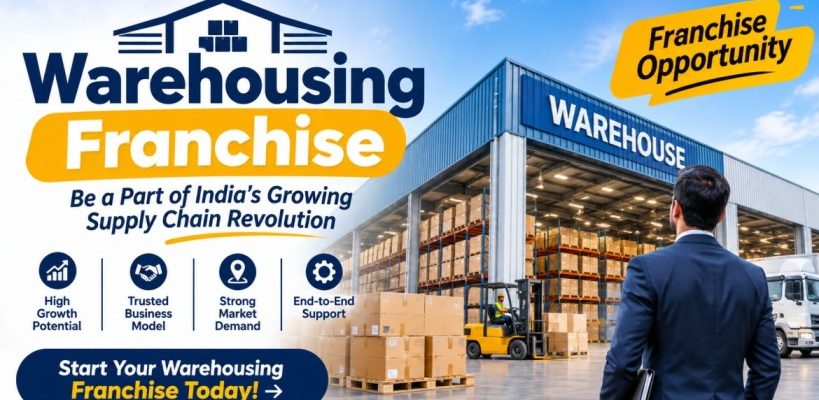
A warehousing franchise in India can be started with ₹5–10 lakh for a space intermediation or logistics service model, or ₹10–25 lakh for a full-service 3PL setup, or ₹50 lakh–₹1 crore+ for a Grade A warehouse format. India’s warehousing market is projected to reach $35 billion by 2027, growing at a CAGR of 15.64% — and the B2B logistics opportunity is no longer limited to metros.
The warehousing sector is being reshaped by GST, the National Logistics Policy, and the rise of quick-commerce. 65–70% of dark stores remain concentrated in metros, but franchise-led models are now explicitly targeting Tier-2 and Tier-3 cities by 2030. Brands like KMS Industrial Space (₹6–10 lakh), Flyment Supply Chain (₹5–10 lakh), and Navata Logistics (₹5–10 lakh) offer B2B franchise models that fit a ₹5–25 lakh budget. This guide breaks down the real costs, the recurring revenue model, and the brands that fit your budget.
One-Line Answer: What Does a Warehousing Franchise Cost in 2027?
₹5–10 lakh (space intermediation / brokerage): A B2B model where you connect businesses needing warehouse space with facility owners. KMS Industrial Space operates at ₹6–10 lakh with a transaction-based fee plus recurring renewal income. Flyment Supply Chain operates at ₹5–10 lakh with a ₹1.5 lakh franchise fee and 30% royalty**. Best for first-timers who want a low-overhead B2B model.
₹5–10 lakh (logistics service franchise): A full logistics coordination business handling freight, warehousing, and distribution. Navata Logistics** operates at **₹5–10 lakh** with a **₹2–5 lakh franchise fee** and a **12–18 month ROI**. Bhartiya Integrated Cargo** operates at **₹5–10 lakh** with a **₹1 lakh franchise fee** and **20% royalty**. Vtc 3PL Services** operates at **₹5–10 lakh** with a **₹1 lakh franchise fee** and a **6–12 month payback**. Best for operators who want a service-based logistics business.
₹10–25 lakh+ (full-service 3PL / space-holding): A larger operation that may include warehouse space, fleet management, or sub-franchising rights. Ekart’s Hub and Fulfilment Model** operates at **₹10–30 lakh+** with **1,000+ sq ft** space. Grade A warehouse formats** can reach **₹50 lakh–₹1 crore+** . Best for experienced operators with larger capital and access to industrial land.
Why this matters to you: The ₹5–10 lakh budget is the realistic entry point for a B2B intermediation or logistics service model. The ₹50 lakh+ budget opens up a space-holding warehouse format. Choose the format before you choose the brand.
Why Warehousing Is Booming in India in 2027
$35 Billion Market by 2027, 15.64% CAGR
India’s warehousing sector is projected to reach $35 billion by 2027**, growing at a **CAGR of 15.64%** from 2022, according to Grant Thornton Bharat and CareEdge Ratings. The market was estimated at **$34.99 billion (₹2,872.10 billion) by 2027**, driven by e-commerce, consumption, and digital adoption. The logistics industry overall is projected to reach **$380 billion by 2025**, growing at 10–12% annually.
GST and National Logistics Policy Driving Consolidation
The GST regime eliminated interstate tax barriers, allowing companies to consolidate operations into fewer, centrally located large warehouses. The National Logistics Policy (2022)** and PM Gati Shakti** are creating integrated, multimodal ecosystems with 35 Multimodal Logistics Parks (MMLPs)** planned across the country. Dedicated Freight Corridors** now run around **400 freight trains daily**, cutting transit times and long-haul costs. These policy shifts are structural, not cyclical — they are changing where warehouses are built and who operates them.
Tier-2/3 Cities Are the Next Warehousing Frontier
Quick-commerce platforms are prioritising profitability, with 65–70% of dark stores concentrated in metros**. But franchise-led models are expected to drive expansion into Tier-2 and Tier-3 cities by 2030**, according to a CBRE report. Cities like Jaipur, Lucknow, Surat, Coimbatore, and Nagpur** are attracting operators due to **cost-effective real estate** and **lower overhead costs**. Tier-2/3 cities remain underserved — stuck between unorganised kiranas and expensive metro imports — creating a first-mover advantage for local warehousing franchises.
Why this matters to you: You are not entering a saturated metro market. You are entering a market where the policy tailwind is pushing warehouses into smaller cities, and the brands need local partners to execute.
The Three Warehousing Franchise Models Under ₹50 Lakh
Space Intermediation / Brokerage Model (₹5–10 Lakh)
The lowest-investment B2B entry. You connect businesses that need industrial or warehousing space with facility owners who have it. KMS Industrial Space** operates at **₹6–10 lakh** with a **transaction-based fee** on each placement and **recurring income** from lease renewals and expansions. The model is structured around **minimal upfront facility investment** — you are not holding or leasing large storage space yourself. The franchisor provides a **shared technology platform and warehouse database** to shortcut supply-side network building. Best for first-timers who want a low-overhead B2B model with recurring revenue potential.
Logistics Service Franchise (₹5–10 Lakh)
A full logistics coordination business handling freight, warehousing, and distribution for B2B clients. Navata Logistics** operates at **₹5–10 lakh** with a **₹2–5 lakh franchise fee**, **400–800 sq ft** space (office + small warehouse), and a **12–18 month ROI**. Flyment Supply Chain** operates at **₹5–10 lakh** with a **₹1.5 lakh franchise fee** and **30% royalty**. Bhartiya Integrated Cargo** operates at **₹5–10 lakh** with a **₹1 lakh franchise fee** and **20% royalty**. Vtc 3PL Services** operates at **₹5–10 lakh** with a **₹1 lakh franchise fee** and a **6–12 month payback**. Best for operators who want a service-based logistics business with multiple revenue streams (freight, storage, consulting).
Full-Service 3PL / Space-Holding Franchise (₹10–25 Lakh+)
A larger operation that may include warehouse space, fleet management, or sub-franchising rights. Ekart’s Hub and Fulfilment Model** operates at **₹10–30 lakh+** with **1,000+ sq ft** space, covering warehousing, multiple delivery points, and fleet management. Grade A warehouse formats** can reach **₹50 lakh–₹1 crore+** depending on location, size, and infrastructure. Best for experienced operators with larger capital and access to industrial land or Grade A facilities.
Comparison Table: Investment, Space, Payback
| Model | Investment | Space | Payback | Best For |
|---|---|---|---|---|
| Space Intermediation | ₹5–10 lakh | Minimal / office-based | 1–2 years (estimated) | First-timers, low overhead |
| Logistics Service | ₹5–10 lakh | 400–800 sq ft | 6–18 months | Service-focused, multiple revenue streams |
| Full-Service 3PL | ₹10–30 lakh+ | 1,000+ sq ft | 2–3 years | Experienced operators, large capital |
Sources: ForeFind (Jun 2026), FranchiseHurt (Aug 2025), Launchlify (Sep 2026), FranchiseBazar (2026). Figures are estimates and vary by city, brand, and format.
The Real Investment: Where Your ₹5–25 Lakh Goes
Franchise Fee, Office Setup, Technology, Working Capital
| Cost Component | Intermediation (₹) | Logistics Service (₹) | Full 3PL (₹) |
|---|---|---|---|
| Franchise fee | ₹50,000–₹1.5 lakh | ₹1–2 lakh | ₹2–5 lakh |
| Office setup & technology | ₹50,000–₹1 lakh | ₹1.5–2 lakh | ₹3–5 lakh |
| Warehouse space/interiors | — | ₹1–3 lakh | ₹5–15 lakh |
| Working capital (3 months) | ₹50,000–₹1 lakh | ₹1–2 lakh | ₹3–7 lakh |
| Total | ₹5–10 lakh | ₹5–10 lakh | ₹10–30 lakh+ |
Sources: ForeFind (Jun 2026), FranchiseHurt (Aug 2025), Launchlify (Sep 2026). Figures are estimates and vary by city and agreement.
The Hidden Costs Nobody Budgets for
Royalty: Flyment charges 30% royalty** — one of the highest in the category. Bhartiya Integrated Cargo charges **20%**. On ₹1 lakh monthly revenue, a 30% royalty takes **₹30,000 per month** — ₹3.6 lakh per year. KMS Industrial Space uses a **transaction-based fee** instead of a flat royalty, which changes the cash-flow pattern entirely.
Client acquisition: B2B sales depend heavily on the franchisee’s own outreach, referrals, and industry relationships. KMS Industrial Space explicitly states that the franchisor **does not generate a steady inbound stream of paying clients** — corporate B2B sales in this category depend on your network. Budget for business development costs.
Working capital: ₹50,000–₹7 lakh. Clients pay per shipment or per lease cycle, but salaries, rent, and technology fees are monthly. A logistics service franchise doing steady volume may have ₹1–3 lakh locked up in receivables.
Seasonality and income lumpiness: B2B warehousing intermediation tends to be **lumpy rather than flat**, with high seasonality and low overall recession resistance. Income in any given month depends on how many client placements close. Building toward monthly stability requires **several client accounts at different stages of their lease cycle simultaneously**.
Why this matters to you: The franchise fee is only 10–30% of the total cost for intermediation models. Royalty and working capital make up the bulk over time. A ₹1.5 lakh franchise fee with no working capital buffer is not a ₹1.5 lakh business — it is a ₹5–6 lakh business waiting to run out of cash.
Profit Margins and ROI: The Real Numbers
Recurring Revenue from Lease Renewals
Warehousing intermediation sits in a **hybrid zone between one-time transaction fees and recurring account management**. The initial placement of a client into a warehouse generates a **transaction-based fee**, but corporate and SME clients renew, expand, relocate, or come back when a lease term ends. A franchisee who manages this relationship well converts a single transaction into a **multi-year account**, with additional placement fees recurring each time the client’s space needs change.
1–3 Year Payback for Most Models
Navata Logistics** reports a **12–18 month ROI**. Vtc 3PL Services** reports a **6–12 month payback**. Flyment Supply Chain** reports a **1–3 year payback**. KMS Industrial Space** has a shorter estimated breakeven window compared to space-holding franchises because the model is low-overhead and breakeven depends on closing the first several client placements rather than absorbing large fixed costs. Eazi Logistic** reports a **1–2 year payback**. MULTIBRAND WAREHOUSE** reports an expected payback of **1 month** and an **ROI of 50%** (an outlier claim that should be verified).
Monthly Profit Scenarios Table
| Model | Monthly Revenue (Est.) | Net Margin | Monthly Net Profit (Est.) |
|---|---|---|---|
| Space Intermediation | ₹50,000–₹1.5 lakh | 40–60% (transaction-based) | ₹20,000–₹90,000 |
| Logistics Service | ₹1–3 lakh | 20–35% | ₹20,000–₹1 lakh |
| Full-Service 3PL | ₹3–8 lakh | 15–25% | ₹45,000–₹2 lakh |
Sources: Industry estimates based on ForeFind (Jun 2026), FranchiseHurt (Aug 2025), and Franchisezing (2026). Figures assume steady client flow and controlled overhead.
Why this matters to you: A space intermediation franchise at ₹1 lakh monthly revenue and 50% net margin can earn ₹50,000 per month. A logistics service franchise at ₹2 lakh revenue and 25% margin can earn ₹50,000 per month. The higher investment buys a higher income ceiling, but the intermediation model delivers a faster percentage return on a lower base.
Top Warehousing Franchise Brands in India (2027)
KMS Industrial Space (₹6–10 Lakh, B2B Intermediation)
A warehousing solutions intermediary connecting businesses with industrial and warehousing space, serving corporate and SME clients through a B2B model. Investment: ₹6–10 lakh** (on inquiry). The model is structured around **minimal upfront facility investment**, with a **shared technology platform and warehouse database** provided by the franchisor. Revenue is **transaction-based** on placements, with **recurring income** from lease renewals and expansions. Best for first-timers who want a low-overhead B2B brokerage model with recurring potential.
Flyment Supply Chain Services (₹5–10 Lakh, 30% Royalty)
A logistics and delivery franchise providing transportation, shipping, warehousing, and distribution. Investment: ₹5–10 lakh**. Franchise fee: **₹1.5 lakh**. Royalty: **30%**. Space: **500–2,000 sq ft**. Payback: **1–3 years**. Best for operators who want a full-service logistics business with warehousing.
Navata Logistics (₹5–10 Lakh, 12–18 Month ROI)
A legacy logistics brand (since 1982) with **650+ branches** across South and West India. Investment: **₹5–10 lakh**. Franchise fee: **₹2–5 lakh**. Space: **400–800 sq ft** (office + small warehouse). ROI: **12–18 months**. Royalty: negotiable based on monthly volume. Best for operators who want a proven brand with a strong B2B network and Tier-2/3 focus.
Bhartiya Integrated Cargo Solutions (₹5–10 Lakh, 20% Royalty)
A logistics and transportation service provider (founded 2001) specialising in bulk cargo, warehousing, and supply chain support. Investment: **₹5–10 lakh**. Franchise fee: **₹1 lakh**. Royalty: **20%**. Best for operators who want a freight-and-warehousing hybrid model.
Vtc 3PL Services (₹5–10 Lakh, 6–12 Month Payback)
A third-party logistics franchise with **₹5–10 lakh** investment, **₹1 lakh** franchise fee, and **501–1,000 sq ft** space. Payback: **6–12 months**. Best for operators who want a fast-payback 3PL model.
Ekart (₹10–30 Lakh+, Hub and Fulfilment)
Flipkart’s logistics arm opened its pan-India network to MSMEs and D2C brands through a franchise model, with **300+ outlets operational** and plans for **1,000 by 2026**. The **Hub and Fulfilment Model** includes warehousing, multiple delivery points, and fleet management. Investment: **₹10–30 lakh+**. Space: **1,000+ sq ft**. Best for operators who want a large-format B2B fulfilment centre.
Brand Comparison Table
| Brand | Investment | Franchise Fee | Royalty | Payback |
|---|---|---|---|---|
| KMS Industrial Space | ₹6–10 lakh | On inquiry | Transaction-based | 1–2 years (est.) |
| Flyment | ₹5–10 lakh | ₹1.5 lakh | 30% | 1–3 years |
| Navata | ₹5–10 lakh | ₹2–5 lakh | Negotiable | 12–18 months |
| Bhartiya | ₹5–10 lakh | ₹1 lakh | 20% | Not specified |
| Vtc 3PL | ₹5–10 lakh | ₹1 lakh | Not specified | 6–12 months |
| Ekart | ₹10–30 lakh+ | Not specified | Not specified | 2–3 years (est.) |
Sources: ForeFind (Jun 2026), FranchiseHurt (Aug 2025), Launchlify (Sep 2026), FranchiseBazar (2026). Figures are estimates and vary by city and agreement.
What ₹5 Lakh Cannot Buy: The Space-Holding Reality
₹50 Lakh–₹1 Crore Grade A Warehouse Formats
Grade A warehouse formats can require ₹50 lakh–₹1 crore+** depending on location, size, and infrastructure. Ekart’s Hub and Fulfilment Model** requires **₹10–30 lakh+** with **1,000+ sq ft** space. The ₹5 lakh budget cannot cover these formats. But the intermediation model lets you learn the B2B warehousing business — client acquisition, space audits, lease negotiations — before committing ₹50 lakh.
Why the Intermediation Route Is Smarter
A ₹5–10 lakh intermediation franchise lets you build a client base and understand local industrial demand without the burden of holding or leasing large storage space. If the intermediation model works, you can upgrade to a space-holding format later using accumulated profits. If it does not, the loss is manageable. Starting with a Grade A warehouse on a ₹5 lakh budget is not possible without underfunding the business.
Why this matters to you: The ₹5 lakh budget is a learning budget. It buys an intermediation business, not a warehouse. Treat it as your entry into the B2B warehousing market, not your final destination.
Tier-2 City Advantage: Why Indore, Jaipur, and Patna Work
Lower Real Estate Costs, Franchise-Led Dark Store Expansion
Tier-2 cities offer a structural advantage for warehousing franchises. Quick-commerce platforms are shifting to **franchise-led and kirana micro-warehouses** to scale across Tier-2 and Tier-3 markets because of **cost-effective real estate** and **lower overhead costs**. Cities like **Jaipur, Lucknow, Surat, Coimbatore, and Nagpur** are explicitly named as expansion targets by 2030. 70% of dark stores remain concentrated in top metros**, leaving Tier-2/3 cities underserved — stuck between unorganised kiranas and expensive imports.
A logistics service franchise in a Tier-2 city can generate ₹1–3 lakh in monthly revenue** within 6–9 months if the location has steady industrial and e-commerce demand, generating **₹20,000–₹1 lakh in monthly net profit** at a 20–35% net margin. A space intermediation franchise can generate **₹50,000–₹1.5 lakh in monthly revenue** with **40–60% net margins** because the model is transaction-based and low-overhead. The first organised B2B warehousing franchise in a district captures the majority of demand simply because there is nothing else competing at that level.
Why this matters to you: The same ₹5–10 lakh that barely covers a metro office deposit can fund a complete logistics service franchise with working capital in a Tier-2 city. Lower real estate costs mean faster break-even and higher net margin on the same revenue.
7-Point Checklist Before Choosing a Warehousing Franchise
- Does the all-in investment (fee + technology + working capital) fit my budget?
- Is the model intermediation, logistics service, or full 3PL? Does it match my location and skills?
- What is the exact royalty or transaction fee? Does it apply to gross or net revenue?
- Does the franchisor provide client leads, or must I acquire all clients through my own B2B outreach?
- Have I budgeted ₹50,000–₹7 lakh for working capital and 3 months of operating costs?
- Have I spoken to 3 existing franchisees about actual monthly client placements and net profit?
- Is the territory protected in writing, and does the brand have a local industrial or e-commerce pipeline I can serve?
If the answer to questions 1, 3, or 4 is unclear, do not sign yet.
Final Verdict
If your budget is ₹5–10 lakh: KMS Industrial Space or Flyment Supply Chain is the realistic entry point. Intermediation or logistics service model, 1–3 year payback, and recurring B2B revenue. Best for first-time operators in Tier-2 cities.
If your budget is ₹5–10 lakh and you want a proven brand: Navata Logistics offers a 12–18 month ROI with a legacy brand and 650+ branches. Best for operators who want a strong B2B network and a Tier-2/3 focus.
If your budget is ₹10–30 lakh+: Ekart’s Hub and Fulfilment Model or a full-service 3PL franchise offers a larger operation with warehousing, multiple delivery points, and fleet management. Best for experienced operators with larger capital.
If you want the lowest-risk first business: Start with a space intermediation model. Learn the B2B warehousing business, build client relationships, and upgrade to a space-holding format later. The ₹5–10 lakh entry is not a compromise — it is a smart first step.
See verified warehousing franchise options:
View warehousing franchise list on free-franchise.com →
Or fill this 2-minute form and get 5 franchise options with full cost and margin breakdowns for your city.
Frequently Asked Questions (FAQ)
What is the best warehousing franchise for a ₹5–10 lakh budget?
KMS Industrial Space starts at ₹6–10 lakh for a B2B space intermediation model with recurring revenue from lease renewals. Flyment Supply Chain offers a ₹5–10 lakh logistics service franchise with a ₹1.5 lakh fee and 30% royalty. Navata Logistics offers a ₹5–10 lakh model with a 12–18 month ROI. These are service or intermediation models, not space-holding warehouses.
How much does a warehousing franchise cost in India?
It ranges from ₹5–10 lakh for a space intermediation or logistics service franchise to ₹10–30 lakh+ for a full-service 3PL setup, and ₹50 lakh–₹1 crore+ for Grade A warehouse formats. The all-in cost includes the franchise fee, office setup, technology, and working capital.
What is the profit margin in a warehousing franchise?
Space intermediation models run at 40–60% net margins because they are transaction-based and low-overhead. Logistics service franchises run at 20–35% net margins. Full-service 3PL operations run at 15–25%. The margin depends on client volume, royalty structure, and cost control.
How long does it take to break even in a warehousing franchise?
Space intermediation models can break even in 1–2 years (estimated). Logistics service franchises take 6–18 months (Navata reports 12–18 months; Vtc 3PL reports 6–12 months). Full-service 3PL operations take 2–3 years. The fastest paybacks are in the lower-capex, transaction-based models.
Is a warehousing franchise profitable in Tier-2 cities?
Yes. Tier-2 cities like Indore, Jaipur, and Patna have lower real estate costs, lower competition, and growing industrial and e-commerce demand. Quick-commerce platforms are expanding into Tier-2/3 cities through franchise-led models by 2030. A logistics service franchise can break even in 6–18 months and generate ₹20,000–₹1 lakh in monthly net profit.
What is the difference between space intermediation and a space-holding warehouse franchise?
A space intermediation franchise (₹5–10 lakh) connects businesses with warehouse space — no large facility investment. A space-holding warehouse franchise (₹50 lakh–₹1 crore+) requires you to hold or lease Grade A warehouse space yourself. Intermediation has lower capex and faster payback; space-holding has higher revenue ceilings but requires large capital.