
Tyre and Battery Service Franchise in India 2027
November 17, 2026
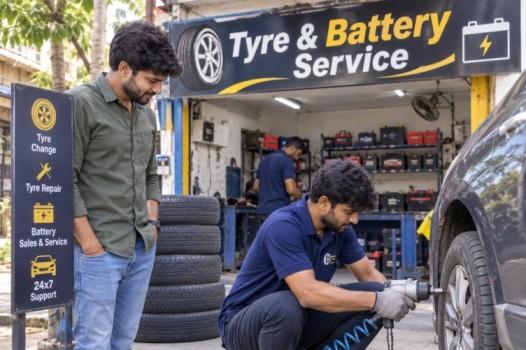
Tyre and Battery Service Franchise in India 2027: Cost, ROI, and the Right Brand for Your Budget
A tyre and battery service franchise in India costs between ₹5 lakh and ₹50 lakh in 2027, depending on whether you choose a single-brand tyre outlet, a multi-brand service studio, or a battery dealership. The Indian automotive aftermarket crossed ₹99,948 crore in FY25, and tyre and battery replacement are the two largest recurring-revenue categories inside it[reference:1].
If you are 25–45, have ₹2–₹25 lakh to deploy, and want a business that does not depend on new-car sales cycles, this is the category to study carefully. This guide gives you the numbers, the trade-offs, and the city-level reality — not brochure claims.
Why Tyre and Battery Service Is the Core Sector of Indian Automotive Aftermarket in 2027
Justdial data shows a 27% year-on-year jump in searches for car tyre dealers and a 13% rise for car battery dealers between March 2025 and February 2026[reference:2]. Delhi alone recorded a 64% increase in tyre-related searches, while Pune led battery searches with a 24% rise[reference:3]. This is not a metro-only story. The growth is spreading to Tier-2 and Tier-3 cities as vehicle ownership deepens.
The ₹1 Lakh Crore Aftermarket Signal
ACMA data confirms the domestic aftermarket grew 6% to ₹99,948 crore in FY25, with tyres and batteries named as the primary drivers[reference:4]. Tyres alone held a 24.07% revenue share of the replacement parts market in 2025[reference:5]. When an industry approaches ₹1 lakh crore, it means the customer base is deep enough to support a new outlet in almost any district with 3 lakh+ vehicles.
Why this matters to you: You are not betting on a trend. You are entering a replacement market that grows every time a vehicle completes 40,000–50,000 km or a battery crosses 3–4 years of age.
Why Replacement Demand Beats New-Vehicle Sales Cycles
New vehicle sales can slow down when interest rates rise or fuel prices spike. Replacement demand behaves differently. It is tied to vehicles already on the road, which keep running regardless of economic sentiment[reference:6]. India’s replacement tyre market alone constitutes roughly 68% of total tyre demand[reference:7]. That means the majority of tyre consumption is not factory-fitted — it is sold through dealerships, service outlets, and franchise networks like yours.
Tyre Franchise vs Battery Franchise: Which Model Fits Your ₹2–₹25 Lakh Budget?
There is no single “best” franchise. The right model depends on your capital, your city’s vehicle mix, and whether you want a single-brand showroom or a multi-brand service workshop.
Single-Brand Tyre Franchise (MRF, CEAT, Apollo)
MRF dealership investment starts around ₹25–₹30 lakh, while an MRF T&S (Tyre & Service) franchise runs ₹40–₹60 lakh[reference:8]. CEAT is more accessible, with franchise options in the ₹10–₹20 lakh range and a payback period of 18–24 months[reference:9][reference:10]. Single-brand outlets give you strong brand pull, training, and warranty-backed customer trust, but you cannot stock competing brands even if a walk-in customer asks for them.
Multi-Brand Tyre + Battery Service Model
Multi-brand formats like Autonet (₹30–₹50 lakh) and Point S India (₹30–₹50 lakh) combine tyre sales, battery replacement, alignment, and basic servicing under one roof[reference:11][reference:12]. These models suit entrepreneurs who want a higher ticket size per customer and are willing to manage a wider inventory. If your budget is below ₹25 lakh, look at emerging multi-brand studios or doorstep models rather than full-scale multi-brand outlets.
Battery-Only Dealership and Distributorship
Exide Power Center dealership listings start as low as ₹10,000–₹50,000 for a distributor-level association, with margins around 15%[reference:13]. But a battery-only store has a narrower customer touchpoint than a tyre outlet. Most successful operators combine battery replacement with tyre service because both categories bring the same customer — the vehicle owner due for periodic maintenance.
Real Investment Breakdown for 2027: Tyre and Battery Franchise Cost in India
The table below consolidates publicly listed investment ranges from franchise portals and brand disclosures. All figures are estimates for 2027 planning and exclude personal working capital beyond the first inventory cycle.
Table 1: Investment Comparison Across Franchise Formats
| Franchise Format | Typical Investment (₹) | Space Needed | Best For |
|---|---|---|---|
| CEAT franchise / tyre stop | 10–20 lakh | 500–1,200 sq ft | First-time franchisees in Tier-2 cities |
| DrWheelz doorstep model | 5–10 lakh | Mobile van + small hub | Low-capex operators in metros and Tier-2 |
| India’s Right Choice (multi-brand) | 10–20 lakh | 101–500 sq ft | Compact tyre + battery service studio |
| Autonet / Point S multi-brand | 30–50 lakh | 1,000–5,000 sq ft | Established operators scaling to a full workshop |
| MRF dealership | 25–30 lakh | 800–1,200 sq ft | Strong brand-first retail in high-traffic locations |
| MRF T&S franchise | 40–60 lakh | 1,200+ sq ft | Full tyre and service operation with MRF exclusivity |
Sources: Franchise India, Forefind, FranchiseVoice, TheBizNus; figures are indicative and vary by city tier and outlet size[reference:14][reference:15][reference:16][reference:17].
What the ₹2–₹25 Lakh Budget Actually Covers
At the ₹5–₹10 lakh end, your money goes into franchise fee (₹1.5–₹3 lakh in many emerging models), basic fitment equipment, a small inventory of fast-moving tyre sizes, and a battery display rack[reference:18]. At the ₹15–₹25 lakh end, you are adding wheel alignment and balancing machines, a larger inventory spread, and a customer seating area that meets brand standards. Inventory is the silent cost. Tyre stock alone can absorb 30–40% of your initial capital if you over-order unpopular sizes.
Why this matters to you: A ₹10 lakh budget does not mean you should spend ₹10 lakh on setup. Keep 25–30% aside for the first three months of working capital, rent, and staff salaries before the outlet stabilises.
Tier-2 and Tier-3 City Cost Advantages (Indore, Patna, Jaipur)
Rent in Indore’s Vijay Nagar or Patna’s Boring Road can be 40–60% lower than a comparable Mumbai suburban location. Technician salaries are also lower, but the trade-off is fewer walk-in customers per day. Jaipur and Indore have dense two-wheeler and hatchback populations, which means high-volume, lower-ticket tyre and battery jobs. Patna’s growing commercial vehicle fleet creates demand for heavier-duty tyres and commercial batteries. Choose your city’s dominant vehicle mix before choosing the franchise format.
ROI and Profit Margins: What a Tyre and Battery Franchise Really Earns
Automotive franchise profit margins typically range from 10% to 20%, with some models offering payback in 18–36 months[reference:19]. But the blended margin hides the real picture: tyre sales and battery sales behave very differently.
Table 2: ROI and Payback Estimates by Format
| Format | Estimated Annual ROI | Payback Period | Margin Reality |
|---|---|---|---|
| DrWheelz doorstep model | ~18% | 6–10 months (reported) | Low overhead; margin depends on service volume |
| CEAT franchise | Estimated 15–20% | 18–24 months | Tyre margin 25–35%; alignment and balancing add service income[reference:20] |
| Battery dealership | Estimated 12–15% | 12–18 months | Automotive battery margin 8–12%; inverter battery margin 10–15%[reference:21] |
| Multi-brand tyre + battery studio | Estimated 14–18% | 24–36 months | Blended margin depends on service mix |
ROI figures are estimates drawn from franchise listings and industry reports; actual returns vary by location, rent, and operator skill. No return is guaranteed.
Tyre Margin vs Battery Margin — Where the Money Sits
Tyre retail margins typically run 25% to 35%, with fitting and balancing services adding to the take[reference:22]. Battery product margins are thinner: roughly 8–12% on automotive lines, 10–15% on inverter and solar batteries, and 12–18% on industrial batteries[reference:23]. This is why a tyre-first outlet with battery as an add-on often outperforms a battery-only store. The customer who buys a tyre is the same customer who will need a battery within 12–18 months.
Why this matters to you: If a franchise pitch promises “30% margin on everything,” ask for the split between product margin and service margin. Service income — fitting, balancing, alignment, battery installation — is where the healthier margins sit.
Top Tyre and Battery Franchise Brands in India for 2027
MRF T&S and MRF Dealership
MRF has over 4,000 dealers and dominates the Indian tyre market[reference:24]. A standard dealership needs ₹25–₹30 lakh; the T&S format needs ₹40–₹60 lakh and includes service equipment and a larger interior setup[reference:25]. Choose MRF if brand recall and walk-in trust are your primary concern, and you have the capital to meet their inventory and space requirements.
CEAT Shoppe and CEAT Tyre Stop
CEAT offers a lower entry point (₹10–₹20 lakh) and has actively expanded into Tier-2 and Tier-3 towns[reference:26]. The franchise fee is reported around ₹2 lakh with 5% royalty[reference:27]. CEAT’s training covers product knowledge across passenger and commercial ranges, which helps if your team is new to tyre fitting[reference:28].
Exide and Amara Raja Battery Networks
Exide and Amara Raja are the two dominant battery suppliers in the Indian aftermarket[reference:29]. Exide distributor-level associations can start very low (₹10,000–₹50,000), but a visible retail battery outlet requires separate investment in display, testing equipment, and inventory[reference:30]. Battery franchises work best when bundled with tyre or general service to keep footfall consistent.
Emerging Multi-Brand and Doorstep Models (DrWheelz, TyresNmore, Point S)
DrWheelz operates a doorstep model with ₹5–₹10 lakh total investment and a reported 18% ROI with 6–10 month payback[reference:31]. TyresNmore, backed by CEAT, focuses on doorstep tyre and battery fitment and is expanding its network. Point S India offers a multi-brand tyre franchise in the ₹30–₹50 lakh range with a global network of 244 stores[reference:33][reference:34]. These models suit operators who want lower real-estate overhead or a globally recognised multi-brand banner.
How to Choose the Right Franchise for Your City (Mumbai vs Indore vs Patna)
Demand Signals You Can Verify Locally
Count the number of tyre shops within a 3 km radius. Check how many are authorised brand outlets versus independent dealers. Use Justdial or Google Maps to see how many “tyre dealer” and “car battery shop” listings exist in your pin code. In Mumbai, high traffic and competition mean you need a differentiated service (doorstep, express fitment, or premium alignment). In Indore or Patna, the opposite may be true — demand may exceed organised supply, giving a new branded outlet an early advantage.
Checklist: 7 Questions Before You Sign the Agreement
- ☐ What is the total inventory commitment in the first 90 days?
- ☐ Is the territory exclusive, or can the franchisor open another outlet nearby?
- ☐ What percentage of my monthly purchase must be from the franchisor’s product line?
- ☐ Does the franchise fee include training for two technicians or only the owner?
- ☐ What is the royalty or commission structure, and is it capped?
- ☐ Who bears the cost of warranty claims and defective battery replacements?
- ☐ What is the exit clause if I want to sell or close the outlet after 24 months?
Why this matters to you: A franchise agreement is a 3–5 year relationship. The questions you ask before signing are cheaper than the lawyer you hire after a dispute.
Step-by-Step: How to Start a Tyre and Battery Service Franchise in 2027
Licences, GST, and Local Compliance
You need GST registration, a Shop & Establishment licence, and local municipal trade permission. If you handle battery storage and disposal, check your state’s e-waste and hazardous-waste rules. Battery swapping formats may need additional safety clearances depending on the city.
Staffing and Technician Training
A two-bay tyre outlet needs at least two trained fitters and one counter person. CEAT and MRF both run structured training programmes covering fitting, balancing, and customer communication[reference:35]. Budget ₹15,000–₹25,000 per month per technician in Tier-2 cities, higher in Mumbai and Delhi.
Inventory Planning for Tyres and Batteries
Start with the top 10 tyre sizes that match your city’s dominant vehicles. In Indore, that may be 145/80 R12 and 155/80 R13 for hatchbacks. In Patna, add commercial vehicle sizes if your location is near a transport hub. For batteries, stock 3–4 fast-moving automotive models and one inverter battery line. Do not try to match a large dealer’s SKU count in month one.
Risks and Reality Checks No One Tells You About
Working Capital Traps in Tyre Inventory
Tyres are bulky and slow-moving in unpopular sizes. If you over-order, your cash is locked in stock that may take six months to sell. A ₹20 lakh outlet can easily tie up ₹6–₹8 lakh in inventory that is not moving. Order in smaller batches and track sell-through weekly.
Brand Exclusivity vs Walk-In Customer Expectations
Single-brand outlets lose customers who want a specific competitor brand. Multi-brand outlets lose the deeper margin support and training that single-brand franchisors provide. Neither is wrong — but you must decide which customer you are serving before you sign.
The 2027 Opportunity: EV Tyres, Battery Swapping, and Tier-3 Formalisation
EV-Specific Service Skills You Will Need
EVs are heavier and wear tyres faster. High-voltage diagnostics, battery health assessment, and thermal-system servicing are becoming billable skills[reference:36]. A franchise that trains your team on EV tyre fitment and battery testing gives you a 3–5 year head start in your city.
Battery Swapping as a Low-Space Add-On
Indofast Energy’s battery-swapping franchise requires only 250 sq ft and ₹10–₹40 lakh investment, with reported returns of 1.7x–2.7x[reference:37]. If you already have a tyre outlet with spare space, a swap station can add revenue without a new customer acquisition cost.
Frequently Asked Questions
Q1: What is the minimum investment for a tyre and battery franchise in India?
A doorstep or compact multi-brand model can start at ₹5–₹10 lakh. A single-brand tyre outlet typically needs ₹10–₹20 lakh, while a full MRF T&S or large multi-brand workshop needs ₹30–₹60 lakh. Keep 25–30% of your budget for working capital.
Q2: Which is more profitable — a tyre franchise or a battery franchise?
Tyre retail margins (25–35%) are higher than automotive battery margins (8–12%). But batteries bring repeat customers with less space. The most profitable small format is a tyre-first outlet that also sells and installs batteries.
Q3: Can I open a tyre and battery franchise in a Tier-3 city?
Yes. CEAT and several multi-brand formats are actively expanding in Tier-2 and Tier-3 towns. Lower rent and lower staff costs improve unit economics, provided your location has at least 2–3 lakh registered vehicles within a 5 km radius.
Q4: How long does it take to break even?
Reported payback ranges from 6–10 months for doorstep models to 18–24 months for CEAT-style outlets and 24–36 months for larger multi-brand studios. These are estimates; actual payback depends on rent, local competition, and how quickly you build a repeat customer base.
Q5: Do I need prior automotive experience to start this franchise?
No. Most franchisors provide technical training for fitters and operational training for owners. What you cannot outsource is people management and cash-flow discipline. If you can manage a small team and track inventory, the technical side can be learned.
Q6: Is a battery swapping franchise a better option than a traditional battery shop?
Battery swapping is a low-space, EV-linked model with reported returns of 1.7x–2.7x, but it depends on EV adoption in your city. A traditional battery shop has broader customer coverage today. In 2027, the safer play is a tyre + battery outlet with a swapping add-on where space allows.
Final Verdict: Who Should Start This Franchise in 2027?
Start a tyre and battery service franchise in 2027 if you have ₹5–₹25 lakh, a ground-floor location with vehicle access, and the patience to build a repeat customer base over 12–18 months. The aftermarket is growing, replacement demand is resilient, and Tier-2 cities still have room for organised players. If you want a business that pays back in six months with no inventory risk, this is not the category for you. If you want a real asset in a growing sector, this is one of the most defensible small-business models in India today.