

Pharma Franchise Break-Even in India: Real Numbers & Timelines (2026)
November 5, 2026
Pharma Franchise Break-Even in India: Real Numbers & Timelines (2026)
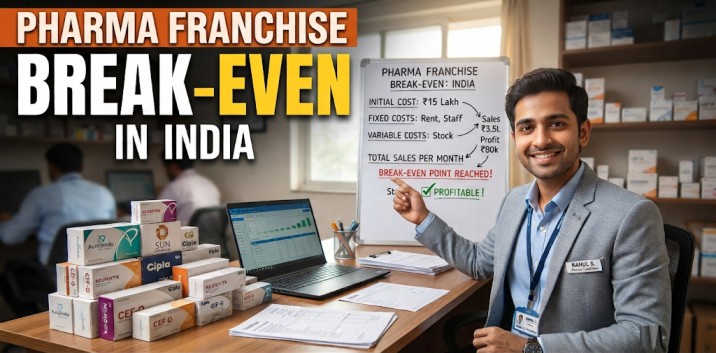
Pharma franchise break-even in India ranges from 2–3 months for asset-light healthcare/wellness FOFO models to 6–8 months for PCD franchises with company support, and 12–18 months for single-territory PCD operations without lead generation. The number you see on a brochure is rarely the number you experience.
Break-even is not decided by the brand. It is decided by your monthly reorder requirement, working capital buffer, credit cycle to chemists, and how fast doctors start prescribing. This guide gives you the real numbers and a step-by-step formula to calculate your own timeline.
One-Line Answer: How Long Does It Actually Take?
2–3 months: Asset-light healthcare/wellness FOFO models with low operational overhead and high repeat demand (e.g., Periodic Healthcare).
6–8 months: PCD franchises with company support, ₹8–9 lakh investment, and structured lead generation (e.g., Generic Remedy FOFO).
6–18 months: Single-territory PCD franchises with ₹50,000–₹5 lakh investment and self-generated doctor network.
12–18 months: Larger PCD operations with ₹3–5 lakh investment, slower doctor activation, and no franchisor lead support.
Why this matters to you: If a franchisor promises break-even in 3 months for a ₹3 lakh PCD franchise with no lead support, ask for their working capital maths. Most such claims ignore the 60–90 day credit cycle to chemists.
What “Break-Even” Means in a Pharma Franchise
Break-Even vs. Payback: The Difference That Matters
Break-even means your monthly revenue covers your monthly operating costs — rent, salaries, reorders, travel, and promotional spend. You stop losing money every month.
Payback means your cumulative profit has recovered your full initial investment — stock order, drug licence, promotional material, and working capital. Payback comes after break-even.
| Term | What It Means | Example |
|---|---|---|
| Break-Even | Monthly revenue = monthly operating costs | You stop losing money every month |
| Payback | Total profit earned = total investment made | You recover the ₹2 lakh you invested |
Why Franchisors Quote Different Numbers
Some franchisors quote break-even based only on product cost vs. selling price — ignoring rent, travel, promotional spend, and credit cycle. Others quote payback as break-even. A 2-month “break-even” claim may be technically true if you ignore every cost except stock. It is not the number that matters for your bank account.
Why this matters to you: Ask two questions before signing: (1) What exactly does your break-even include? (2) What is the expected payback period on total investment? If the answer is vague, the number is marketing.
The Three Pharma Franchise Models and Their Break-Even Timelines
Model 1 — FOFO PCD Franchise (6–8 Months)
A Franchise Owned, Franchise Operated PCD model requires an investment of ₹8–9 lakh, covering franchise fees, infrastructure, initial stock, IT, licensing, and marketing. Generic Remedy expects break-even in 6–8 months, with additional company support of ₹10,000 per month for five years under applicable terms. The franchisee owns and operates the outlet; the company provides the brand, systems, and marketing support.
Model 2 — Single-Territory PCD Franchise (6–18 Months)
A single-territory PCD franchise typically requires ₹50,000–₹5 lakh in initial investment, depending on product range and territory. Most partners recover their investment in 6–18 months, provided the product range and territory are picked well. The first 3–6 months go into setup and building doctor relationships, with monthly turnover reaching ₹3–5 lakh once the territory is genuinely active.
Model 3 — Healthcare/Wellness Franchise (2–3 Months)
Some healthcare and wellness franchise models — particularly those with low operational overhead, high repeat demand, and minimal infrastructure — report payback periods as short as 2–3 months. Periodic Healthcare, for example, lists an investment of ₹50,000–₹2,00,000 with a payback period of 2–3 months, driven by repeat orders from healthcare providers and low operational overheads. This is the exception, not the rule.
Comparison Table: Investment, Break-Even, Payback
| Model | Investment | Break-Even | Payback |
|---|---|---|---|
| FOFO PCD (Generic Remedy) | ₹8–9 lakh | 6–8 months | 6–8 months |
| Single-Territory PCD | ₹50,000–₹5 lakh | 6–18 months | 6–18 months |
| Healthcare/Wellness FOFO | ₹50,000–₹2 lakh | 2–3 months | 2–3 months |
Sources: BioSpectrum India (2026), Aconwell Pharma (2026), ForeFind (2026). Figures are estimates and vary by brand, territory, and execution.
What Decides Your Break-Even: The 5 Variables
1. Monthly Reorder Requirement (₹15,000–₹40,000)
The initial stock order is not the only stock cost. To keep products available at chemists and maintain supply when doctors start prescribing, you need to reorder regularly. Budget ₹15,000–₹40,000 per month, depending on territory size and product range. If your monthly reorder is ₹30,000 and your gross margin is 30%, you need ₹1,00,000 in monthly sales just to cover the reorder cost.
2. Working Capital Buffer (1 Month of Stock Value)
You absolutely need a working capital buffer equal to about one month’s stock value. Without it, a single delayed payment from a chemist can stall your reorders and break your supply chain. For a ₹50,000 initial stock order, keep ₹50,000 as working capital reserve.
3. Credit Cycle to Chemists (30–90 Days)
Chemists and stockists do not pay immediately. You extend credit, and they pay in 30–90 days. This means you are funding the supply chain. If your monthly sales are ₹1 lakh and your credit cycle is 60 days, you need ₹2 lakh in working capital just to cover receivables.
4. Doctor Activation Speed
Your break-even timeline is a direct function of how many doctors you activate and how consistently they prescribe. A small-district franchise may need only 3–5 active doctors to reach ₹15,000–₹30,000 monthly revenue in months 1–3. A mid-city franchise may need 10–15 active doctors to reach ₹1–1.8 lakh monthly revenue by months 9–12.
5. Territory Size and Competition
A district with low PCD competition and 5–8 active prescribers will break even faster than a metro territory where 20 operators fight over the same doctors. In Tier-2 cities, lower rent and lower competition compress the break-even timeline.
Why this matters to you: Break-even is not a brand decision. It is a maths problem with five variables. Control the variables you can control — working capital, reorder discipline, and doctor activation — and the timeline follows.
The First-Year Reality: Why Most People Quit in Month 6
The Working Capital Trap
The first six months are the hardest. Most people who quit do so in this window, not because the business model failed, but because they ran out of working capital. The initial stock order gets all the attention. The working capital needed to sustain the next two or three months gets ignored — and that is exactly when partners hit a wall.
Month-by-Month Cash Flow Table
| Month | Revenue (Est.) | Costs (Est.) | Cash Position |
|---|---|---|---|
| Month 1 | ₹20,000–₹50,000 | ₹40,000–₹60,000 | Dipping into working capital |
| Month 2 | ₹30,000–₹60,000 | ₹40,000–₹60,000 | Lowest cash point |
| Month 3 | ₹40,000–₹80,000 | ₹40,000–₹60,000 | Approaching break-even |
| Month 4–6 | ₹60,000–₹1,20,000 | ₹45,000–₹70,000 | Break-even visible |
Source: Industry estimates based on Pharmatradz (2026) and Aconwell Pharma (2026) data. Figures vary by territory, product range, and execution.
Why this matters to you: Month 2 is the danger zone, not Month 1. Plan for the gap between reorders and receivables before you launch.
Break-Even by Product Segment: General vs. Specialty
General Medicines (12–18 Months)
General medicines — antibiotics, painkillers, antacids — have lower gross margins (15–30%) and high competition. Break-even is slower because the margin per unit is thin and the prescription repeat rate is lower (40–60%).
Chronic-Care (8–12 Months)
Chronic-care products — cardiac, diabetic, and neuro medicines — have higher margins (20–35%) and higher repeat rates (85–95%). A patient refills the same prescription monthly for years, so each doctor conversion compounds.
Specialty and Derma (6–10 Months)
Specialty segments — derma, gynae, and nutraceuticals — have the highest gross margins (30–50%+) and strong doctor loyalty. The prescriber base is narrower, but the margin per prescription is higher. Break-even is faster if you have existing relationships with specialists.
Why this matters to you: The segment you choose decides the margin and the repeat rate. Both feed directly into the break-even timeline.
How to Calculate Your Own Break-Even (Before You Sign)
Step 1 — Total Investment
Add initial stock + drug licence + promotional material + working capital reserve. Example: ₹50,000 + ₹15,000 + ₹15,000 + ₹50,000 = ₹1,30,000.
Step 2 — Monthly Fixed Costs
Add rent + staff + travel + promotional spend + reorder cost. Example: ₹10,000 + ₹15,000 + ₹8,000 + ₹5,000 + ₹30,000 = ₹68,000.
Step 3 — Gross Margin
Assume 30% gross margin on sales. To cover ₹68,000 in fixed costs, you need ₹68,000 ÷ 0.30 = ₹2,26,667 in monthly sales just to break even on operating costs.
Step 4 — Break-Even Sales Volume
If your average monthly sales per active doctor are ₹10,000, you need 23 active doctors to reach ₹2,26,667 in monthly sales.
Step 5 — Break-Even Months
If you activate 3 doctors per month, it takes ~8 months to reach 23 doctors. Add the initial ramp-up months, and your realistic break-even is 10–14 months.
Why this matters to you: This formula turns a vague “6-month break-even” claim into a number you can verify against your territory, margin, and doctor activation speed.
7-Point Checklist Before Choosing a Pharma Franchise
- What is the total investment including working capital reserve, not just the stock order?
- What is the monthly reorder requirement, and does it match your cash flow?
- What is the gross margin on the products you will actually sell?
- How many doctors do you need to activate to cover fixed costs?
- Does the franchisor provide lead generation, or must you build the doctor network yourself?
- Have you spoken to 3 existing franchisees about their actual break-even timeline?
- Do you have 60–90 days of credit cycle funded separately?
If the answer to questions 1, 4, or 6 is unclear, do not sign yet.
Final Verdict
If your budget is ₹50,000–₹2 lakh: A single-territory PCD franchise with self-generated doctor network is the realistic entry point. Expect 6–18 months to break even depending on territory and segment.
If your budget is ₹2–5 lakh: A larger territory or chronic-care/derma focused PCD franchise can break even in 8–12 months if you have existing doctor relationships.
If your budget is ₹8–9 lakh: A FOFO PCD model with company support (Generic Remedy) offers structured break-even in 6–8 months, but requires higher upfront capital.
If you want the fastest possible break-even: Asset-light healthcare/wellness FOFO models (Periodic Healthcare) report 2–3 month payback, but these are exceptions and depend on high repeat demand and low overheads.
See verified pharma franchise options with transparent break-even data:
View franchise list on free-franchise.com →
Frequently Asked Questions (FAQ)
How long does it take for a pharma franchise to break even in India?
It ranges from 2–3 months for asset-light healthcare/wellness FOFO models to 6–8 months for PCD franchises with company support, and 12–18 months for single-territory PCD operations without lead generation. The timeline depends on investment size, monthly reorder requirement, credit cycle, and doctor activation speed.
What is the difference between break-even and payback in a pharma franchise?
Break-even means monthly revenue equals monthly operating costs. Payback means cumulative profit has recovered the full initial investment. A franchise can break even in 6 months but take 12 months to fully pay back the stock order, licence, and working capital.
Why do most people quit a pharma franchise in the first 6 months?
Most people who quit do so because they run out of working capital, not because the business model failed. The initial stock order gets all the attention, but the working capital needed to sustain the next two or three months gets ignored. The first 6 months are the hardest.
How much working capital do I need for a pharma franchise?
You need a working capital buffer equal to about one month’s stock value, plus 60–90 days of credit cycle. For a ₹50,000 initial stock order, keep at least ₹50,000 as working capital reserve. For a ₹2 lakh stock order, keep ₹1.5–2 lakh.
Is a pharma franchise profitable in Tier-2 cities?
Yes. Tier-2 cities like Indore, Jaipur, and Patna have lower rent, lower competition, and growing demand. A partner with 5–10 active doctors can break even in 8–12 months, faster than a metro territory with higher fixed costs and more competition.
How many doctors do I need to activate to break even?
It depends on your monthly fixed costs and average prescription value. If fixed costs are ₹50,000 and each active doctor generates ₹10,000 in monthly sales at 30% gross margin, you need ~17 active doctors. If fixed costs are ₹30,000, you need ~10 active doctors.