

PCD Pharma Franchise in India: Complete Guide for New Distributors (2026)
October 31, 2026
PCD Pharma Franchise in India: Complete Guide for New Distributors (2026)
A PCD (Propaganda Cum Distribution) pharma franchise in India can be started with as little as ₹25,000 for a single-division range, or ₹60,000–₹3,00,000 for a properly set up multi-division operation. Profit margins range from 20% to 50% on the net rate, but real net profit after promotional spend and logistics is typically 15–40% of monthly turnover.
Most PCD franchises do not charge a franchise fee. Your investment is almost entirely recoverable stock — medicine inventory you sell in your territory. The real risk is not the entry cost; it is the working capital required to survive the first 6 months while doctor relationships and chemist networks are being built. This guide gives you the real numbers.
One-Line Answer: What Does a PCD Pharma Franchise Cost?
Minimum entry: ₹25,000 for a single-division, limited-range franchise.
Properly set up single division: ₹60,000–₹1,00,000.
Multi-division or multi-district: ₹1,50,000–₹3,00,000.
General range (realistic 2026 investment): ₹60,000–₹1,75,000.
Why this matters to you: The ₹25,000 figure is real but it buys a very narrow product range. A properly stocked single-division franchise needs ₹60,000–₹1,00,000. Budget for the realistic number, not the headline minimum.[reference:24][reference:25]
What Is a PCD Pharma Franchise? (And What It Is Not)
Propaganda Cum Distribution Explained
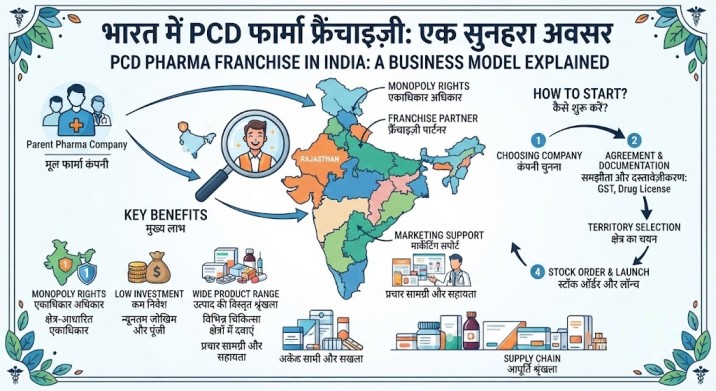
PCD stands for Propaganda Cum Distribution. It is a franchise model where a pharmaceutical company grants you the exclusive right to promote and distribute its branded medicines in a defined territory — usually a district or a group of districts. You do not manufacture anything. You build relationships with doctors, chemists, and stockists, and you earn the margin between the company’s net rate and the price you sell at.[reference:26][reference:27]
PCD vs. Third-Party Manufacturing: The Key Difference
A PCD franchise sells someone else’s brand in your territory. Third-party manufacturing means you own your own brand and outsource production to a contract manufacturer. The investment, margin structure, and compliance burden are completely different.
| Factor | PCD Franchise | Third-Party Manufacturing |
|---|---|---|
| Brand ownership | Parent company’s brand | Your own brand |
| Minimum investment | ₹20,000–₹50,000 per order | ₹1–2 lakh per SKU/MOQ |
| Profit margin | 20–40% | 200–500% MRP markup |
| Minimum order quantity | Extremely low (1 box) | 3,000–5,000 units per SKU |
| Operational complexity | Low (sales-focused) | High (brand, compliance, production, distribution) |
Source: Strausswell (Mar 2026), Advacare Pharma (Jul 2026).[reference:28][reference:29]
PCD vs. Ordinary Distributor: Margin and Monopoly Rights
An ordinary pharma distributor buys bulk stock and supplies chemists, earning 5–10% margin with no exclusive territory. A PCD franchise partner gets 20–50% margin and exclusive monopoly rights for a district. The PCD partner also gets their name printed on boxes and marketing support from the company.[reference:30]
Why this matters to you: PCD is not a distributor role. It is a brand-building role with territory protection. If you want to build a local pharma business, PCD is the higher-margin, higher-control model.
The Real Investment Breakdown: Where Your ₹25,000–₹3 Lakh Goes
Initial Stock Order (The Biggest Expense)
Your largest single cost is the minimum order value (MOV) for initial stock. Most companies require:
- Starter (30–50 products): ₹20,000–₹50,000
- Mid-range (60–100 products): ₹50,000–₹1,20,000
- Comprehensive (120–200+ products): ₹1,20,000–₹3,00,000
Experienced operators recommend starting with 40–60 focused products in 2–3 therapeutic areas, then expanding once your doctor network is established.[reference:31]
Drug License, GST, and Setup
Wholesale Drug License (Form 20B/21B): ₹5,000–₹15,000 one-time. This is mandatory for storing and selling medicines.[reference:32][reference:33]
GST registration: Mandatory for commercial activity.
Storage space: Your existing space or a small warehouse. A first-time entrepreneur starting from scratch will invest more.[reference:34]
Promotional Material and Working Capital
Promotional inputs (visual aids, samples, MR bags, gifts): ₹5,000–₹25,000. Partly recoverable through sales.[reference:35]
Working capital: ₹20,000–₹1,00,000+ to cover 60–90 days of credit cycle, travel, and monthly reorders.[reference:36][reference:37]
Investment Comparison Table
| Cost Component | Starter Model | Properly Set-Up Single Division | Multi-Division |
|---|---|---|---|
| Initial stock order | ₹20,000–₹50,000 | ₹60,000–₹1,00,000 | ₹1,50,000–₹3,00,000 |
| Drug license & GST | ₹5,000–₹15,000 | ₹5,000–₹15,000 | ₹5,000–₹15,000 |
| Promotional material | ₹5,000–₹15,000 | ₹10,000–₹25,000 | ₹20,000–₹40,000 |
| Working capital | ₹20,000–₹50,000 | ₹50,000–₹1,00,000 | ₹1,00,000–₹2,00,000 |
| Total | ₹50,000–₹1,30,000 | ₹1,25,000–₹2,40,000 | ₹2,75,000–₹5,55,000 |
Sources: Amplec Healthcare (Sep 2026), Globus Labs (Mar 2026), Biozia Lifesciences (Aug 2026), Pharmatradz (Jun 2026). Figures are estimates and vary by brand, territory, and product mix.[reference:38][reference:39][reference:40][reference:41]
Why this matters to you: The ₹25,000 headline is real but it is a starter order, not a full setup. A properly stocked single-division franchise with working capital is a ₹1.25–₹2.4 lakh investment. Budget for the total.
Profit Margins: Gross vs. Net (What You Actually Keep)
The Four Numbers: Net Rate, PTS, PTR, MRP
Every PCD price conversation comes down to four numbers:
| Term | What It Means | Who Pays It |
|---|---|---|
| Net Rate | Price the company charges you | You → company |
| PTS | Price to Stockist | Stockist → you |
| PTR | Price to Retailer | Retailer → stockist |
| MRP | Maximum Retail Price | Patient → chemist |
Your gross margin is the difference between your net rate and the price at which you sell — PTS if you supply stockists, PTR if you supply chemists directly. The MRP sets the ceiling; you never pocket the full MRP-minus-net difference because the retailer and stockist each take a slice.[reference:42]
Gross Margin vs. Net Profit After Promotional Spend
PCD gross margins range from 20% to 50% depending on the product and segment. But net profit is lower after:
- Promotional spend: 5–8% of sales
- Logistics: 2–4% of sales
- Travel and field costs
- Credit cycle delays
Realistic net profit after everything is 15–40% of monthly turnover for most partners.[reference:43][reference:44]
Margin by Therapeutic Segment
| Segment | Typical Gross Margin |
|---|---|
| General medicines (antibiotics, analgesics) | 15–35% |
| Cardiac & diabetic | 30–45% |
| Paediatric | 30–40% |
| Dermatology | 50–60% |
| Gynaecology | 55–65% |
| Nutraceuticals & supplements | 60–70% |
Sources: Novalab (Jul 2026), Health Pride (Jun 2026), Vibcare (Sep 2026). Specialty segments carry higher margins but also higher per-unit costs and slower doctor adoption.[reference:45][reference:46][reference:47]
Why this matters to you: A 50% gross margin on dermatology does not mean 50% net profit. After promotional spend, logistics, and credit delays, your real net margin may be 25–30%. Plan your personal income around net, not gross.
Licensing and Compliance: What You Need Before You Start
Wholesale Drug License (Form 20B/21B)
A valid wholesale drug license is mandatory to store and sell medicines. It is issued by your State Drug Control Authority**. The license must be in place before you place your first order. A retail license (Form 20/21) is for chemists; a wholesale license (Form 20B/21B) is for distributors and PCD partners.[reference:48][reference:49]
GST Registration
GST registration is mandatory for any commercial pharma distribution activity. Without it, you cannot invoice chemists or stockists legally.[reference:50]
WHO-GMP and DCGI Approvals (The Franchisor’s Responsibility)
The franchisor** must hold WHO-GMP certification, ISO certification, and DCGI-approved formulations. These are not your responsibility to obtain, but they are your responsibility to verify. A company without WHO-GMP or DCGI-approved products is a risk to your business and your reputation.[reference:51][reference:52]
Why this matters to you: Your drug license makes you legally responsible for the products you distribute. If the franchisor’s products fail quality checks, your license and reputation are at risk. Verify certifications before signing.
Monopoly Rights: How to Verify Before You Sign
What Monopoly Actually Means
Monopoly rights mean the company will not appoint a second franchise partner for the same product range in your defined territory. One partner, one area, one range.[reference:53]
The 5-Point Monopoly Checklist
Before signing, verify that the agreement includes:
- Named territory:** District, pin-code, or defined market area — not “as discussed.”
- Product range:** Which divisions and SKUs are covered by the monopoly. A company may have monopoly divisions and open divisions.
- Duration:** Is the exclusivity permanent, annual, or tied to minimum order conditions?
- Non-appointment commitment:** A written clause that the company will not appoint another partner in your territory.
- Breach consequences:** What happens if the company violates the monopoly? What is your remedy?
Sources: Vibcare (Apr 2026), Zeela Laboratories (Aug 2026), Medhexa (Oct 2026).[reference:54][reference:55][reference:56]
Red Flags in Franchise Agreements
- Verbal monopoly promises. If it is not written, it is not enforceable.
- Vague territory descriptions. “Your area” is not a territory.
- No breach clause. A monopoly without consequences is a suggestion.
- Unilateral MOQ increases. Check whether the company can raise minimum order quantities after year one.
Why this matters to you: Monopoly rights are the entire reason the PCD model works. Without written exclusivity, you are just another distributor competing on price.
First-Year Reality: Working Capital, Credit Cycle, and Break-Even
The ₹15,000–₹40,000 Monthly Reorder Requirement
The initial stock order is not the only stock cost. To keep products available at chemists and maintain supply when doctors prescribe, you must reorder regularly**. Budget **₹15,000–₹40,000 per month** depending on territory size and product range.[reference:57]
The 60–90 Day Credit Cycle to Chemists
Chemists and stockists do not pay immediately. You extend credit, and they pay in 30–90 days**. This means you are funding the supply chain. Working capital must cover **60–90 days of credit cycle** — otherwise you will run out of cash even if sales are growing.[reference:58]
Break-Even Timelines and Realistic Income
Most franchise partners recover their initial investment within 6–12 months** with consistent ordering and field work. But the **first 6 months are the hardest** — most people who quit do so because they run out of working capital, not because the model failed.[reference:59][reference:60]
Most partners reach a sustainable monthly secondary sales figure of ₹4–8 lakh within 12 months** if they work two districts seriously. The top 10% reach **₹15+ lakh monthly secondary sales by year 2**. At a 20–35% net margin, that translates to **₹80,000–₹2.8 lakh monthly net profit** for top performers.[reference:61]
City-Wise Income Table
| City Tier | Monthly Secondary Sales (Est.) | Net Margin (Est.) | Monthly Net Profit (Est.) |
|---|---|---|---|
| Tier-1 (Mumbai, Delhi, Bangalore) | ₹5–10 lakh | 20–30% | ₹1–3 lakh |
| Tier-2 (Jaipur, Indore, Patna) | ₹3–6 lakh | 25–35% | ₹75,000–₹2.1 lakh |
| Tier-3 | ₹2–4 lakh | 25–35% | ₹50,000–₹1.4 lakh |
Source: Industry estimates based on PharmmaEx (2026), Novalab (2026), and Yodley Life Sciences (2026). Actual figures depend on territory, product mix, and field effort.[reference:62][reference:63][reference:64]
Why this matters to you: The income potential is real, but it is not passive. A PCD franchise is a field sales business**. Your income is a direct function of how many doctors you meet and how many chemists stock your products.
PCD vs. Third-Party Manufacturing: Which Model Fits You?
Investment, Margin, and Control Comparison
| Factor | PCD Franchise | Third-Party Manufacturing |
|---|---|---|
| Brand | Parent company’s brand | Your own brand |
| Investment | ₹25,000–₹3 lakh | ₹1–2 lakh per SKU/MOQ |
| Margin | 20–40% | 200–500% MRP markup |
| Control | Limited (company owns brand) | Full (you own brand, formulation, packaging) |
| Speed to market | 2–4 weeks | 2–4 months |
| Compliance burden | Limited (drug license + GST) | Higher (brand registration, GMP audits) |
Source: Strausswell (Mar 2026), PharmmaEx (Mar 2026).[reference:65][reference:66]
When PCD Makes Sense
Choose PCD if you want low investment, fast start, and a proven brand**. It is the right model for medical representatives, pharmacists, and first-time entrepreneurs who want to learn the pharma distribution business without manufacturing risk.[reference:67]
When Third-Party Manufacturing Makes Sense
Choose third-party manufacturing if you want your own brand, full margin control, and long-term scalability**. It requires higher investment and more compliance work, but the upside is much larger.[reference:68]
Why this matters to you: PCD is a distribution business. Third-party manufacturing is a brand business. Do not confuse the two. If you want to own a brand, PCD is not the right starting point.
7-Point Checklist Before Choosing a PCD Pharma Franchise
- Is the company WHO-GMP certified and are its products DCGI-approved?
- Is the monopoly territory written into the agreement with named districts and product ranges?
- What is the exact net rate, PTS, PTR, and MRP for each product?
- What is the minimum order value, and can it be increased unilaterally after year one?
- Have I budgeted for 60–90 days of credit cycle and monthly reorders?
- Have I spoken to 3 existing franchise partners about actual monthly sales and net income?
- Do I have a drug license and GST registration in place before signing?
If the answer to questions 1, 2, or 6 is unclear, do not sign yet.
Final Verdict
If your budget is ₹25,000–₹1 lakh: A single-division PCD franchise is a real entry point, but it is a starter range**. You will need to reinvest profits into expanding the product portfolio. Plan for ₹1–1.5 lakh total including working capital.
If your budget is ₹1–3 lakh: A properly set up single-division or small multi-division franchise gives you enough product range and working capital to survive the first 6 months. This is the realistic entry point for a full-time operator.
If you have medical representative or pharma sales experience: PCD is a natural fit. Your existing doctor relationships are the single biggest factor in early sales.
If you want to own your own brand: Do not choose PCD. Look at third-party manufacturing instead — but budget ₹1–2 lakh per SKU and a longer runway.
See verified PCD pharma franchise options:
View franchise list on free-franchise.com →
Frequently Asked Questions (FAQ)
How much investment is required for a PCD pharma franchise?
A single-division PCD franchise starts at ₹25,000. A properly set-up single division costs ₹60,000–₹1,00,000. Multi-division setups run ₹1,50,000–₹3,00,000. Add ₹20,000–₹1,00,000 for working capital and 60–90 days of credit cycle.
What is the profit margin in a PCD pharma franchise?
Gross margins range from 20% to 50% depending on the product segment. Dermatology, gynaecology, and nutraceuticals carry higher margins (50–70%); general medicines carry lower margins (15–35%). Net profit after promotional spend and logistics is typically 15–40% of monthly turnover.
Do I need a drug license for a PCD pharma franchise?
Yes. A wholesale drug license (Form 20B/21B) issued by your State Drug Control Authority is mandatory to store and sell medicines. GST registration is also mandatory. The franchisor must provide WHO-GMP certification and DCGI-approved products, but your license makes you legally responsible.
What is monopoly rights in a PCD pharma franchise?
Monopoly rights mean the company will not appoint a second franchise partner for the same product range in your defined territory. It must be written into the agreement with a named district, product range, duration, and breach consequences. Verbal exclusivity is not enforceable.
How long does it take to break even in a PCD pharma franchise?
Most franchise partners recover their initial investment within 6–12 months with consistent ordering and field work. The first 6 months are the hardest — most people who quit do so because they run out of working capital, not because the model failed. Top performers reach ₹15+ lakh monthly secondary sales by year 2.
What is the difference between PCD pharma franchise and third-party manufacturing?
A PCD franchise sells the parent company’s brand in your territory with a 20–40% margin and low investment (₹20,000–₹50,000 per order). Third-party manufacturing means you own your own brand and outsource production, with 200–500% MRP markup but higher investment (₹1–2 lakh per SKU) and higher compliance burden.