


Kirana Store Franchise in India 2027
November 17, 2026
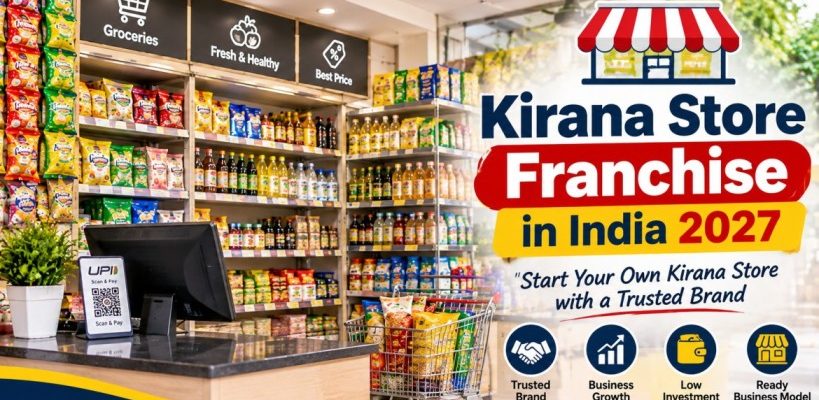
Kirana Store Franchise in India 2027: From Traditional Shop to Organised Retail
: A kirana store franchise in India costs ₹5–₹12 lakh for a new 300 sq ft outlet, and ₹5–₹15 lakh to convert an existing kirana into an organised brand. In 2027, Tier-2 and Tier-3 cities offer the strongest opportunity because organised retail penetration is still below 5–15% there, while rent and competition remain manageable.
Why this matters to you: The traditional kirana model is under pressure from quick commerce and rising customer expectations. Converting or starting as a franchise is the middle path — you keep local trust, but add centralised supply chain, billing tech, and brand pull.
Why Kirana Stores Are Converting to Organised Retail in 2027
India has roughly 12–13 million kirana stores, and they still hold about 91% of grocery retail share in 2025. But that share is expected to settle around 86% by 2030 as quick commerce and organised formats expand. The kirana is not disappearing — it is being forced to modernise.
Why this matters to you: Standing still is now a bigger risk than investing in a system. Customers want clean aisles, transparent pricing, digital billing, and home delivery. A franchise gives you all three from day one.
The Quick-Commerce Pressure and the White Space in Tier-2/3 India
Quick commerce has already taken roughly 6–9% of grocery channel share in major cities. Kirana owners in Mumbai or Bengaluru feel it first. But in Indore, Patna, Jaipur, and smaller towns, organised retail penetration is still below 5% — and that is where the real opportunity sits.
Rent in a Tier-2 city can be 40–60% lower than a metro for the same square footage. Competition from large chains is thinner. Customers still buy daily and still trust the face behind the counter. A branded kirana gives them the best of both worlds.
Why this matters to you: The same ₹12 lakh that buys a cramped metro store can buy a clean, well-stocked branded outlet in Indore or Patna — with better margins and faster break-even.
What Actually Changes When a Kirana Becomes a Franchise
Four things change on day one: your supply chain, your billing system, your store layout, and your customer’s perception. The brand brings centralised procurement at better rates, POS software with inventory tracking, a standardised planogram, and instant trust.
What does not change is your daily work. You still open the shutter, manage staff, handle wastage, and talk to customers. FOFO means you own and operate the store — the brand gives you the system, not the salary.
Why this matters to you: A franchise upgrades your infrastructure, not your effort level. If you want passive income, FOFO is the wrong model.
Kirana Store Franchise Investment in India 2027
A kirana franchise in India is not a single cheque. It is six separate costs, and the franchise fee is often the smallest one. A 300 sq ft franchise-style kirana typically needs ₹5–₹12 lakh all-in, including fit-out, opening inventory, POS, and security deposit.
Why this matters to you: If you budget only for the franchise fee, you will run out of cash before opening day. Build a line-item sheet, not a headline number.
Line-Item Cost Table (₹5–₹25 Lakh Budget)
| Cost Head | Typical Range (₹) | What It Covers |
|---|---|---|
| Franchise / licence fee | 50,000–2,00,000 | Brand rights, training, setup support |
| Fit-out and shelving | 1,00,000–3,00,000 | Racking, lighting, signage, billing counter |
| Opening inventory | 3,00,000–6,00,000 | 2,000–5,000 SKUs of grocery stock |
| POS / billing software | 15,000–50,000 | Billing, inventory, barcode |
| GST & FSSAI registration | 5,000–15,000 | Licences, compliance |
| Security deposit / rent advance | 20,000–1,20,000 | 1–2 months’ rent (refundable) |
| Total realistic range | 5,00,000–12,00,000 | Add 10–15% buffer |
Source: IIFL illustrative cost breakdown for 300 sq ft franchise-style kirana, 2026; SuperK franchise cost guide.
Why this matters to you: A ₹10 lakh budget works for a 300–500 sq ft store. A 1,000+ sq ft mini-mart will usually need ₹14–₹20 lakh, and a full supermarket ₹25 lakh+.
Conversion Cost vs New Store Cost: What Changes
If you already own or rent a kirana store, conversion costs are lower because you skip the rent advance and some civil work. Setting up or converting a store typically needs ₹10–₹15 lakh, including store setup and initial stock. The biggest new costs are brand-spec interiors, POS software, and a deeper opening inventory.
Why this matters to you: Existing kirana owners can modernise without losing their location, local customer relationships, or market knowledge. That is a real advantage a new entrant cannot buy.
Kirana Franchise Profit Margin and ROI in 2027
Grocery retail is a volume game with thin margins. A franchise kirana typically earns an 8–15% gross margin, compared to 4–8% for an independent store (estimated). After rent, salaries, royalty, and wastage, a well-run franchise store typically nets 6–10% of sales.
Why this matters to you: A 15% gross margin sounds impressive until rent and royalty are deducted. Model your net margin, not the headline gross figure.
Franchise vs Independent: Margin Comparison
| Metric | Franchise Kirana (Estimated) | Independent Kirana (Estimated) |
|---|---|---|
| Gross margin | 8–15% | 4–8% |
| Net margin | 6–10% | 8–10% (owner-operated, low overhead) |
| Monthly profit (₹10L monthly sales) | ₹60,000–₹1,00,000 | ₹50,000–₹80,000 |
| Royalty | 3–7% of sales | Nil |
| Supply chain | Centralised, better rates | Local distributors, variable rates |
Sources: IIFL (franchise margin 8–15%, independent 5–10%); industry data (kirana net margin 8–10%); SuperK (franchise partners see estimated net monthly profit ₹30,000–₹1.5 lakh).
Why this matters to you: An independent kirana with zero rent (own shop) and family labour can match a franchise on net margin. A franchise wins on supply chain and brand trust, not always on net percentage.
Break-Even and Payback Period for Tier-2/3 Cities
Operational break-even for a compact kirana franchise usually arrives in 6–12 months. Full investment recovery typically takes 12–24 months for smaller formats, and 24–36 months for larger mini-marts. Some brands claim 6–9 month payback, but those numbers assume strong footfall and disciplined operations.
Why this matters to you: If a brand promises payback in 6 months on a ₹12 lakh kirana, ask for audited store-level data. Grocery does not work that way at scale.
Licences and Legal Checklist for a Kirana Franchise in India
India has no dedicated franchise law. The relationship rests on the franchise agreement, governed by the Indian Contract Act, 1872, and food retail regulations. Licences are non-negotiable — a missing FSSAI registration can shut your store on day one.
Why this matters to you: Compliance is not paperwork. It is your licence to operate.
FSSAI, GST, and Shop & Establishment Registration
- ✅ FSSAI Basic Registration (turnover below ₹12 lakh; fee around ₹100/year) or State Licence as turnover grows
- ✅ GST registration (mandatory above ₹40 lakh turnover for goods; ₹20 lakh in special category states)
- ✅ Shops and Establishment Act licence (state-level registration)
- ✅ Municipal trade licence
- ✅ Legal metrology registration if you weigh or pack goods
- ✅ Fire NOC where applicable
Why this matters to you: Budget ₹5,000–₹15,000 for registrations and 4–8 weeks for approvals. Start early; municipal timelines vary by city.
Franchise Agreement Clauses That Protect Your Capital
- ✅ Territory clause: exclusivity radius and online-delivery rights
- ✅ Royalty base: gross sales vs net sales, GST treatment
- ✅ Supply-chain obligation: mandatory procurement vs local sourcing flexibility
- ✅ Exit and transfer clause: fee, notice period, buyer approval
- ✅ Security deposit refund terms and timelines
- ✅ Dispute resolution and jurisdiction
Why this matters to you: Verbal promises about “support” and “exclusive territory” disappear after the cheque clears. Only written clauses survive.
How to Choose the Right Kirana Franchise Brand in 2027
Do not choose a brand because its brochure looks polished. Choose it because its unit economics work in your city, its supply chain reaches your pin code, and its agreement is transparent.
6 Questions to Ask Every Franchisor
- What is the total investment per square foot, including inventory and working capital?
- What is the category-wise gross margin for staples, FMCG, and private label?
- Is royalty charged on gross sales or net sales, and does it include GST?
- What territory protection do I get, and does it cover online delivery?
- What support stops after opening day, and what is chargeable?
- What is the average payback period of your existing franchisees, and can I speak to three of them?
Why this matters to you: A franchisor who cannot answer these six questions with numbers is selling a story, not a system.
Red Flags in Kirana Franchise Agreements
- ❌ Franchise fee is non-refundable but “support” is vaguely defined
- ❌ Royalty is charged on gross sales without adjusting returns or wastage
- ❌ The brand can open a company-owned store or second franchise in your catchment
- ❌ Mandatory 100% procurement with no local sourcing flexibility
- ❌ No exit clause or a transfer fee above 20% of sale value
- ❌ Refusal to share a line-item investment sheet
Why this matters to you: Every red flag above has trapped first-time franchisees. Walk away from any agreement that hides numbers.
Should You Convert Your Existing Kirana Store or Start New?
| Factor | Convert Existing Kirana | Start a New Franchise Store |
|---|---|---|
| Investment | Lower (₹10–₹15 lakh) | Higher (₹12–₹25 lakh) |
| Location risk | Already proven | Unproven; site survey critical |
| Customer base | Existing trust and footfall | Must be built from scratch |
| Brand trust | Instant upgrade | Instant recognition |
| Operational disruption | Manageable with phased rollout | Full setup from day one |
| Best for | Existing kirana owners | First-time investors without a store |
Sources: IIFL and SuperK on kirana conversion; conversion cost ₹10–15 lakh.
Why this matters to you: If you already run a kirana with steady footfall, conversion is the lower-risk path. If you are new to retail, a franchise site survey protects you from a bad location.
Frequently Asked Questions
1. Can an existing kirana store be converted into a franchise?
Yes. Existing kirana owners can modernise through franchise models while retaining their location, customer relationships, and market knowledge. Conversion typically costs ₹10–₹15 lakh, covering store setup, branding, POS, and initial stock. It is usually cheaper and lower-risk than starting a new store.
2. How much investment is required for a kirana store franchise in India?
A 300 sq ft franchise-style kirana typically needs ₹5–₹12 lakh all-in. A 500–1,000 sq ft mini-mart usually needs ₹12–₹20 lakh. Franchise fees range from ₹50,000 to ₹2,00,000, but fit-out and opening inventory are the bigger cheques.
3. What is the profit margin of a kirana franchise?
A franchise kirana typically earns an 8–15% gross margin and a 6–10% net margin after rent, salaries, royalty, and wastage. Independent kiranas often run lower gross margins (4–8%) but can match net margins with zero rent and family labour.
4. Is a kirana franchise better than an independent store?
A franchise is better if you want a proven supply chain, billing software, and brand trust from day one. An independent store is better if you have deep retail experience, strong local supplier relationships, and want full control. Franchise reduces product-mix risk but adds royalty cost.
5. What licences are required for a kirana store franchise in India?
You need FSSAI registration, GST registration (mandatory above ₹40 lakh turnover), Shops and Establishment Act licence, municipal trade licence, and legal metrology registration if you weigh goods. Budget ₹5,000–₹15,000 and 4–8 weeks for approvals.
6. How long does it take to break even in a kirana franchise?
Operational break-even usually takes 6–12 months. Full investment recovery typically takes 12–24 months for compact stores, and 24–36 months for larger mini-marts. Tier-2/3 stores often recover faster because rent and competition are lower.
Final Verdict: Is a Kirana Franchise Right for You in 2027?
A kirana franchise is the right move if you want supply-chain power, technology, and brand trust without building them from scratch. It is the wrong move if you want zero royalty, complete pricing freedom, or passive income. In 2027, the strongest opportunity is in Tier-2 and Tier-3 cities, where organised retail penetration is still below 5% and a converted kirana can serve brand-hungry customers without metro-level rents.