

IT & Software Services Franchise in India: Big Scope in Small Cities
October 30, 2026
IT & Software Services Franchise in India: Big Scope in Small Cities (2026 Guide)
An IT and software services franchise in India can be started with ₹1–2 lakh for an entry-level computer training institute, ₹10,000–₹50,000 for a software product reseller model, or ₹5–10 lakh for a full IT services and web development franchise. The real opportunity in 2026 is in Tier-2 and Tier-3 cities, where IT jobs are growing 95% faster than in metros and operating costs are 30–40% lower.
India’s IT sector is projected to hit US$300 billion in revenue by FY2026, but the growth is shifting. Tier-II hubs like Indore, Jaipur, Coimbatore, and Ahmedabad are growing 20% faster than metros, and over 41,000 IT jobs are opening in smaller cities every quarter. This guide breaks down the real costs, royalty structures, and income potential for each franchise model.
One-Line Answer: The Three Entry Models
IT Training Institute Franchise (₹1–10 lakh): You run a computer training centre offering diploma and certificate courses. Revenue from student fees. Low overhead, recurring batches. Payback in 6–18 months.
Software Product Reseller Franchise (₹10,000–₹2 lakh): You sell software subscriptions (ERP, CRM, POS) to local SMEs. Commission and subscription revenue. Fast payback if you have a business network.
IT Services / Web Development Franchise (₹50,000–₹5 lakh): You run a local digital agency offering web development, IT support, and cybersecurity services. Revenue from monthly retainers and project fees. Payback in 6–12 months.
Why this matters to you: The cheapest model is not always the most profitable. A ₹50,000 software reseller franchise with a 30% royalty can leave you with less net profit than a ₹2 lakh training institute with a 10% royalty. Compare total cost, not just the entry fee.
Why Tier-2/3 Cities Are the Real Opportunity
95% Growth in IT Jobs Outside Metros
Tier-2 and Tier-3 cities registered a 95% increase in active IT jobs year-on-year, with over 41,000 IT jobs opening in September 2026 alone, according to Xpheno data. The growth is driven by GCCs (Global Capability Centres) and IT services firms expanding beyond saturated metros.
Tier-II hubs such as Coimbatore, Ahmedabad, and Kochi are growing 20% faster than metros, benefiting from 35–40% lower real estate costs and more stable workforce retention. Cities like Jaipur and Indore offer 30% cost savings compared to traditional IT hubs.
30% Cost Savings vs. Metros
A 200–500 sq ft training centre in Indore costs ₹15,000–₹25,000 per month in rent. The same space in Mumbai or Bangalore costs ₹40,000–₹80,000. Lower rent means faster break-even and higher net margins for the same revenue.
Why this matters to you: The Tier-2/3 opportunity is not a compromise — it is a financial strategy. Lower fixed costs mean you can survive slower ramp-up periods and still reach profitability faster than a metro competitor.
The Three Franchise Models Compared
Model 1 — IT Training Institute Franchise (₹1–10 Lakh)
This model focuses on computer education: diploma and certificate programmes in software development, hardware networking, computer applications, and Tally. Space requirement is small (200–1,000 sq ft), and the student demographic exists in every district.
Examples: Sysway Software Solutions (₹1–2 lakh investment, Tier-2/3 focus, 101–250 franchise count), Compucom Software (₹1–2 lakh, 1,001–2,000 sq ft), Nict Computer Education, and CITC Sapphire (₹10 lakh, 1,000–1,500 sq ft).
Revenue comes from student fees (₹5,000–₹15,000 per course). Monthly income ranges from ₹20,000–₹1,50,000 depending on enrolment. Royalty ranges from 10% (ThinkQuotient) to 12% or fixed ₹15,000 (A3IT Skills).
Model 2 — Software Product Reseller Franchise (₹10,000–₹2 lakh)
You sell software subscriptions (ERP, CRM, HRMS, POS) to local SMEs. The franchisor provides the product and backend support; you focus on sales and client relationships. Space requirement is minimal (under 250 sq ft), and the model can be run from a small office or home.
Examples: Focus Softnet (₹10,000–₹50,000 investment, ₹50,000 franchise fee, 20% royalty, 1–6 month payback), Nanotech Web Solutions (₹10,000–₹50,000 investment, ₹25,000 franchise fee, 30% royalty, 1–3 year payback), and MyWebSpace Technologies (₹50,000–₹1 lakh, AI-powered business OS for MSMEs).
Revenue comes from subscription commissions and per-sale margins. Payback is fast (3–6 months) if you have an existing business network, but slower (1–2 years) if you are building from scratch.
Model 3 — IT Services / Web Development Franchise (₹50,000–₹5 lakh)
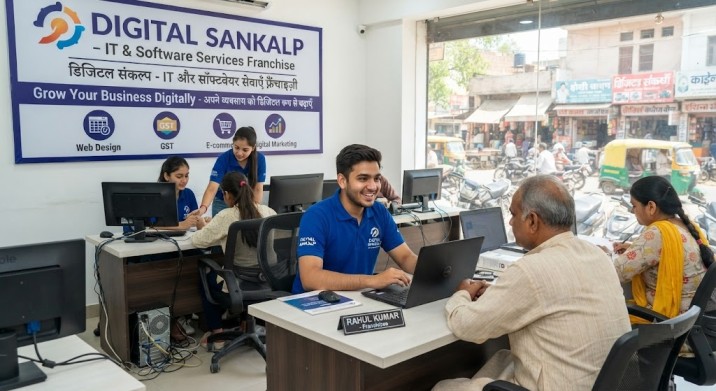
You run a local digital agency offering website development, IT support, cybersecurity audits, and digital transformation services for SMEs. The franchisor provides the brand, processes, and sometimes lead generation.
Examples: ITSOFTLAB360 (Indore-based, 12+ integrated software solutions, recurring subscription revenue), and ThinkQuotient (₹10,000–₹50,000 investment, ₹4 lakh franchise fee, 10% royalty, 40% ROI).
Revenue comes from monthly retainers (₹5,000–₹25,000 per client) and project fees. A CITC partner from Tier-3 Rajasthan earned ₹2.4 lakh in 40 days by selling 4 websites and 2 online stores.
Comparison Table: Investment, Royalty, Payback
| Model | Investment | Revenue Source | Royalty | Payback |
|---|---|---|---|---|
| IT Training Institute | ₹1–10 lakh | Student course fees | 10–12% or fixed ₹15,000 | 6–18 months |
| Software Reseller | ₹10,000–₹2 lakh | Subscription commissions | 20–30% | 3 months–2 years |
| IT Services / Web Dev | ₹50,000–₹5 lakh | Monthly retainers + projects | 10–25% | 6–12 months |
Sources: ForeFind (Jun 2026), Franchise India (2026), A3IT Solutions (Apr 2026), CITC Chandigarh (Oct 2026). Figures are estimates and vary by brand, city, and enrolment/client acquisition.
The Royalty Trap: 0.25% vs. 10% vs. 30%
Net Profit Comparison on ₹1 Lakh Monthly Revenue
Royalty structures vary dramatically. Intarvo Technologies charges 0.25% of revenue (but has a ₹2–5 lakh franchise fee). ThinkQuotient charges 10% royalty** (with a ₹4 lakh franchise fee). Nanotech Web Solutions charges **30% royalty** (with a ₹25,000 franchise fee). A3IT Skills charges **12% or fixed ₹15,000 per month**, whichever is higher.
Why a 30% Royalty Can Still Work If the Franchisor Provides Leads
A 0.25% royalty model may require you to acquire every client yourself. A 30% royalty model may include lead generation, software licensing, and back-office support. If the franchisor brings clients, the higher royalty can be cheaper than independent client acquisition.
| Royalty Model | Monthly Revenue | Royalty Paid | Operating Costs | Net Profit |
|---|---|---|---|---|
| 0.25% royalty (high upfront fee) | ₹1,00,000 | ₹250 | ₹50,000 (you acquire clients) | ₹49,750 |
| 30% royalty (franchisor provides leads) | ₹1,00,000 | ₹30,000 | ₹25,000 (leads + support reduce acquisition cost) | ₹45,000 |
Source: Industry estimates (2026). Operating costs vary by model and city.
Why this matters to you: A lower royalty is not always better if it means you have to spend more on client acquisition. Compare total cost, not just the royalty percentage.
What You Actually Earn: Monthly Income by City Tier
Student Enrolment Math (Training Model)
An IT training centre with 50 students paying ₹8,000 per course earns ₹4 lakh per batch cycle (3–4 months). Monthly revenue stabilises at ₹1–1.5 lakh after 6–12 months. Monthly fixed costs (rent ₹15,000 + staff ₹25,000 + marketing ₹10,000) are ₹50,000. Net profit: ₹50,000–₹1 lakh.
Client Retainer Math (Services Model)
An IT services franchise with 8 retainer clients at ₹10,000/month earns ₹80,000 in monthly revenue. Fixed costs (rent ₹12,000 + staff ₹25,000 + software ₹8,000) are ₹45,000. Net profit: ₹35,000 before royalty.
Net Take-Home After Royalty, Rent, and Staff
Tier-1 (Mumbai, Bangalore, Delhi): Gross ₹1–2 lakh; net ₹40,000–₹70,000.
Tier-2 (Indore, Jaipur, Patna): Gross ₹60,000–₹1.2 lakh; net ₹30,000–₹50,000.
Tier-3: Gross ₹40,000–₹80,000; net ₹20,000–₹35,000.
Income Comparison Table (Tier-1 vs. Tier-2 vs. Tier-3)
| City Tier | Gross Monthly Income (Est.) | Typical Royalty | Estimated Net Take-Home |
|---|---|---|---|
| Tier-1 | ₹1,00,000–₹2,00,000 | 10–30% | ₹40,000–₹70,000 |
| Tier-2 | ₹60,000–₹1,20,000 | 10–12% | ₹30,000–₹50,000 |
| Tier-3 | ₹40,000–₹80,000 | 10–12% | ₹20,000–₹35,000 |
Source: Industry estimates based on ForeFind (Jun 2026) and FranchiseBazar (Feb 2026) data. Net take-home assumes one staff member and ₹8,000–₹25,000 rent.
Why this matters to you: Plan your personal budget around net take-home, not gross revenue. The royalty and operating costs come out first.
How to Start: A Step-by-Step Roadmap
Step 1 — Choose the Right Model
Decide between IT training (student-fee revenue, 200–1,000 sq ft), software reseller (commission revenue, minimal space), and IT services (retainer revenue, small office). Do not choose a training institute unless you are comfortable with student acquisition and education operations.
Step 2 — Verify the Franchisor’s Placement/Lead Support
Ask one question: Does the franchisor provide student placement support (training model) or client leads (services model)? Placement support is the single biggest enrolment driver in Tier-2 cities. For services franchises, lead generation support can add 6 months to your runway if missing.
Step 3 — Budget the Working Capital
The franchise fee is only 20–40% of the total capital required. Keep ₹50,000–₹1.5 lakh for software, marketing, and personal runway for the first 3 months. The real investment for a ₹2 lakh franchise is closer to ₹3.5 lakh.
Step 4 — Set Up the Minimum Viable Centre/Office
You do not need a 1,000 sq ft centre on day one. A 200–300 sq ft space with 10–15 computers is sufficient for the first 6 months. Upgrade only after enrolment crosses 50 students.
Step 5 — Enrol Your First Batch / Sign Your First Client
For training: run a free demo class and convert 10–15 students into a paid batch. For services: target 3–5 retainer clients in the first 60 days. A CITC partner from Tier-3 Rajasthan earned ₹2.4 lakh in 40 days by selling 4 websites and 2 online stores.
7-Point Checklist Before Choosing an IT Franchise
- Is this a training franchise, a software reseller, or an IT services franchise?
- What is the exact royalty structure — 0.25%, 10%, 30%, or fixed monthly fee?
- Does the franchisor provide placement support (training) or client leads (services)?
- Is the software licensing included, or do I pay separately every month?
- Have I calculated net take-home after royalty, rent, staff, and software?
- Have I spoken to 3 existing franchisees about actual monthly enrolment/client count and income?
- Do I have ₹50,000–₹1.5 lakh in working capital beyond the franchise fee?
If the answer to questions 1, 2, or 5 is unclear, do not sign yet.
Final Verdict
If your budget is ₹1–2 lakh: An IT training institute franchise (Sysway, Compucom) offers the best balance of investment, royalty (10–12%), and recurring student revenue. Focus on Tier-2/3 cities where formal IT education infrastructure is limited.
If your budget is ₹10,000–₹50,000: A software product reseller franchise (Focus Softnet, Nanotech) offers fast payback if you have an existing SME network. Watch the 20–30% royalty — it can shrink net margins.
If your budget is ₹3–10 lakh: An IT services/web development franchise (ITSOFTLAB360, CITC) offers the highest income ceiling and recurring retainer revenue. Choose a brand with clear lead-generation support.
See verified IT and software services franchise options:
View franchise list on free-franchise.com →
Frequently Asked Questions (FAQ)
How much does an IT franchise cost in India?
It ranges from ₹10,000–₹50,000 for a software reseller model to ₹1–2 lakh for an entry-level computer training institute, and ₹5–10 lakh for a full IT services franchise. Add ₹50,000–₹1.5 lakh as working capital for the first 3 months.
Can I start an IT franchise without a technical background?
Yes. Software reseller and IT services franchises provide product training and technical support. Training institute franchises provide curriculum, faculty training, and placement support. Sales ability and business management matter more than coding skills.
What is the royalty structure for IT franchises?
Royalty ranges from 0.25% (Intarvo Technologies) to 10% (ThinkQuotient) to 30% (Nanotech Web Solutions). Some models charge a fixed monthly fee (₹15,000 for A3IT Skills). The percentage varies by brand and support level.
Is an IT training franchise profitable in Tier-2 cities?
Yes. Tier-2 cities like Indore, Jaipur, and Patna have lower rent (₹10,000–₹20,000) and growing demand for IT skills. Net take-home of ₹30,000–₹50,000 per month is realistic with 50–100 students. Break-even is faster than in metros.
How many students do I need to break even in an IT training franchise?
At ₹8,000 average course fee and ₹50,000 monthly fixed costs, you need 20–25 students per batch cycle (3–4 months) to cover costs. A centre running 2–3 batches simultaneously can break even in 6–12 months.
What is the difference between an IT training franchise and an IT services franchise?
An IT training franchise earns from student course fees. An IT services franchise earns from client retainers and project fees (web development, IT support). The revenue engines are completely different. Choose based on whether you want to teach students or serve businesses.