
Cloud Kitchen Franchise in India: Complete Guide to Starting with ₹5 Lakh (2026)
November 5, 2026
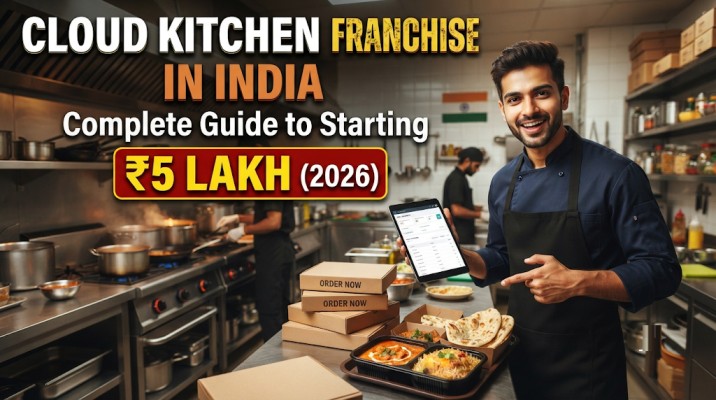
Cloud Kitchen Franchise in India: Complete Guide to Starting with ₹5 Lakh (2026)
A cloud kitchen franchise in India can be started with ₹3–5 lakh for a single-brand model, or ₹5 lakh for a multi-brand package with 3 brands, training, and equipment. Net margins range from 15–20% for single-brand kitchens to 20–25% for multi-brand setups, and break-even typically takes 6–12 months depending on location, order volume, and aggregator commissions.
India’s online food delivery market was valued at USD 55.6 billion in 2025, growing at over 22% CAGR through 2034, with Zomato and Swiggy covering more than 90% of organised food orders. Cloud kitchens are the lowest-capital entry into this market — no dining room, no front-of-house staff, no prime-location rent. This guide gives you the real costs, margins, and the commission trap that most new operators discover too late.
One-Line Answer: What Does ₹5 Lakh Actually Buy?
Single-brand cloud kitchen: ₹3–5 lakh for one brand from your own kitchen. Break-even in 6–12 months. Net margin 15–20%.
Multi-brand shared kitchen: ₹1–3 lakh for a shared/co-working kitchen space, testing the market before committing to a lease. Best for first-timers.
Tier-2/3 city independent kitchen: ₹3–5 lakh for a delivery-only kitchen in a smaller city. Lower rent, lower competition, faster break-even.
Why this matters to you: The ₹5 lakh budget is realistic for a single-brand or small multi-brand cloud kitchen in a Tier-2 city. In a metro, the same budget may only cover equipment and deposit — leaving no room for working capital. Choose the city and model together.
Why Cloud Kitchens Work in 2026
India’s Online Food Delivery Market: USD 55.6 Billion
India’s online food delivery market was at USD 55.6 billion in 2025, on track at 22%+ CAGR through 2034, according to IMARC Group data. Zomato and Swiggy together cover over 90% of organised food orders. The delivery habit is already built — you are tapping into an existing network, not creating one from scratch.
Zomato and Swiggy Cover 90%+ of Organised Orders
For a cloud kitchen, aggregator platforms are the storefront. There is no walk-in traffic. Your visibility, ratings, and delivery time on Swiggy and Zomato determine your order volume. This is both the model’s biggest advantage (instant access to millions of customers) and its biggest risk (platform dependence).
Tier-2 and Tier-3 Cities Are the Growth Engine
Tier-2 and Tier-3 cities are no longer small markets. Orders in these cities have grown significantly over the last two years, and a Tier-2/3 city setup costs noticeably less than Mumbai or Bangalore. A 150–200 sq ft kitchen in a Tier-2 city runs at ₹8,000–₹20,000 per month in rent, versus ₹30,000–₹60,000+ in a metro. Lower rent means faster break-even on the same revenue.
Why this matters to you: If your budget is ₹5 lakh, a Tier-2 city gives you more room for equipment, licences, and working capital without stretching the budget thin. The same ₹5 lakh in a metro buys less kitchen and no buffer.
The Three Cloud Kitchen Franchise Models Under ₹5 Lakh
Single-Brand Cloud Kitchen (₹3–5 Lakh)
Operate one brand from your own kitchen. This is the lowest-risk entry model for first-time entrepreneurs. You learn the delivery business — aggregator onboarding, menu engineering, packaging, and order management — without the complexity of running multiple brands.
Investment: ₹3–5 lakh. Break-even: 6–12 months. Net margin: 15–20%. Best for: first-time operators in Tier-2/3 cities with a focused menu (8–12 items max).
Multi-Brand Shared Kitchen (₹1–3 Lakh)
Rent space in a shared or co-working kitchen and operate multiple virtual brands from the same facility. You avoid the full kitchen setup cost, lease deposit, and equipment purchase. The trade-off is shared kitchen time, limited menu flexibility, and higher per-order costs.
Investment: ₹1–3 lakh. Break-even: 4–8 months. Net margin: 20–25% (once volume scales). Best for: first-timers testing demand without locking into a lease.
Tier-2/3 City Independent Kitchen (₹3–5 Lakh)
A standalone delivery-only kitchen in a Tier-2 or Tier-3 city. Lower rent, lower staff costs, and lower competition than metros. The menu can be broader than a shared-kitchen operation because you control the full kitchen schedule.
Investment: ₹3–5 lakh. Break-even: 6–12 months. Net margin: 15–22%. Best for: operators who want full control and are based in or willing to relocate to a smaller city.
Comparison Table: Investment, Break-Even, Margins
| Model | Investment | Break-Even | Net Margin | Best For |
|---|---|---|---|---|
| Single-Brand Cloud Kitchen | ₹3–5 lakh | 6–12 months | 15–20% | First-time operators, focused menu |
| Multi-Brand Shared Kitchen | ₹1–3 lakh | 4–8 months | 20–25% | Testing demand, low capital |
| Tier-2/3 Independent Kitchen | ₹3–5 lakh | 6–12 months | 15–22% | Full control, lower rent |
Sources: Yummy Cloud (Apr 2026), FranchiseBazar (Apr 2026). Figures are estimates and vary by city, brand, and execution.
The Real Investment: Where Your ₹5 Lakh Goes
Franchise Fee, Equipment, Deposit, Licences, Working Capital
| Cost Component | Estimated Amount (₹) | What It Covers |
|---|---|---|
| Franchise fee | ₹1.5–2.0 lakh | Brand rights, recipes, training, territory protection |
| Kitchen equipment | ₹75,000–₹1.5 lakh | Commercial range, chiller, freezer, prep tables, exhaust |
| Initial raw material & packaging | ₹50,000 | First 10–14 days of stock and packaging |
| Security deposit | ₹40,000–₹1.0 lakh | 1–3 months rent (Tier-2 vs metro) |
| Licences & registration | ₹15,000–₹30,000 | FSSAI, GST, trade licence, fire NOC |
| POS & aggregator onboarding | ₹15,000 | Billing software, Zomato/Swiggy integration |
| Working capital (2–3 months) | ₹1.0–1.5 lakh | Rent, staff, raw material, platform commissions |
| Total | ₹4.45–7.0 lakh | Depends on city tier, equipment sourcing, and brand |
Sources: TBWX (2026), Forkcast (Jul 2026), FranchiseBazar (Apr 2026). Figures are estimates and vary by city, brand, and format.
The Hidden Costs Nobody Budgets For
The quoted franchise fee is rarely the whole bill. Ask each brand to price these in writing before you sign: packaging costs (5% of order value), aggregator commissions (18–30% per order), GST on commissions, ad spend to stay visible on the apps, and the 7–14 day delay in aggregator settlements. These are operational costs, not setup costs, but they hit your cash flow from month one.
Why this matters to you: A ₹3 lakh franchise fee sounds manageable. But if the total all-in cost is ₹5.5 lakh and you only have ₹5 lakh, you will run out of working capital before month three. Budget for the all-in number, not the headline fee.
The Royalty and Commission Trap
Franchise Royalty: 2–12% of Revenue
Cloud kitchen franchise royalties vary widely. The Rolling Plate charges 2% royalty on its ₹1.9 lakh FOFO package. SaladO charges 2% royalty on its ₹2.36 lakh package. Ching Chong charges 5% royalty. Rebel Foods charges 12% of revenue on its ₹30–50 lakh model. Most Indian franchisors charge 5–8% of net sales, plus a 2% marketing fee for national brand building.
Swiggy/Zomato Commission: 18–30% per Order
Swiggy takes roughly 18–25% per order and Zomato 15–30%, varying by city and contract. After GST and other charges, many kitchens lose 25–35% of each order to the platforms. In July 2026, over 1,000 Bengaluru restaurants threatened to leave the apps over fee disputes — a signal that commission pressure is not a minor line item.
The 25–35% Order Value Loss After Commissions and GST
On a ₹200 order, a 25% commission is ₹50. GST on the commission adds another ₹9. Packaging is ₹10. By the time the order reaches you, the ₹200 bill has already lost ₹69 — before you pay for raw material, rent, or staff. This is why cloud kitchen margins look thin on paper but can turn negative if you do not price the menu correctly.
Why this matters to you: Do not calculate margin on menu price. Calculate it on the net amount you receive after aggregator commissions, GST, and packaging. The menu price is not your revenue.
What You Actually Earn: Net Margin Reality
Single-Brand: 15–20% Net Margin
A single-brand cloud kitchen earning ₹3 lakh in monthly gross orders (after commission deductions, ₹2.1–2.4 lakh net) with ₹1.8–2.0 lakh in operating costs leaves 15–20% net margin, or ₹30,000–₹60,000 per month. Break-even on a ₹4–5 lakh investment takes 8–12 months.
Multi-Brand: 20–25% Net Margin
A multi-brand kitchen operating 3–5 brands from the same facility can spread fixed costs (rent, staff, equipment) across multiple revenue streams. At ₹5–8 lakh in monthly gross orders across brands, the net margin can reach 20–25%, or ₹1.0–₹2.0 lakh per month. Break-even is faster (4–8 months) because the capital is lower and the volume is higher.
Monthly Income Scenarios Table
| Scenario | Monthly Gross Orders | Net After Commissions | Operating Costs | Monthly Net Profit |
|---|---|---|---|---|
| Single-brand, low volume | ₹2.0 lakh | ₹1.4 lakh | ₹1.2 lakh | ₹20,000–₹30,000 |
| Single-brand, stable | ₹3.5 lakh | ₹2.4 lakh | ₹1.9 lakh | ₹45,000–₹65,000 |
| Multi-brand, growing | ₹6.0 lakh | ₹4.2 lakh | ₹3.2 lakh | ₹90,000–₹1.2 lakh |
Source: Industry estimates based on Yummy Cloud (2026) and FranchiseBazar (2026) data. Figures assume 25–30% aggregator commission and 20% food cost.
Why this matters to you: The ₹5 lakh investment does not generate ₹1 lakh per month from day one. Most single-brand kitchens stabilise at ₹30,000–₹60,000 monthly net profit after 6–9 months of consistent operations and menu optimisation.
Top Cloud Kitchen Franchise Brands Under ₹5 Lakh (2026)
The Rolling Plate
India’s largest cloud kitchen franchise company since 2019, with 20+ brands. Entry cost: ₹1.9 lakh (FOFO) + GST, ₹2.9 lakh (FOCO), ₹12 lakh (FOPO). The lowest published entry point in the category, but verify what the fee includes — equipment and setup may be separate.
SaladO
A healthy-food brand with a ₹2.36 lakh package and 2% royalty. Best for fitness centres, malls, and wellness zones. The low royalty is a structural advantage if you can hit volume in a health-conscious catchment.
Yummy Cloud
A multi-brand delivery-only concept with about ₹5 lakh for 3 brands, including ₹1.5 lakh fee, about ₹1.75 lakh equipment, training, and app onboarding. Best for first-time operators who want multiple virtual brands from a single kitchen.
WarmOven
A bakery-focused cloud kitchen franchise with investment in the ₹2–5 lakh range. Smaller format, minimal staffing. Best for Tier-2 cities with a bakery and dessert demand gap.
Brand Comparison Table
| Brand | Investment | Royalty | Best For |
|---|---|---|---|
| The Rolling Plate | ₹1.9 lakh (FOFO) | 2% | Lowest entry, multi-brand |
| SaladO | ₹2.36 lakh | 2% | Healthy food niche |
| Yummy Cloud | ~₹5 lakh for 3 brands | Varies | Multi-brand, first-timers |
| WarmOven | ₹2–5 lakh | Varies | Bakery, Tier-2 cities |
Sources: FranchiseBazar (Oct 2026), Restro Consultants (Oct 2026), brand websites. Figures are indicative and should be verified directly with the franchisor.
Cloud Kitchen Franchise vs. Independent Brand
Franchise Advantages: Brand Recall, SOPs, Aggregator Help
A franchise shortens the ramp-up. You get instant brand recall (orders from day one), pre-built menus and recipes, standard operating procedures, supplier networks, and sometimes aggregator listing support with a dedicated operations manager. For someone without a strong recipe or marketing skill, this is a real advantage.
Independent Advantages: 100% Margins, Freedom, Customer Data
An independent cloud kitchen keeps 100% of margins — no royalty, no franchise fee. You control the menu, pricing, packaging, and brand. You own the customer data and the direct WhatsApp channel. The trade-off is a slower ramp (3–6 months to hit break-even), higher marketing cost, and longer aggregator onboarding for an unknown brand.
The Hybrid Path
Many successful operators franchise one proven brand for steady cash flow while building a second, own brand from the same kitchen. Once the own brand scales, they drop the franchise. This spreads risk and builds brand equity simultaneously.
Why this matters to you: If you have capital and want lower operational risk, a franchise is the faster path. If you have a strong recipe and marketing skill, an independent brand keeps more profit. The hybrid approach gives you both — steady income plus long-term brand ownership.
Tier-2 City Advantage: Why Indore, Jaipur, and Patna Work
Lower Rent, Lower Competition, Growing Order Volume
A 150–200 sq ft kitchen in a Tier-2 city costs ₹8,000–₹20,000 per month, versus ₹30,000–₹60,000+ in a metro. Competition is lower, and delivery order volume is growing significantly as aggregators expand into smaller cities. The same ₹5 lakh that buys a bare-bones metro kitchen can fund a complete Tier-2 setup with working capital buffer.
A single-brand cloud kitchen in Indore or Jaipur can reach ₹2.5–₹4 lakh in monthly gross orders within 6–9 months if the menu is focused and aggregator ratings stay above 4.0, generating ₹40,000–₹70,000 in monthly net profit at a 15–20% net margin.
Why this matters to you: In Tier-2 cities, a ₹5 lakh cloud kitchen franchise can break even in 6–10 months because rent and staff costs are lower. The same investment in a metro buys more competition and higher fixed costs.
7-Point Checklist Before Choosing a Cloud Kitchen Franchise
- Does the ₹5 lakh budget cover all-in costs, or only the franchise fee?
- What is the exact royalty — 2%, 5%, 12%, or revenue share?
- Does the franchisor help with Zomato/Swiggy onboarding and visibility?
- What is the aggregator commission in your city (18–30%)?
- Have I budgeted ₹1.0–₹1.5 lakh for working capital and the 7–14 day settlement delay?
- Have I spoken to 3 existing franchisees about actual monthly net profit?
- Is the territory protected in writing?
If the answer to questions 1, 2, or 5 is unclear, do not sign yet.
Final Verdict
If your budget is ₹1–3 lakh: A shared/co-working kitchen or a low-entry brand like The Rolling Plate (₹1.9 lakh FOFO) is the safest first step. Test demand before committing to a lease.
If your budget is ₹3–5 lakh: A single-brand cloud kitchen in a Tier-2 city is the realistic entry point. Focus on an 8–12 item menu, maintain 4.0+ ratings, and budget ₹1–1.5 lakh for working capital.
If you want multi-brand volume: A ₹5 lakh Yummy Cloud package (3 brands) or a shared kitchen with 2–3 virtual brands can generate ₹90,000–₹1.2 lakh monthly net profit at scale, but requires operational discipline.
If you want to own your brand: Build an independent cloud kitchen. You keep 100% of margins, but the ramp is slower (3–6 months) and you bear all marketing costs.
See verified cloud kitchen franchise options:
View franchise list on free-franchise.com →
Frequently Asked Questions (FAQ)
Can I start a cloud kitchen franchise with ₹5 lakh?
Yes. A single-brand cloud kitchen franchise costs ₹3–5 lakh, and a multi-brand shared kitchen can start at ₹1–3 lakh. The ₹5 lakh budget is realistic for a Tier-2 city. In a metro, the same amount may only cover equipment and deposit, leaving no working capital.
What is the profit margin in a cloud kitchen franchise?
Single-brand cloud kitchens typically earn 15–20% net margin. Multi-brand kitchens can reach 20–25% by spreading fixed costs across multiple brands. After aggregator commissions (18–30%), GST, and packaging, a ₹3.5 lakh monthly gross order generates ₹45,000–₹65,000 in net profit.
How do Swiggy and Zomato commissions affect cloud kitchen profitability?
Swiggy takes 18–25% and Zomato 15–30% per order. After GST on commissions and packaging costs, many kitchens lose 25–35% of each order to the platforms. This is why menu pricing must account for the net amount received, not the gross menu price.
What licences are required for a cloud kitchen in India?
You need FSSAI registration or licence (₹100–₹7,500 per year depending on turnover), GST registration, trade licence, fire NOC, and shop & establishment registration. Total licensing cost is typically ₹15,000–₹30,000 including professional fees.
Is a cloud kitchen franchise profitable in Tier-2 cities?
Yes. Tier-2 cities like Indore, Jaipur, and Patna have lower rent (₹8,000–₹20,000 for 150–200 sq ft), lower competition, and growing order volume. A single-brand kitchen can break even in 6–10 months and generate ₹40,000–₹70,000 in monthly net profit.
Should I choose a franchise or start my own cloud kitchen brand?
Choose a franchise if you want brand recall, pre-built menus, and aggregator onboarding support — and are willing to pay royalty. Choose an independent brand if you have a strong recipe, marketing skill, and want to keep 100% of margins. The hybrid path — franchise for cash flow, own brand for equity — works for many operators.