


Home Automation Franchise in India: The Smart Home Business (2027 Guide)
November 12, 2026
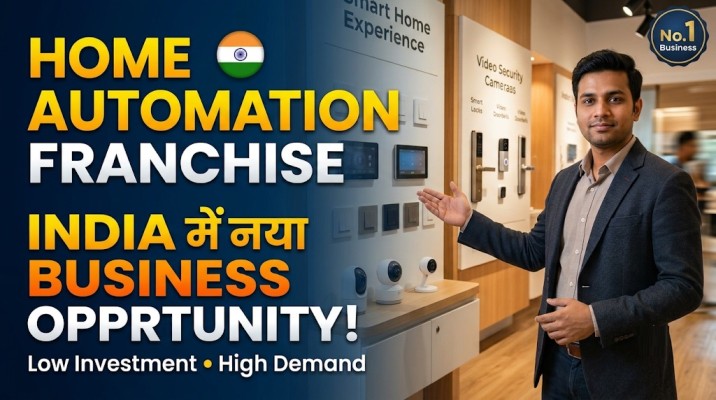
Home Automation Franchise in India: The Smart Home Business (2027 Guide)
A home automation franchise in India can be started with ₹10,000–₹50,000 for a dealer or reseller model, or ₹2–5 lakh for a franchise partner setup, or ₹20–30 lakh for a full distribution and experience centre. India’s home automation market is forecast to grow by USD 5,095 million during 2025–2030, accelerating at a CAGR of 16.4% — driven by smart lighting, security, and the mainstreaming of connected homes beyond metros .
The smart home is no longer a luxury. Tata Power is targeting 1 crore smart homes in three years, explicitly including Tier-2 and Tier-3 cities . Brands like Thasmai (₹10,000–₹50,000 entry), Dyfolabs (₹2–5 lakh), and Digilux (₹20–30 lakh) offer franchise and dealership models that fit almost any budget. This guide breaks down the real costs, margins, and brands.
One-Line Answer: What Does a Home Automation Franchise Cost?
₹10,000–₹50,000 (dealer / reseller): A low-inventory or virtual franchise model. You sell, coordinate installation, and earn a margin without a full showroom. Thasmai operates at ₹10,000–₹50,000 for operational setup, with a ₹3 lakh franchise fee and 15% royalty . Cloudblocks operates at ₹10,000–₹50,000 . Payback: under 1 year for efficient operators.
₹2–5 lakh (franchise partner): A small showroom or service office with demo units. Dyfolabs operates at ₹2–5 lakh with a ₹65,000 franchise fee and 30% royalty . Payback: under 3 months for a lean setup .
₹20–30 lakh (distribution / experience centre): A full showroom with stock investment and demo installations. Digilux operates at ₹20–30 lakh with approximately ₹25 lakh allocated for stock . Payback: 1–3 years .
Why this matters to you: The ₹10,000–₹50,000 budget is the realistic entry point for a dealer or reseller model. The ₹20–30 lakh budget opens up a full distribution setup. Choose the format before you choose the brand.
Why Home Automation Is Booming in India in 2027
India Home Automation Market: USD 5,095 Million Growth (2025–2030)
India’s home automation market is forecasted to grow by USD 5,095.0 million during 2025–2030, accelerating at a CAGR of 16.4%** during the forecast period . Another estimate places the market at USD 3.71 billion in 2025**, reaching **USD 13.58 billion by 2034 at a 15.51% CAGR . The India Home Automation market is anticipated to grow at more than 15.57% CAGR from 2026 to 2031 .
15.5–16.4% CAGR Driven by Smart Lighting and Security
Growth is being driven by smart lighting** (expected to grow at over **30% CAGR** this decade), **home security**, and **energy management** . The security segment is a major revenue driver, with smart locks, video doorbells, and CCTV cameras becoming standard in new residential projects. Energy monitoring tools are also emerging as a key demand driver .
The Shift from Luxury to Mainstream
What was once marketed as a luxury feature is gradually becoming part of mainstream residential planning, especially in metros and emerging Tier-2 cities. Tata Power’s campaign aims to make “smart living” accessible and affordable for homeowners in Tier-2 and Tier-3 cities . The smart home is no longer a metro-only product — it is becoming a standard expectation in new homes.
Why this matters to you: You are not entering a niche luxury market. You are entering a market that is shifting from early adopters to mainstream buyers — and that shift creates volume.
The Three Home Automation Franchise Models Under ₹30 Lakh
Dealer / Reseller Model (₹10,000–₹2 Lakh)
The lowest-investment entry. You operate as a dealer or reseller — selling products, coordinating installation, and earning a margin without a full showroom. Thasmai Automation** operates at **₹10,000–₹50,000** for operational setup, with a **₹3 lakh franchise fee** and **15% royalty** . Cloudblocks** operates at **₹10,000–₹50,000** . Madhura Smart Homes** operates at **₹50,000–₹2 lakh** . Rifcare Homes** operates at **₹50,000–₹2 lakh** with a **6–12 month payback** . Payback: **under 1 year** for efficient operators. Best for first-timers and part-time entrepreneurs.
Franchise Partner Model (₹2–5 Lakh)
A small showroom or service office with demo units and initial inventory. Dyfolabs** operates at **₹2–5 lakh** with a **₹65,000 franchise fee** and **30% royalty** . The investment covers a basic office or showroom setup, demo units, initial inventory, and working capital . Fox Domotics** operates at **₹2–5 lakh** . Payback: **under 3 months** for a lean setup . Best for operators who want a physical presence with a moderate investment.
Distribution / Experience Centre (₹20–30 Lakh)
A full showroom with significant stock investment, demo installations, and a sales team. Digilux** operates at **₹20–30 lakh** with approximately **₹25 lakh allocated for stock and initial setup** . Space: **400+ sq ft** with a 2–4 member team . Payback: **1–3 years**, with ROI as low as 1 year depending on area of operation and business plan . The model is distribution-led, focused on product sales, installation support, and annual maintenance contracts (AMCs) . Best for experienced operators who want a full-scale smart home business.
Comparison Table: Investment, Space, Payback
| Model | Investment | Space | Payback | Best For |
|---|---|---|---|---|
| Dealer / Reseller | ₹10,000–₹2 lakh | Minimal / virtual | Under 1 year | First-timers, part-time |
| Franchise Partner | ₹2–5 lakh | 100–500 sq ft | Under 3 months (lean) | Physical presence, moderate investment |
| Distribution / Experience Centre | ₹20–30 lakh | 400+ sq ft | 1–3 years | Full-scale smart home business |
Sources: ForeFind (2026), FranchiseIndia (2026), FranchiseMart (2026). Figures are estimates and vary by city, brand, and format.
The Real Investment: Where Your ₹10,000–₹30 Lakh Goes
Franchise Fee, Inventory, Showroom Setup, Working Capital
| Cost Component | Thasmai (₹) | Dyfolabs (₹) | Digilux (₹) |
|---|---|---|---|
| Franchise fee | ₹3,00,000 | ₹65,000 | Included |
| Inventory / stock | ₹10,000–₹50,000 (initial) | ₹1–2 lakh | ~₹25 lakh |
| Showroom / office setup | 1,200–1,500 sq ft fit-out | ₹50,000–₹1 lakh | ₹2–4 lakh |
| Working capital (2–3 months) | ₹30,000–₹75,000 | ₹50,000–₹1 lakh | ₹1–2 lakh |
| Total | ₹10,000–₹50,000 (setup) + ₹3 lakh fee | ₹2–5 lakh | ₹20–30 lakh |
Sources: ForeFind (2026), FranchiseMart (2026), FranchiseIndia (2026). Figures are estimates and vary by city and agreement.
Why this matters to you: The franchise fee is not the total investment. Inventory and working capital make up the bulk of the cost, especially in the distribution model. A ₹3 lakh franchise fee with no inventory budget is not a ₹3 lakh business — it is a ₹10–15 lakh business waiting to run out of stock.
Profit Margins and ROI: The Real Numbers
45–50% Margin on Product MRP
Home automation franchises operate on product margins. Digilux** offers approximately **45% discount on MRP** plus additional incentives on high sales volumes . SmarDen** offers **50% margin on all home automation products** and up to **50% benefit on lead sharing, installation, and support** . Thasmai** operates on a **15% royalty** model with high-margin operations due to its premium product portfolio .
1–3 Year Payback for Most Formats
Payback timelines vary widely by format. Thasmai** reports a payback of **under 1 year** for efficient operators . Dyfolabs** reports a payback of **under 3 months** for a lean setup . Digilux** reports a payback of **1–3 years**, with ROI as low as 1 year depending on area of operation and business plan . The dealer and franchise partner models have the fastest payback because of lower capex; the distribution model takes longer but generates higher absolute revenue.
Monthly Profit Scenarios Table
| Format | Monthly Revenue (Est.) | Net Margin | Monthly Net Profit (Est.) |
|---|---|---|---|
| Dealer / Reseller | ₹50,000–₹1.5 lakh | 25–40% | ₹12,500–₹60,000 |
| Franchise Partner | ₹1–2.5 lakh | 20–35% | ₹20,000–₹87,500 |
| Distribution / Experience Centre | ₹3–6 lakh | 15–25% | ₹45,000–₹1.5 lakh |
Sources: Industry estimates based on ForeFind (2026), FranchiseIndia (2026), and FranchiseMart (2026). Figures assume controlled overhead and steady project flow.
Why this matters to you: A ₹2 lakh Dyfolabs franchise at ₹1.5 lakh monthly revenue and 30% net margin can earn ₹45,000 per month. A ₹25 lakh Digilux distribution setup at ₹4 lakh revenue and 20% margin can earn ₹80,000 per month. The higher investment buys a higher income ceiling, but the lower-capex model delivers a faster percentage return.
Top Home Automation Franchise Brands in India (2027)
Thasmai Automation (₹10K–₹50K Setup + ₹3 Lakh Fee)
A premium home automation and home theater brand (founded 2011, franchising since 2017). Setup investment: ₹10,000–₹50,000**. Franchise fee: **₹3,00,000**. Royalty: **15%**. Space: **1,200–1,500 sq ft** for a showroom. Payback: **under 1 year**. Anticipated ROI: **25%**. Product portfolio includes Crabtree and Philips automation, JBL/Revel audio, and Yale/Honeywell security . Best for: operators who want a premium, high-margin brand with a manageable upfront fee.
Cloudblocks (₹10,000–₹50,000)
A home automation brand listed on Franchise India with an indicative investment of ₹10,000–₹50,000** . Best for: the absolute lowest-capital entry into the home automation category.
Madhura Smart Homes (₹50,000–₹2 Lakh)
An emerging smart home brand with an indicative investment of ₹50,000–₹2 lakh** . The brand is expanding into Gujarat, Rajasthan, and Maharashtra . Best for: first-time operators who want a low-investment dealership model.
Dyfolabs (₹2–5 Lakh)
A smart home automation and security solutions franchise (founded 2017, franchising since 2019). Investment: ₹2–5 lakh**. Franchise fee: **₹65,000**. Royalty: **30%**. Space: **100–500 sq ft**. Payback: **under 3 months**. Product portfolio includes smart lighting, video doorbells, smart locks, and automated curtains . Best for: operators who want a low-capex, fast-payback model.
AIT Smart Automation (₹5–10 Lakh)
A home automation brand (established 2012) that has evolved into an AI and IoT solutions provider. Indicative investment: ₹5–10 lakh** . The brand uses 128-bit encryption for data security and has opened franchise locations in Kota, Nashik, Lucknow, Hyderabad, Kochi, and Vadodara . Best for: operators who want a mid-range investment with a technology-focused brand.
Digilux (₹20–30 Lakh)
A home automation solutions provider (founded 2004) with a distribution-led model. Investment: ₹20–30 lakh**, with approximately **₹25 lakh allocated for stock and initial setup**. Space: **400+ sq ft** with a 2–4 member team . Payback: **1–3 years**, with ROI as low as 1 year . Offers ~45% discount on MRP, AMC revenues, and an exit option (stock buyback after 1 year) . Best for: operators who want a full-scale distribution business with a proven product line.
Brand Comparison Table
| Brand | Investment | Franchise Fee | Royalty | Payback |
|---|---|---|---|---|
| Cloudblocks | ₹10K–₹50K | Not disclosed | Not disclosed | Under 1 year |
| Madhura | ₹50K–₹2 lakh | Not disclosed | Not disclosed | Under 1 year |
| Thasmai | ₹10K–₹50K + ₹3L fee | ₹3,00,000 | 15% | Under 1 year |
| Dyfolabs | ₹2–5 lakh | ₹65,000 | 30% | Under 3 months |
| AIT Smart | ₹5–10 lakh | Not disclosed | Not disclosed | 1–2 years |
| Digilux | ₹20–30 lakh | Included | Not disclosed | 1–3 years |
Sources: ForeFind (2026), FranchiseIndia (2026), FranchiseMart (2026). Figures are estimates and vary by city and agreement.
What ₹2 Lakh Cannot Buy: The Experience Centre Reality
Digilux (₹20–30 Lakh)
Digilux requires ₹20–30 lakh** for a full distribution setup, with approximately **₹25 lakh allocated for stock**. The ₹2 lakh budget cannot cover this format. The space requirement is **400+ sq ft** with a 2–4 member team, and the model is designed for operators who can invest in inventory and a showroom .
Why the Dealer Model Is the Smarter First Step
A ₹10,000–₹50,000 dealer or reseller model lets you learn the business — product knowledge, customer acquisition, installation coordination — without committing ₹20 lakh. If the dealer model works, you can upgrade to a franchise partner or distribution setup later using accumulated profits. If it does not, the loss is manageable. Starting with a distribution centre on a ₹2 lakh budget is not possible without underfunding the business.
Why this matters to you: The ₹2 lakh budget is a learning budget. It buys a dealership, not a showroom. Treat it as your entry into the home automation business, not your final destination.
Tier-2 City Advantage: Why Indore, Jaipur, and Patna Work
Lower Rent, Lower Competition, Rising Smart Home Adoption
Tier-2 and Tier-3 cities are becoming the next growth frontier for smart homes. Tata Power is explicitly targeting 1 crore smart homes in three years**, including **Tier-2 and Tier-3 cities** . Häfele is expanding its franchise network to 95 cities, with a growing focus on Tier II and III cities . AIT World Automation has opened franchise locations in Kota, Nashik, Lucknow, Hyderabad, Kochi, and Vadodara . Madhura Smart Homes is expanding into Gujarat, Rajasthan, and Maharashtra .
A dealer or franchise partner in a Tier-2 city can generate ₹80,000–₹1.5 lakh in monthly revenue** within 6–9 months if the location has steady residential and builder demand, generating **₹20,000–₹50,000 in monthly net profit** at a 25–35% net margin. The first organised brand in a locality captures the majority of demand simply because there is nothing else competing at that level.
Why this matters to you: The same ₹2–5 lakh that barely covers a metro showroom deposit can fund a complete franchise partner setup with inventory in a Tier-2 city. Lower rent means faster break-even and higher net margin on the same revenue.
7-Point Checklist Before Choosing a Home Automation Franchise
- Does the all-in investment fit my budget, or am I stretching to the last rupee?
- Is the format a dealer, franchise partner, or distribution centre? Does it match my location and skills?
- What is the exact royalty — 15%, 30%, or a revenue share? Does it apply to gross or net revenue?
- Does the franchisor provide product training, installation support, and lead generation?
- Have I budgeted ₹30,000–₹2 lakh for working capital and 2–3 months of operating costs?
- Have I spoken to 3 existing franchisees about actual monthly revenue and net profit?
- Is the territory protected in writing, and are the products Matter-compatible for future integration?
If the answer to questions 1, 3, or 5 is unclear, do not sign yet.
Final Verdict
If your budget is ₹10,000–₹50,000: Thasmai or Cloudblocks is the realistic entry point. Lowest capital, under 1 year payback, and a dealer or reseller model. Best for first-time operators in Tier-2 cities.
If your budget is ₹2–5 lakh: Dyfolabs offers a franchise partner model with a ₹65,000 fee, 30% royalty, and under 3 months payback. Best for operators who want a physical presence with a moderate investment.
If your budget is ₹5–10 lakh: AIT Smart Automation offers a mid-range investment with a technology-focused brand. Best for operators who want a balance of brand support and investment size.
If your budget is ₹20–30 lakh: Digilux offers a full distribution setup with a 45% product margin, AMC revenues, and an exit option. Best for experienced operators who want a full-scale smart home business.
See verified home automation franchise options:
View home automation franchise list on free-franchise.com →
Or fill this 2-minute form and get 5 franchise options with full cost and margin breakdowns for your city.
Frequently Asked Questions (FAQ)
What is the best home automation franchise for a ₹2 lakh budget?
Dyfolabs starts at ₹2–5 lakh with a ₹65,000 franchise fee and a payback of under 3 months for a lean setup. Thasmai and Cloudblocks offer dealer models starting at ₹10,000–₹50,000. These are the realistic entry points for a ₹2 lakh budget.
How much does a home automation franchise cost in India?
It ranges from ₹10,000–₹50,000 for a dealer model (Thasmai, Cloudblocks) to ₹2–5 lakh for a franchise partner (Dyfolabs), ₹5–10 lakh for a mid-range brand (AIT Smart), and ₹20–30 lakh for a distribution setup (Digilux). The all-in cost includes the franchise fee, inventory, showroom setup, and working capital.
What is the profit margin in a home automation franchise?
Product margins range from 45–50% on MRP. Digilux offers ~45% discount on MRP plus volume incentives. SmarDen offers 50% margin on all home automation products. After royalty and operating costs, net margins typically run 15–40% depending on the format and sales mix.
How long does it take to break even in a home automation franchise?
Dealer and franchise partner models can break even in under 1 year. Dyfolabs reports under 3 months for a lean setup. Thasmai reports under 1 year. Digilux reports 1–3 years for its distribution model. The fastest paybacks are in the lower-capex, inventory-light formats.
Is a home automation franchise profitable in Tier-2 cities?
Yes. Tier-2 cities like Indore, Jaipur, and Patna have lower rent, lower competition, and rising smart home adoption. Tata Power is targeting 1 crore smart homes including Tier-2/3 cities, and brands like Madhura Smart Homes are expanding into Gujarat, Rajasthan, and Maharashtra. A dealer or franchise partner can break even in under 1 year.
What is the difference between a dealer and a distribution franchise?
A dealer or reseller (₹10,000–₹2 lakh) sells products and coordinates installation without a full showroom. A distribution setup (₹20–30 lakh) includes a full showroom, significant inventory, and a sales team. Dealers have lower capex and faster payback; distributors have higher revenue ceilings and require more working capital.