
Cloud Kitchen vs Takeaway Outlet: Which Model Is Cheaper in India? (2027)
November 10, 2026
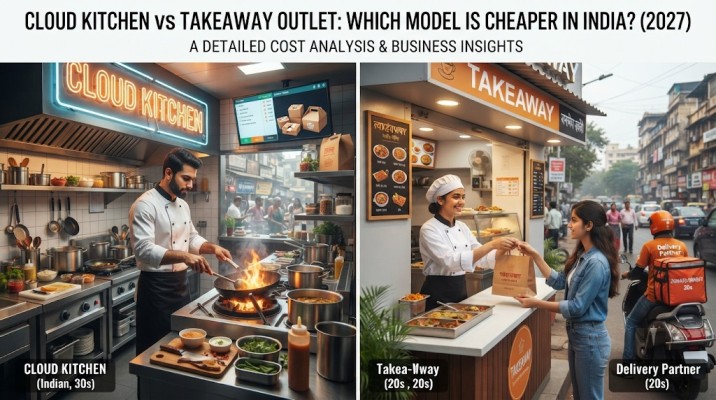
Cloud Kitchen vs Takeaway Outlet: Which Model Is Cheaper in India? (2027)
A cloud kitchen is cheaper to open — ₹5–20 lakh versus ₹5–15 lakh for a small takeaway outlet. But a takeaway outlet is often cheaper to run in the long term, because it pays rent instead of 18–30% aggregator commission on every order. The model that is “cheaper” depends on whether you are optimising for upfront capital or monthly net margin.
India’s food services industry was valued at approximately USD 85 billion in 2025 and is projected to reach USD 120–125 billion by 2030, with the organised segment growing at 12–14% CAGR[reference:0]. Cloud kitchens are the fastest-growing format, but their unit economics are heavily dependent on delivery platforms. This guide gives you the real numbers side by side.
One-Line Answer: Cheaper to Open vs Cheaper to Run
Cheaper to open: Cloud kitchen. A lean single-brand pod of 150–400 sq ft costs ₹3–10 lakh to launch, or ₹5–20 lakh for a standard setup[reference:1][reference:2]. A small takeaway outlet costs ₹5–15 lakh**, but a proper 400–900 sq ft takeaway QSR can run **₹25–50 lakh[reference:3].
Cheaper to run: Takeaway outlet — if it has footfall. A takeaway outlet pays rent (fixed) and keeps 100% of walk-in revenue**. A cloud kitchen pays **18–30% of every order to Swiggy and Zomato, plus ad spend and refunds[reference:4][reference:5].
Why this matters to you: If your budget is ₹2–10 lakh, the cloud kitchen is the only realistic entry. If you have ₹5–15 lakh and can secure a high-footfall location, the takeaway outlet may deliver better long-term margins because you are not renting your customers from an aggregator.
The Real Cost Comparison: Setup, Monthly, and Break-Even
Setup Cost: Cloud Kitchen (₹5–20 Lakh) vs Takeaway (₹5–15 Lakh)
Cloud kitchen setup: A 150–400 sq ft delivery-only pod costs ₹5–12 lakh** for a lean setup, or **₹10–20 lakh for a mid-range single-brand kitchen[reference:6][reference:7]. The breakdown includes equipment (₹2.5–5 lakh), interiors (₹1.5–2 lakh), deposit (₹1–3 lakh), licences (₹15,000–40,000), and working capital[reference:8][reference:9].
Takeaway outlet setup: A small takeaway counter (100–200 sq ft) costs ₹5–15 lakh**[reference:10]. A branded takeaway QSR model (250–400 sq ft) can be priced at ₹22–65 lakh depending on the brand[reference:11][reference:12]. The lean comparison: a ₹5 lakh cloud kitchen vs a ₹5–15 lakh takeaway counter. The cloud kitchen saves ₹0–10 lakh upfront, but the takeaway counter owns its customer relationship.
Monthly Operating Cost Comparison
| Cost Component | Cloud Kitchen (Est.) | Takeaway Outlet (Est.) |
|---|---|---|
| Rent | ₹25,000–₹70,000 | ₹20,000–₹80,000 (Tier-2); ₹60,000–₹1.2L (metro prime) |
| Staff | ₹45,000–₹1.2 lakh | ₹75,000–₹2.5 lakh (includes counter staff) |
| Aggregator commission | 18–30% of revenue | Only on delivery orders (if any) |
| Packaging | 3–5% of revenue | 3–5% of revenue |
| Ad spend (platform visibility) | 3–6% of revenue | ₹0–5% (local marketing) |
| Utilities | 2–4% of revenue | ₹20,000–₹60,000 |
| Total monthly (indicative) | ₹1.0–3.0 lakh | ₹50,000–₹4 lakh |
Sources: F&Bos (2026)[reference:13], ProKitchens (2026)[reference:14], FranchiseBazar (2026)[reference:15], industry estimates.
Why this matters to you: The cloud kitchen has lower fixed costs (rent, staff). The takeaway outlet has higher fixed costs but no commission on walk-in revenue. The monthly cost comparison is not as one-sided as it looks.
Break-Even and Payback Comparison
| Metric | Cloud Kitchen | Takeaway Outlet |
|---|---|---|
| Contribution margin | 35–38% | 54–58% (dine-in heavy) / 45–55% (takeaway) |
| Break-even revenue | ₹5.4 lakh/month (~₹18,000/day) | ₹8–10 lakh/month (~₹27,000–₹33,000/day) |
| Typical break-even time | 6–12 months | 12–18 months |
| ROI timeline | 10–15 months | 18–36 months |
| Net margin | 10–25% (well-run); 15–35% (optimistic)[reference:16][reference:17] | 12–18% (takeaway kiosk)[reference:18] |
Sources: ProKitchens (2026)[reference:19], F&Bos (2026)[reference:20][reference:21], The Bar Consultants (2026)[reference:22], industry estimates.
Why this matters to you: The cloud kitchen breaks even faster on paper (6–12 months vs 12–18 months) because of lower capex. But its long-term net margin is dragged down by aggregator commissions. The takeaway outlet takes longer to open but keeps more of every walk-in rupee.
Why Cloud Kitchens Look Cheaper on Paper
No Dining Room, No Front-of-House Staff
A cloud kitchen removes the two biggest cost centres of a traditional restaurant: the dining room and the front-of-house staff. No seating means no interior fit-out for customers, no tables, no chairs, no air-conditioned seating area. No front-of-house staff means no servers, no hosts, no cashiers (if you use kiosks). This is why a cloud kitchen can launch for ₹3–10 lakh** while a dine-in outlet needs **₹30 lakh–₹2 crore+**[reference:23].
Lower Rent in Non-Prime Locations
Cloud kitchens do not need high-street visibility. They can operate from a non-prime location, a back lane, or even a shared kitchen facility. Rent for a 200–400 sq ft cloud kitchen space is typically ₹15,000–₹55,000 per month**, compared to ₹60,000–₹1.2 lakh+ for a prime takeaway location in a metro[reference:24].
The Lower Startup Cost Claim
Industry sources consistently quote lower startup costs for cloud kitchens. A lean single-brand kitchen is widely reported to launch for roughly ₹3–10 lakh**[reference:25]. A small takeaway outlet has a similar lean range (₹5–15 lakh) but climbs steeply for branded formats[reference:26]. On paper, the cloud kitchen is the cheaper entry.
Why this matters to you: Lower capex means lower risk. If your first food business fails, a ₹5 lakh loss is recoverable. A ₹25 lakh loss is not.
The Hidden Costs of Cloud Kitchens
Aggregator Commission: 18–30% of Every Order
This is the single biggest cost that cloud kitchen operators underestimate. Swiggy and Zomato take 18–30% of every order** as commission[reference:27][reference:28]. Curefoods discloses paying **18–22% of net value** as service charge and commission[reference:29]. After GST and other charges, many kitchens lose **25–35% of each order**[reference:30].
On a ₹300 order with 25% commission, the kitchen receives ₹225. The food cost (28–32%) takes another ₹84–96. Platform commission and food cost together consume 50–60% of revenue** before rent, staff, packaging, or profit[reference:31].
Ad Spend and Refund Drag
Staying visible on delivery apps requires ad spend. Marketing costs typically run 3–6% of net revenue**[reference:32]. Refunds and cancellations add another 2–4% drag. These are not optional costs — they are the price of competing on the platforms.
Platform Dependency: 95%+ Orders from Swiggy/Zomato
Most cloud kitchens depend on Swiggy and Zomato for the vast majority of their orders. When platforms change their algorithms, commission rates, or visibility rules, the kitchen has no control. In July 2026, over 1,000 Bengaluru restaurants threatened to leave the apps over fee disputes — a signal of how much power the platforms hold[reference:33].
The ONDC Escape Route
The Open Network for Digital Commerce (ONDC) is emerging as a partial escape. ONDC commissions run 8–12%**, compared to **25–28%** on Zomato/Swiggy[reference:34]. The commission differential can improve EBITDA by **13–20 percentage points**[reference:35]. Independent operators who invested in ONDC presence report that the platform accounts for **18–22% of total orders**[reference:36]. But ONDC still requires investment in your own ordering channels and customer relationships.
Why this matters to you: The cloud kitchen’s low fixed costs are real. But the variable cost of aggregator commission can eat 25–35% of every order. If you cannot shift even 30% of your orders to ONDC or direct channels, your net margin will stay thin.
Why Takeaway Outlets Are Not as Expensive as They Look
Direct Walk-In Customers Reduce Aggregator Dependency
A takeaway outlet with footfall serves walk-in customers who pay the full menu price — no 25% commission. Every walk-in order keeps 100% of revenue after food cost. This is the structural advantage of a physical location. A takeaway kiosk with 0–2 seats and ₹1.5–2 lakh monthly revenue operates at an 8–10% rent ratio** and a **12–18% net margin**[reference:37] — comparable to or better than many cloud kitchens, without platform dependency.
Higher Contribution Margin
A takeaway outlet with a strong walk-in mix can achieve a contribution margin of 45–58%**, compared to **35–38%** for a delivery-dependent cloud kitchen. The difference is the commission saved on every direct order. Over a year, this compounds into a significantly higher net profit.
Rent Is Higher but Predictable
Yes, a takeaway outlet pays more rent than a cloud kitchen. But rent is a fixed, predictable cost. You know what you will pay every month. Commission is a variable cost that scales with revenue — the more you sell, the more you pay. For a high-volume outlet, a fixed rent is often cheaper than a percentage commission.
Why this matters to you: A takeaway outlet requires more capital upfront, but it builds an asset — a location with footfall and a direct customer base. A cloud kitchen builds a delivery brand that is rented from the platforms.
Which Model Is Actually Cheaper? The Verdict
Cheaper to Open: Cloud Kitchen
On upfront capital, the cloud kitchen wins. A lean single-brand kitchen launches for ₹3–10 lakh[reference:38]. A small takeaway outlet starts at ₹5–15 lakh[reference:39]. If your budget is under ₹10 lakh, the cloud kitchen is the only realistic option.
Cheaper to Run: Takeaway (If You Have Footfall)
On monthly net margin, the takeaway outlet wins — if it has footfall. A takeaway kiosk with ₹1.5–2 lakh monthly revenue can net 12–18%[reference:40]. A cloud kitchen with the same revenue pays 18–30% commission on every order, leaving a net margin of 10–25% in the best case, and often lower[reference:41]. The more revenue you generate, the wider the gap becomes, because commission scales while rent does not.
The Decision Framework
| Your Situation | Better Model | Why |
|---|---|---|
| Budget under ₹10 lakh | Cloud kitchen | Lower capex, faster launch |
| Budget ₹10–20 lakh, high-footfall location available | Takeaway outlet | Lower commission, higher long-term margin |
| No footfall location, delivery-first plan | Cloud kitchen | No need for prime rent |
| Want to build a direct customer base | Takeaway outlet | Walk-in customers are yours, not the platform’s |
| Testing a new menu or brand | Cloud kitchen | Lowest risk, fastest iteration |
Why this matters to you: The “cheaper” model depends on your budget, location, and long-term goal. A cloud kitchen is cheaper to start. A takeaway outlet is cheaper to run — if you have the footfall to make it work.
Tier-2 City Economics: Where the Maths Changes
Lower Rent Changes the Trade-Off
In Tier-2 cities, rent is 40–60% lower than metros. A 200–400 sq ft takeaway space in Indore or Jaipur costs ₹20,000–₹50,000 per month**, compared to ₹60,000–₹1.2 lakh+ in a metro. This changes the maths significantly. The takeaway outlet’s fixed-cost disadvantage shrinks, while its commission advantage remains. In a Tier-2 city, a takeaway outlet can break even in 12–18 months** and deliver a net margin of 12–18%**[reference:42], without the platform dependency of a cloud kitchen.
Why this matters to you: If you are in a Tier-2 city, the takeaway model is more competitive than it looks. Lower rent narrows the gap on fixed costs, while the commission saved on walk-in orders widens the gap on margins.
7-Point Checklist Before Choosing Your Model
- Does my budget cover the all-in capex, or am I stretching to the last rupee?
- Do I have access to a high-footfall location, or am I dependent on delivery?
- Have I modelled the aggregator commission at 25–30%, not 10%?
- Can I shift at least 30% of orders to ONDC or direct channels over time?
- Have I budgeted for packaging, ad spend, and refunds?
- Have I spoken to 3 existing operators about actual monthly net profit?
- Is the FSSAI licence category correct for my turnover and format?
If the answer to questions 2, 3, or 6 is unclear, do not commit yet.
Final Verdict
If your budget is ₹3–10 lakh: The cloud kitchen is the only realistic entry. Launch lean, model your unit economics on net revenue after 25–30% commission, and build an ONDC/direct-order channel from day one.
If your budget is ₹10–20 lakh and you can secure a high-footfall location: The takeaway outlet offers better long-term margins. You pay rent instead of commission, and every walk-in customer is yours.
If you are in a Tier-2 city: The takeaway model is more competitive than in metros because rent is lower. A small takeaway kiosk can break even in 12–18 months with a 12–18% net margin.
If you want the lowest-risk first business: Start with a cloud kitchen. Learn the delivery business, build a customer base, and upgrade to a takeaway outlet once you have cash flow and a proven menu.
See verified cloud kitchen and takeaway franchise options:
View franchise list on free-franchise.com →
Or fill this 2-minute form and get 5 franchise options with full cost and margin breakdowns for your city.
Frequently Asked Questions (FAQ)
Is a cloud kitchen cheaper than a takeaway outlet?
A cloud kitchen is cheaper to open (₹3–10 lakh vs ₹5–15 lakh), but a takeaway outlet can be cheaper to run because it pays rent instead of 18–30% aggregator commission on every order. The “cheaper” model depends on your budget and whether you have footfall.
How much does a cloud kitchen cost to set up in India?
A lean single-brand cloud kitchen launches for ₹3–10 lakh. A standard single-brand setup costs ₹5–20 lakh, including equipment (₹2.5–5 lakh), deposit (₹1–3 lakh), fit-out, licences, and working capital. Metro costs are at the higher end.
How much does a takeaway outlet cost to set up?
A small takeaway counter (100–200 sq ft) costs ₹5–15 lakh. A branded takeaway QSR (250–400 sq ft) can cost ₹22–65 lakh depending on the brand and location. The lean end competes directly with cloud kitchen pricing.
What is the profit margin in a cloud kitchen vs a takeaway outlet?
Well-run cloud kitchens achieve 10–25% net margins after 18–30% aggregator commission. Takeaway kiosks achieve 12–18% net margins with lower commission dependency. The takeaway model has higher margins at high revenue because rent is fixed while commission scales.
How long does it take to break even in a cloud kitchen?
Cloud kitchens typically break even in 6–12 months in high-footfall delivery zones. Takeaway outlets take 12–18 months. The cloud kitchen breaks even faster on paper because of lower capex, but its long-term margin is thinner due to commission.
Can I run a cloud kitchen without Swiggy or Zomato?
Yes, but it is difficult to scale without them. ONDC commissions run 8–12% compared to 25–28% on Swiggy/Zomato. Operators who build direct WhatsApp or website ordering channels can reduce platform dependency, but they must invest in their own marketing and customer acquisition.