

How to Reduce Staff Dependency in a Food Franchise
November 10, 2026
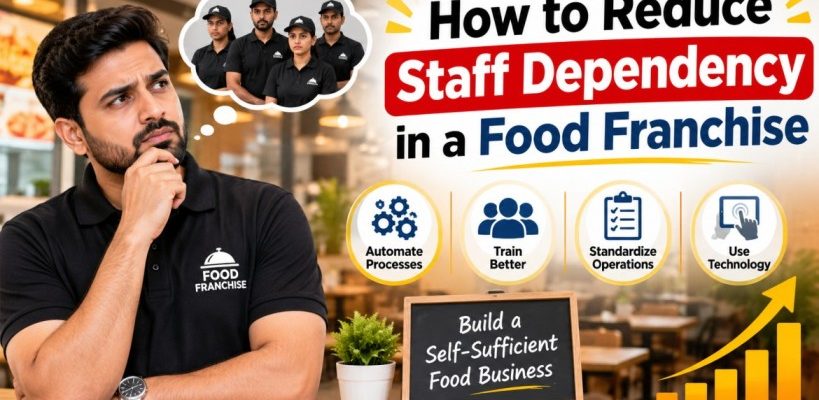
How to Reduce Staff Dependency in a Food Franchise
Food franchises in India face 60–100% annual staff attrition, and replacing one employee costs ₹25,000–₹75,000. The franchises that survive and scale are not the ones that find “better staff” — they are the ones that build systems, technology, and menus that do not depend on any single person.
Staff dependency is not an HR problem. It is an operational design problem. A franchise where the chef holds the recipes in his memory, where only one person knows how to close the cash register, and where training takes three weeks is a franchise that breaks every time someone resigns. This guide gives you seven practical systems to fix that — without increasing your investment.
One-Line Answer: The 3 Pillars of Staff Independence
Systems: Written SOPs, station checklists, and modular training that let any new hire perform to standard within days.
Technology: Self-service kiosks, automated POS, digital inventory, and AI scheduling that reduce the number of people needed at the counter, in the kitchen, and in the back office.
Menu design: Chef-less, assembly-line menus built on pre-processed ingredients and standardised recipes, so skill is replaced by process.
Why this matters to you: A franchise that depends on a single chef or a “star” counter person is not a business — it is a job with extra risk. The systems below turn it into an asset that runs without you and without any one employee.
Why Food Franchises Are So Staff-Dependent in India
Attrition Rates: 60–100% Annually
Industry data paints a stark picture. F&B attrition in India is around 60%, with a large share of QSR workers staying under three years . The National Restaurant Association of India reports monthly attrition of 10–40% in food service, with nearly 75% of QSR employees staying less than three years in a role . Curefoods reported an attrition rate of 111.7% for FY25 .
This is not a temporary problem. It is a structural feature of the industry. Your franchise must be designed for constant churn.
Replacement Cost: ₹25,000–₹75,000 Per Employee
Every exit costs real money: recruiting, onboarding, and lost productivity can run ₹25,000–₹75,000 per replacement** . For a 10-person outlet with 100% attrition, that is **₹2.5–7.5 lakh per year** in replacement costs alone — before you count the revenue lost to inconsistent service and food quality.
The Skill Trap: Recipes Locked in a Chef’s Memory
Many independent restaurants and even some franchises build their menu around a single chef’s skill. The recipes exist in his head, not in a manual. When he leaves, the food changes. When he is absent, the kitchen stalls. This is the skill trap — and it is the single biggest source of staff dependency in Indian food businesses.
Why this matters to you: The solution is not to pay the chef more. It is to remove the dependency entirely by documenting the recipes, simplifying the menu, and building a system that any trained worker can execute.
Pillar 1 — SOPs: Turn Knowledge Into Written Systems
40+ SOPs for a Mid-Sized F&B Format
A typical mid-sized F&B format needs 40 or more individual SOPs covering kitchen prep, service, hygiene, inventory reorder triggers, cleaning schedules, and staff shift patterns . Every recipe, every customer interaction script, and every process must exist as a written, numbered, followable document.
This is not bureaucracy. It is the difference between a franchise that runs on memory and one that runs on systems. When a new hire joins, you do not “hope” they learn from watching. You hand them the SOP and train them against it.
What Every SOP Must Include
- Step-by-step instructions: numbered, in simple language.
- Visual aids: photos or short videos of the correct output.
- Station checklists: what “done” looks like.
- Training sign-off: the employee demonstrates the task before being certified.
- Responsibility by role, not by name: naming an individual leaves instructions out of date as soon as staff change .
The 3-Step Training Method: Tell, Show, Do
The most effective franchise training is simple: Tell the employee what to do, Show them how to do it, and Do it with them until they can perform to standard independently. Training should never be a one-time event — it must be continuous, rooted in the franchisor’s SOPs .
Why this matters to you: A new hire trained against an SOP can be productive in days, not weeks. That is the difference between a franchise that collapses when someone resigns and one that barely notices.
Pillar 2 — Menu Engineering: Design for the Staff You Have
Modular Menus: 2–3 Mother Gravies, Multiple Dishes
Indian kitchens are moving toward modular formats** — two or three core “mother gravies” that power multiple mains, standardised marinades, pre-portioned spice blends, and clearly defined SOPs. This makes execution easier **even when new cooks join .
Instead of training a chef to make 20 different curries from scratch, you train a worker to prepare three base gravies and assemble dishes from them. The skill requirement drops. The consistency rises.
Pre-Portioned Spice Blends and Standardised Marinades
When spices are pre-portioned and marinades are pre-mixed, the kitchen no longer depends on a cook’s “feel” for flavour. A standardised sachet of spice mix and a pre-measured marinade bag produce the same taste every time, regardless of who is cooking.
This is how chains like ZORKO operate: a chef-less, SOP-driven assembly process using pre-processed ingredients, where staff can be trained in 48 hours because the format does not require culinary skill .
Chef-Less and Assembly-Line Models
Chef-less models are growing fast in India. MELTS uses a 150 sq ft kiosk format with “standardised processes and a chef-less operating approach” . The Emperor Foods markets itself as a “No-Chef & Zero-Wastage QSR” . These models work because the menu is designed around pre-processed, portioned ingredients and assembly-line execution, not around a chef’s skill.
Menu Simplification Table
| Menu Type | Skill Dependency | Training Time | Consistency Risk | Best For |
|---|---|---|---|---|
| Complex, chef-driven | High | 3–6 weeks | High (depends on who cooks) | Fine dining, destination restaurants |
| Modular, gravy-based | Medium | 1–2 weeks | Medium | Casual dine-in, family restaurants |
| Assembly-line, chef-less | Low | 2–5 days | Low (SOP-driven) | QSR, kiosks, cloud kitchens |
Sources: RestaurantIndia (Feb 2026-27), ZORKO / SharesCart (Sep 2026-27), MELTS / IndianRetailer (Sep 2026-27).
Why this matters to you: A simpler menu is not a worse menu. It is a staff-proof menu. It trains faster, executes more consistently, and breaks less often.
Pillar 3 — Technology: Automate What Humans Shouldn’t Do
Self-Service Kiosks: 40% Labour Cost Reduction
Self-ordering kiosks reduce the need for cashiers and order-taking staff. IndiaMART listings for self-service kiosks claim up to 40% reduction in manpower costs** . Kiosks are cost-effective, require fewer staff, and streamline the entire ordering experience . For a franchise with a high volume of counter orders, a kiosk can replace one full-time cashier — and it never resigns.
POS and Inventory Automation: 20–30% Overhead Reduction
SaaS platforms automate repetitive tasks like inventory reordering and employee shift scheduling . Well-implemented systems show 20–30% overhead reductions** compared to traditional setups, with food waste dropping by **upward of 30%** . Automated inventory tracking alerts franchisees to variances, curbing pilferage and enforcing accountability .
AI Scheduling: 10–12% Payroll Savings
AI-driven demand-based scheduling ensures staff levels mirror customer flow, typically reducing labour costs by 10–12%** . One case study showed labour cost as a percentage of revenue dropping from **26% to 22%** with optimised scheduling .
Technology Impact Table
| Technology | What It Replaces | Estimated Impact |
|---|---|---|
| Self-service kiosk | Cashier / order-taking staff | Up to 40% reduction in counter manpower |
| Automated POS + inventory | Manual stock-taking and reordering | 20–30% overhead reduction |
| AI scheduling | Manual shift planning | 10–12% payroll savings |
| Digital checklists (e.g., Zenput) | Paper-based hygiene and recipe checks | Consistent brand standards, fewer complaints |
Sources: IndiaMART (2026-27), FranchiseIndia (Apr 2026-27), QSR Media Asia (May 2026-27), FranchiseBazar (Apr 2026-27), RanceLab case study (2026-27).
Why this matters to you: Technology is not a luxury for large chains. A single self-service kiosk or a ₹2,000/month SaaS subscription can remove an entire category of staff dependency.
Cross-Training: The Cheapest Insurance Against Absence
How to Build a Multi-Skilled Team
Cross-training means ensuring your counter person knows basic kitchen prep, and your kitchen helper can handle the POS. When one person is absent, the outlet does not stall . This is the cheapest form of staff-dependency insurance — it costs nothing but a training plan.
The Cross-Training Matrix
Create a simple matrix: list every station (POS, prep, cooking, packing, cleaning) and every employee. Mark who is trained, who is in training, and who is not trained. Aim for at least two people trained on every critical station.
Why this matters to you: A single absent employee should never be able to shut down a station. Cross-training makes that impossible.
Retention: The Other Side of the Equation
Pay, Recognition, and Career Paths
Reducing dependency is not just about replacing people with systems. It is also about keeping the people you have. Competitive wages, recognition programs, and clear career paths reduce turnover. McDonald’s India, which faces 58% attrition** , has built structured hiring, customised training, clear career progression, and flexible shift options to improve retention . Their Guwahati restaurant became the first in North and East India with **100% of crew hired through an NGO**, supported by a six-month apprenticeship programme .
What McDonald’s India Does (And What You Can Copy)
- Structured onboarding:** uniform, logins, schedule, and a training plan ready before day one.
- Mentorship: a buddy or shift leader assigned to every new hire.
- Career progression: clear pathways from crew member to shift leader to manager.
- Flexible shifts: accommodating different life stages and responsibilities.
You do not need McDonald’s budget to copy these principles. A simple buddy system, a written career path, and predictable shift schedules cost almost nothing.
Why this matters to you: Retention and systems are not opposites. The best franchises do both — they build systems so the business survives turnover, and they build culture so turnover happens less often.
The Real Cost of Staff Dependency: A Comparison Table
High-Dependency vs. Low-Dependency Franchise Models
| Factor | High-Dependency Model | Low-Dependency Model |
|---|---|---|
| Training time | 3–6 weeks | 2–5 days |
| Replacement cost (per exit) | ₹25,000–₹75,000 | ₹10,000–₹25,000 (faster onboarding) |
| Annual attrition impact (10 staff) | ₹2.5–7.5 lakh | ₹1–2.5 lakh |
| Consistency risk | High | Low |
| Scalability | Slow (depends on finding skilled staff) | Fast (SOP-driven, train anyone) |
| Owner independence | Low (owner is the system) | High (systems run the outlet) |
Sources: Industry estimates based on Tandooriwala (Aug 2026-27), FranchiseIndia (Apr 2026-27), and RestaurantIndia (Feb 2026-27) data.
Why this matters to you: The low-dependency model does not just save money on replacement costs. It makes the franchise scalable. You cannot open outlet #2 if outlet #1 falls apart every time a staff member resigns.
7-Point Checklist Before Choosing a Low-Dependency Franchise
- Does the franchisor provide a written SOP manual covering kitchen, service, and hygiene?
- Is the menu modular or assembly-based, or does it depend on a skilled chef?
- How long does it take to train a new hire to full productivity? (Under 1 week is ideal.)
- Does the franchise support self-service kiosks or automated POS/inventory systems?
- Is there a cross-training matrix, or does each station depend on one person?
- What is the franchisor’s own staff turnover rate, and what retention systems do they have?
- Can the outlet run for a week without the owner present?
If the answer to questions 1, 2, or 7 is unclear, do not sign yet.
Final Verdict
If you are choosing a franchise: Prioritise brands with written SOPs, chef-less or modular menus, and technology support. A franchise that depends on a chef is not a franchise — it is a restaurant with a logo.
If you already run a franchise: Start with SOPs. Document every critical task. Then simplify the menu. Then add one piece of technology — a kiosk, a POS upgrade, or a scheduling tool. You do not have to do all seven at once.
If you are scaling to a second outlet: Do not open outlet #2 until outlet #1 can run for a week without you. Staff dependency is the single biggest reason multi-outlet franchisees fail.
See verified low-dependency food franchise options:
View food franchise list on free-franchise.com →
Or fill this 2-minute form and get 5 franchise options with SOP, training, and technology support details.
Frequently Asked Questions (FAQ)
Why is staff turnover so high in Indian food franchises?
F&B attrition in India is around 60%, with QSR monthly attrition at 10–40%. Entry-level roles are often seen as temporary or low-paying, and 75% of QSR employees stay less than three years. Training costs and constant churn create a cycle that is hard to break without systems.
How much does staff turnover cost a food franchise?
Replacing one employee in India costs ₹25,000–₹75,000, including recruiting, onboarding, and lost productivity. For a 10-person outlet with 100% attrition, that is ₹2.5–7.5 lakh per year in replacement costs alone.
What is a chef-less food franchise model?
A chef-less model uses pre-processed ingredients, standardised recipes, and assembly-line processes so that staff can be trained in 2–5 days instead of weeks. Brands like ZORKO and MELTS operate this way. It removes the dependency on a single skilled chef.
How do self-service kiosks reduce staff dependency?
Self-service kiosks handle ordering and payment, reducing the need for cashiers and counter staff. They can cut counter manpower by up to 40%, never resign, and improve order accuracy. A single kiosk can replace one full-time cashier.
What should an SOP manual include for a food franchise?
A good SOP manual includes step-by-step instructions for every recipe and process, visual aids, station checklists, training sign-off sheets, and responsibility assigned by role (not by name). A mid-sized format typically needs 40 or more individual SOPs.
Can a food franchise run without the owner present?
Yes, if it is designed for it. A low-dependency franchise with written SOPs, cross-trained staff, and technology support can run for a week without the owner. A high-dependency franchise where the owner is the system cannot scale beyond one outlet.