


Food Franchise Location Selection in India 2026
November 9, 2026
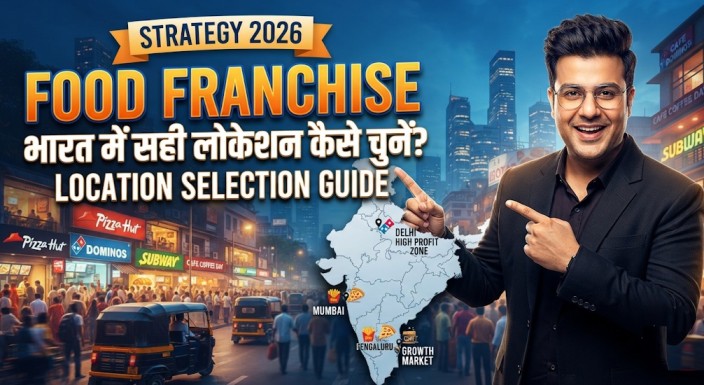
Food Franchise Location Selection in India 2026: 7 Points That Decide Your ROI
Food franchise location selection in India comes down to seven checks: real footfall count, rent-to-revenue ratio under 15%, a defined 3–5 km catchment, format-location fit, visibility and access, competition density, and a downside revenue stress test. Roughly 40% of franchise failures are caused by bad locations — not bad products, not bad brands, not bad operators.
Location drives an estimated 60–70% of a food outlet’s success, more than the menu, the brand, or the marketing combined (Tandooriwala, 2026). India’s food services industry was valued at approximately USD 85 billion in 2025 and is projected to reach USD 120–125 billion by 2030, per the Kearney-Swiggy “How India Eats 2025” report — but that growth does not protect a poorly located outlet.
Why this matters to you: You can negotiate a franchise fee. You can change a menu. You cannot fix a location after signing a three-year lease.
Why Location Is the Single Biggest ROI Decision in a Food Franchise
Location sets the ceiling on your sales before you cook a single dish. Rent, the crowd that passes by, and nearby competition are all fixed the day you sign the lease. A great menu in a weak spot struggles; an average menu in a busy, well-matched spot can still thrive.
The 40% Failure Statistic You Cannot Ignore
Around 40% of franchise failures in India are caused by bad locations, according to industry data from TBWX Press (2026). The tragic part is that most bad location decisions are driven by cheap rent. A ₹8,000 rent location with no footfall will lose more money long-term than a ₹25,000 location with strong walk-in traffic.
Separately, roughly 7 out of 10 independent restaurants in India close within their first year, according to NRAI data cited by location analyst Prajwal Soni (2026). The single biggest reason is not bad food — it is a bad location picked for the wrong reason.
What “Location” Actually Means in the Indian Context
In India, location is not just the pin code. It is the specific street, the ground-floor access, the delivery radius, the festival footfall pattern, and the rent as a percentage of realistic revenue. Two outlets 500 metres apart can have completely different payback timelines.
Why this matters to you: If you evaluate location by rent alone, you are filtering by the wrong variable. You should filter by revenue potential.
Point 1: Run the Footfall Test Before You Sign Anything
This takes one hour and costs nothing. It tells you more about a location than any broker or mall brochure.
How to Count Real Footfall (Not Guess)
Go to the location on a weekday between 5–8 PM. Stand at the exact spot where your outlet would be. Count every person who walks past the door in 30 minutes. Multiply by 2 for the hourly rate. Repeat on a Saturday between 6–9 PM.
Do not count cars. Do not count people on the opposite side of the road. Count only people who pass within a few metres of your door.
Footfall Benchmarks: What Number Is Good Enough?
| Footfall (per hour) | Verdict | What It Means |
|---|---|---|
| Under 100 | Do not take this location | Revenue will not cover rent |
| 100–200 | Marginal | Only works if rent is very low (under ₹10,000) |
| 200–400 | Good | Standard for commercial streets and small markets |
| 400+ | Excellent | Mall food courts, major commercial areas, college streets |
Source: TBWX Press location selection guide, 2026.
Why this matters to you: A road thick with fast traffic may bring almost no walk-ins. Count the people who actually pass the door, not the cars speeding by.
Point 2: Apply the 15% Rent-to-Revenue Rule (and Walk Away If It Fails)
Your monthly rent should not exceed 15% of your expected monthly revenue. Ideally, it should be 10–12%. For cloud kitchens, the ratio should be even tighter at 6–8%.
The Math That Kills Outlets
| Monthly Rent | Minimum Monthly Revenue Needed (15% Rule) | Realistic for a New Outlet? |
|---|---|---|
| ₹8,000 | ₹55,000 | Yes, for a kiosk |
| ₹15,000 | ₹1,00,000 | Yes, for a compact outlet |
| ₹25,000 | ₹1,65,000 | Yes, for a well-located QSR |
| ₹40,000 | ₹2,65,000 | Only with proven footfall |
Source: TBWX Press rent-to-revenue rule, 2026. Industry benchmarks for QSR rent range from 8–12% of revenue.
Metro vs. Tier-2 Rent Reality
Commercial leases in prime metro zones can exceed ₹1,800 per sq ft per month. Tier-2 markets can be available at roughly one-tenth of that level — ₹200–₹250 per sq ft, according to the Grant Thornton Bharat–NRAI report (2025).
A kiosk in Delhi or Mumbai might pay ₹25,000–₹50,000 in rent. The same kiosk in Lucknow or Indore might pay ₹8,000–₹15,000, according to TBWX Press Tier-2 analysis (2026).
Why this matters to you: If the rent requires revenue that seems unrealistic for the footfall in the area, the location does not work at that rent. Do not hope for “someday” footfall growth.
Point 3: Define Your Catchment Area (3–5 km for Dine-In, 10+ km for Delivery)
Your catchment is the zone your customers actually come from — usually where about 70% of them live or work. For most food outlets, people travel roughly 3–5 km for a regular meal. Delivery widens this a lot. With Zomato and Swiggy, an outlet can serve customers 10 km or more away.
What Belongs Inside Your Catchment
- Residential density and household income levels
- Office and commercial footfall
- Colleges, coaching centres, and schools
- Competing food outlets within 1 km and 3 km
- Delivery order density on Swiggy and Zomato in that pin code
Delivery Radius Changes the Game
A slightly cheaper spot with strong delivery demand can beat an expensive high-street unit. If 60% of your orders will come through aggregators, your location decision should weight delivery demand heavily — not just walk-in visibility.
Why this matters to you: A location that looks weak for walk-ins may be excellent for delivery. Define your format first, then judge the location.
Point 4: Compare High Street vs. Mall vs. Residential Market vs. Transit Hub
Every location type has a different cost structure, footfall pattern, and risk profile. The table below gives directional ranges from Indian location guides.
Format-by-Location Fit Table
| Location Type | Why It Works | Watch Out For | Ideal Rent Range |
|---|---|---|---|
| College areas | Young crowd, daily repeat visits, free social media marketing | Vacations can drop revenue 50%; plan 2–3 slow months | ₹10,000–₹20,000 |
| Mall food courts | Captive audience already in spending mood; high footfall | Highest rents; mall commissions; closed on mall holidays | ₹25,000–₹40,000 only if footfall is 400+/hour |
| Commercial high streets | Mix of walk-in and delivery; good visibility | Competition density; check Google Maps within 500m | ₹12,000–₹25,000 |
| Residential neighbourhood markets | Low rent; loyal local base; less competition | Lower footfall; heavier delivery dependence | ₹5,000–₹15,000 |
| Transit hubs | Constant flow; quick-service format works perfectly | Licensing complexity; limited space | Varies; often concession fees |
Source: TBWX Press location-type analysis, 2026.
The Trade-Offs Nobody Puts in the Brochure
Mall food courts have the highest footfall and the highest rent. Residential markets have the lowest rent and the weakest walk-in traffic. High streets sit in the middle — but competition density can kill a new entrant. There is no universally “best” location. There is only the best fit for your format, budget, and delivery strategy.
Why this matters to you: A kiosk in a college area and a dine-in outlet in a mall have completely different payback math. Match the location type to the format before you negotiate rent.
Point 5: Check Visibility, Access, and Competition Density
Ground Floor, Main Road, No Excuses
A first-floor or basement location loses 30–50% of walk-in traffic compared to a ground-floor, main-road-facing spot. Visibility is not a “nice to have” — it is a revenue line. If a customer cannot see your signage from the main road, you are paying rent for a billboard they will never read.
Competition: How Close Is Too Close?
Check Google Maps for similar food outlets within 500 metres. If there are five outlets serving the same cuisine in the same price band within that radius, your location is saturated. Being the first branded outlet in a nearby area is better than being the fifth option in a crowded one.
Why this matters to you: A ₹15,000 rent shop in a quiet lane looks like a bargain compared to a ₹40,000 high-street spot. But the cheap location with no footfall will lose more money in six months than the expensive one earns in a year.
Point 6: Negotiate the Lease Like an Operator, Not an Investor
Clauses That Cost You Money
- Lock-in period: A three-year lock-in with no exit clause traps you in a bad location. Negotiate a 6-month trial or a break clause.
- Rent escalation: 10–15% annual escalation is common. On a ₹25,000 rent, that becomes ₹33,000 by year three. Build it into your ROI model.
- CAM charges (Common Area Maintenance): In malls, CAM can add 20–30% to the base rent. Confirm the all-in cost, not just the headline rent.
- Signage rights: Confirm you can install the signage your franchise requires. Some buildings restrict facade changes.
- Exclusivity: If you are signing in a mall, ask for category exclusivity. The mall should not lease to a direct competitor in the same cuisine.
What to Ask Before Signing
Ask for the landlord’s previous tenant history. If three food outlets have failed at that address in five years, that is data — not bad luck.
Why this matters to you: The lease is a 3–5 year financial commitment. A bad clause costs more than a bad month of sales.
Point 7: Stress-Test the Location with a Downside Revenue Scenario
If Revenue Is 50% of Projection, Does the Rent Still Work?
Take your conservative revenue estimate and cut it in half. Can the outlet survive 12–24 months at that revenue level with your working capital? If the answer is no, the location is too expensive for your risk profile.
Franchise projections are sales documents. They typically assume strong footfall from day one and ignore local competition intensity. A realistic first-year ramp-up for a new outlet in a new market is 60–75% of the franchisor’s projection by month 12.
Why this matters to you: The downside case is not pessimistic. It is the scenario you need to survive before the base case becomes possible.
Food Franchise Location Due Diligence Checklist
Use this checklist before signing any lease. If any item fails, walk away or renegotiate.
- ☐ Footfall count: 200+ per hour on a weekday evening and weekend. Under 100 means walk away.
- ☐ Rent-to-revenue ratio: Under 15% of realistic monthly revenue; ideally 10–12%.
- ☐ Catchment definition: 3–5 km dine-in radius mapped; delivery density checked on Swiggy/Zomato.
- ☐ Ground-floor visibility: Signage visible from the main road. No first-floor or basement compromise.
- ☐ Competition density: Fewer than 3 direct competitors within 500 metres.
- ☐ Lease clauses: Exit clause, rent escalation cap, CAM disclosure, signage rights, category exclusivity.
- ☐ Downside test: Outlet survives 12–24 months at 50% of projected revenue.
- ☐ Landlord history: No pattern of failed food tenants at the address.
Why this matters to you: A single unchecked item on this list can wipe out 12–18 months of profit.
The Bottom Line: Location Is a Numbers Decision, Not a Gut Feeling
Food franchise location selection in India rewards operators who count footfall, calculate rent as a percentage of realistic revenue, define their catchment, and stress-test the downside case. Tier-2 cities like Indore, Jaipur, and Lucknow offer rent advantages that can improve payback by 4–6 months compared to metros. But the same rules apply everywhere: rent under 15% of revenue, footfall above 200 per hour, ground-floor visibility, and a lease you can exit if the numbers do not work.
Next step: Compare verified food franchise listings with transparent location requirements and investment data on free-franchise.com.
→ View Food Franchise Listings or Fill the Form for a Callback.
Frequently Asked Questions
1. What is the ideal rent-to-revenue ratio for a food franchise in India?
Your monthly rent should stay under 15% of expected monthly revenue, and ideally between 10–12%. For cloud kitchens, the ratio should be tighter at 6–8%. If rent exceeds 15%, profitability drops sharply and payback timelines stretch beyond 36 months.
2. How do I test footfall before signing a food franchise lease?
Stand at the exact location on a weekday between 5–8 PM and count every person who walks past the door in 30 minutes. Multiply by 2 for the hourly rate. Repeat on a Saturday evening. Under 100 per hour is a no-go. 200–400 per hour is good for a commercial street.
3. Is a high-street location better than a mall for a food franchise?
High streets offer lower rent and a mix of walk-in and delivery demand. Malls offer higher footfall but charge the highest rents (₹25,000–₹50,000+) plus commissions. Choose based on your format: kiosks and QSRs often work better on high streets, while premium brands benefit from mall visibility.
4. Why do Tier-2 cities offer better food franchise ROI than metros?
Commercial leases in Tier-2 cities run ₹200–₹250 per sq ft versus ₹1,800–₹2,200 in prime metro zones, according to Grant Thornton Bharat–NRAI data. Staff salaries are 30–45% lower. Average order values are only 15–25% lower, so the net margin is often better in Tier-2 cities.
5. How close is too close to a competitor when choosing a food franchise location?
If there are three or more direct competitors in the same cuisine and price band within 500 metres, the location is saturated. Being the first branded outlet in a nearby underserved area is usually better than being the fifth option in a crowded market.
6. What lease clauses should I negotiate before signing a food franchise location?
Negotiate an exit clause or break option, a cap on annual rent escalation, full disclosure of CAM charges, signage rights, and category exclusivity in malls. Also ask for the landlord’s tenant history — if multiple food outlets have failed at the address, treat that as a warning.