Franchise vs. Franchise-Free Cloud Kitchen in India 2026
November 9, 2026
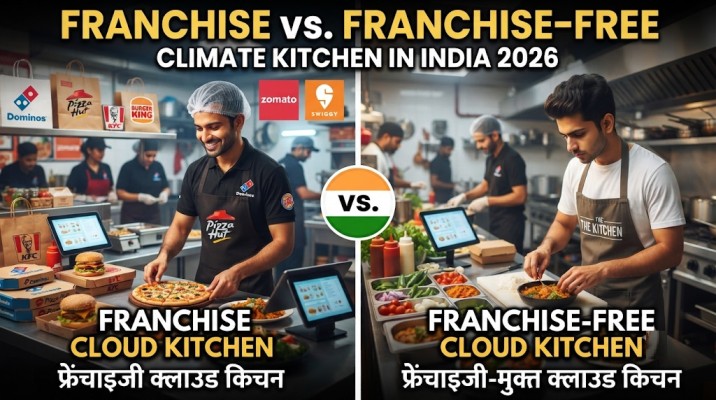
Franchise vs. Franchise-Free Cloud Kitchen in India 2026: Which One Actually Makes You Money?
A franchise cloud kitchen in India typically requires ₹15–₹50 lakh in total investment with 8–15% net margins after royalty and aggregator commissions. A franchise-free (independent) cloud kitchen starts at ₹3–₹8 lakh with 15–22% net margins because you keep full control of pricing and sourcing — but you build brand demand from zero.
The choice is not about which model is “better.” It is about which model matches your budget, your risk tolerance, and your city tier. India’s cloud kitchen market was valued at USD 9,725.5 million in 2025 and is projected to reach USD 28,566.9 million by 2033, growing at 14.7% CAGR.
Why this matters to you: If you have ₹2–₹25 lakh and are deciding between a franchise outlet and a delivery-only cloud kitchen, the wrong format choice will drain your returns even if your food is good.
Franchise vs. Cloud Kitchen: The Core Difference in One Paragraph
A franchise gives you a recognised brand, a proven menu, and a supply chain. You pay for that trust through franchise fees, royalties (typically 4–8% of sales), and reduced menu freedom. A franchise-free cloud kitchen gives you full control and full margin, but you are responsible for building demand, managing aggregator relationships, and surviving the first 6–12 months without brand pull.
Why this matters to you: A franchise reduces your trial-and-error risk. An independent kitchen maximises your upside if you execute well. Neither is automatically better.
Cloud Kitchen Market in India 2026: Why This Decision Matters Now
India’s food services industry was valued at approximately USD 85 billion in 2025 and is projected to reach USD 120–125 billion by 2030, according to the Kearney-Swiggy “How India Eats 2025” report. The organised segment is growing at 12–14% CAGR.
The cloud kitchen segment is growing even faster. Independent cloud kitchens were the largest revenue-generating type in 2025, while commissary/shared kitchens are the fastest-growing segment. This is the market you are entering.
Market Size and Growth Projections
| Metric | 2025 Value | 2033 Projection | CAGR | Source |
|---|---|---|---|---|
| India cloud kitchen market | USD 9,725.5 million | USD 28,566.9 million | 14.7% (2026–2033) | Grand View Research, 2026 |
| India food services industry | ~USD 85 billion | USD 120–125 billion by 2030 | 12–14% (organised segment) | Kearney-Swiggy, 2025 |
| India online food delivery | — | ₹2 lakh crore by 2027 | — | Yummy Cloud, 2026 |
Why this matters to you: You are entering a growing market. But growth at the market level does not guarantee profit at the unit level. Format and execution decide that.
Investment Comparison: Franchise vs. Franchise-Free Cloud Kitchen
The capital gap between the two models is wider than most first-time investors expect. A franchise cloud kitchen carries a brand premium; an independent kitchen carries no brand fee but higher customer-acquisition cost.
Table 1: Investment Breakdown (₹ Lakh)
| Cost Component | Franchise Cloud Kitchen | Franchise-Free Cloud Kitchen | Notes |
|---|---|---|---|
| Franchise fee | ₹3–₹10L | ₹0 | One-time, non-refundable |
| Kitchen setup (equipment, fit-out) | ₹5–₹15L | ₹3–₹6L | Franchise specs often require higher-grade equipment |
| Security deposit (rent) | ₹1–₹3L | ₹0.6–₹2L | 300–600 sq ft, Tier-2 city |
| Licences (FSSAI, GST, trade) | ₹0.15–₹0.5L | ₹0.1–₹0.25L | Same compliance, similar cost |
| Initial inventory + packaging | ₹1–₹3L | ₹0.6–₹1.5L | Franchise supply chains may be costlier |
| Working capital (2–3 months) | ₹2–₹5L | ₹1–₹2L | Higher for franchise due to royalty load |
| Total investment (estimated) | ₹15–₹50L | ₹3–₹8L | Franchise range varies by brand and city |
Sources: FranchiseBazar (2026), Cloud Kitchen Adda (2026), Yummy Cloud (2026). Figures are directional and vary by city, brand, and outlet format.
Table 2: Top Cloud Kitchen Franchise Brands and Their Investment Bands (2026)
| Brand | Investment Range | Model | Best For |
|---|---|---|---|
| Rebel Foods (Faasos, Behrouz Biryani) | ₹30–₹50L | Multi-brand | Metro and Tier-1 |
| Curefoods (EatFit) | ₹20–₹35L | Multi-brand | Urban health hubs |
| Biryani By Kilo | ₹25–₹40L | FOFO | Strong biryani demand cities |
| What A Sandwich | ₹10–₹15L | Single-brand | College towns |
| SaladO | ₹8–₹12L | Single-brand | Fitness centres, malls |
| Prasuma | ₹5–₹10L | Single-brand | Tier-2 cities |
| Mr Shawarma | ₹5–₹10L | Cloud/Takeaway | High-street markets |
| Single-brand franchise (generic) | ₹3–₹5L | Single-brand | First-time entrepreneurs |
| Multi-brand franchise (generic) | ₹8–₹15L | Multi-brand | Maximising kitchen capacity |
Sources: FranchiseBazar (2026), Yummy Cloud (2026). Investment ranges are indicative and vary by location and agreement terms.
Why this matters to you: A franchise cloud kitchen can cost 3–5× more upfront than an independent kitchen. That extra capital buys you brand pull — but only if the brand actually has pull in your city.
ROI and Payback: Which Model Returns Money Faster?
Franchise-free cloud kitchens often have a shorter payback period on paper because the initial investment is smaller. But they also take longer to build order volume because there is no brand recognition. Franchises ramp up faster but carry ongoing royalty and supply markups that reduce net margin.
Table 3: ROI Comparison — Franchise vs. Independent Cloud Kitchen
| Metric | Franchise Cloud Kitchen | Franchise-Free Cloud Kitchen |
|---|---|---|
| Initial investment | ₹15–₹50L | ₹3–₹8L |
| Time to first order | 6–10 weeks (setup + training) | 3–6 weeks |
| Time to stable order volume | 2–4 months (brand pull) | 3–6 months (build from zero) |
| Net profit margin (after all costs) | 8–15% (royalty + aggregator fees) | 15–22% (Tier-2), 10–15% (metro) |
| Payback period (estimated) | 18–30 months | 12–24 months |
| Royalty / ongoing brand cost | 4–8% of sales | ₹0 |
| Aggregator commission | 18–28% of order value | 18–28% of order value |
| Menu flexibility | Low | Full control |
Sources: FranchiseBazar (2026), Cloud Kitchen Adda (2026), Yummy Cloud (2026), industry estimates. Payback periods assume stable operations and exclude one-time shocks.
Why Franchise-Free Kitchens Often Have Better Margins in Tier-2 Cities
A 600 sq ft kitchen space that costs ₹60,000–₹90,000 per month in Bengaluru or Mumbai runs ₹18,000–₹32,000 in Indore, Bhopal, Nagpur, or Vijayawada. Chef and helper salaries are 30–45% lower. Meanwhile the average order value on delivery apps is only about 15–25% lower. That gap turns a 10% metro margin into an 18–22% Tier-2 margin.
An operator in Indore running three brands from a 900 sq ft kitchen reported 19% EBITDA in FY25 — a number that would be exceptional anywhere in the country.
Why this matters to you: If you are in a Tier-2 city, the independent model may give you both lower entry cost and better unit economics. Franchise brands often price their royalties for metro volumes, which can crush margins in smaller markets.
Franchise vs. Franchise-Free: Side-by-Side Comparison
| Factor | Franchise Cloud Kitchen | Franchise-Free Cloud Kitchen |
|---|---|---|
| Brand recognition | Immediate | Zero (build from scratch) |
| Initial capital required | ₹15–₹50L | ₹3–₹8L |
| Royalty / ongoing fees | 4–8% of sales | ₹0 |
| Menu control | Limited | Full |
| Supply chain | Centralised (markup 10–25%) | Local sourcing (your negotiation) |
| Marketing support | Brand-level campaigns | Self-funded |
| Risk of brand failure | Shared with franchisor | Entirely yours |
| Exit / transfer | Often restricted | Full flexibility |
| Best for | First-time investors with ₹15L+ who want brand pull | Operators with ₹3–₹10L who want margin control |
Why this matters to you: The franchise model sells certainty. The independent model sells control. Pick the one that matches your skill set, not the one that sounds safer.
5 Factors That Decide Which Model Wins for You
- Your budget: Under ₹10 lakh, a franchise-free kitchen is the only realistic option. Above ₹20 lakh, a franchise becomes viable — but not automatically better.
- Your city tier: In Tier-2 cities like Indore, Jaipur, or Patna, independent kitchens often outperform on margin because rents are low and direct ordering works better. In metros, brand pull matters more.
- Your operational experience: If you have never run a kitchen, a franchise’s playbook reduces your failure risk. If you have F&B experience, you may find franchise restrictions costly.
- Your tolerance for aggregator dependence: Both models depend on Swiggy and Zomato for orders. But a franchise may have better aggregator relationships and priority listing. An independent kitchen must build direct ordering (WhatsApp, own website) to escape the 18–28% commission.
- Your exit plan: Franchise agreements often restrict transfer and renewal. Independent kitchens are easier to sell or repurpose.
Why this matters to you: The right model is the one you can operate profitably for 24 months without running out of cash.
Due Diligence Checklist Before You Choose
Whether you go franchise or independent, verify these before signing anything or signing a lease.
- ☐ Aggregator commission structure: Confirm the exact commission (18–28%) and any additional listing or promotion fees on Swiggy and Zomato.
- ☐ Franchise supply markup (if franchise): Ask for a landed-cost comparison of key ingredients against local suppliers. A 10–25% markup kills margin.
- ☐ Territory protection (if franchise): Is your delivery radius protected? Can the franchisor open another outlet or sub-brand nearby?
- ☐ Renewal and exit terms (if franchise): What is the renewal fee? Can you sell the kitchen? Is there a buyback clause?
- ☐ Rent-to-revenue ratio: Target under 10% for delivery-only. Above 15%, your margin is at risk.
- ☐ Licences: FSSAI, GST, municipal trade licence, and fire clearance (where applicable).
- ☐ Direct ordering plan: How will you build WhatsApp or website orders to reduce aggregator dependence?
Why this matters to you: The biggest cost in a cloud kitchen is not rent or food. It is the commission you pay every time an order comes through an app. Plan for it from day one.
Final Verdict: Franchise or Franchise-Free Cloud Kitchen?
If you have ₹3–₹10 lakh and are willing to build demand from scratch, a franchise-free cloud kitchen offers better margins and full control — especially in Tier-2 cities. If you have ₹15 lakh+ and want brand pull to shorten your ramp-up period, a franchise cloud kitchen reduces trial-and-error risk, but you must negotiate the royalty and supply markup hard.
Neither model is passive. Both require daily operational involvement, tight food-cost control (target 28–33% of revenue), and a direct-ordering strategy to escape aggregator commissions.
Next step: Compare verified cloud kitchen franchise listings and independent kitchen opportunities on free-franchise.com.
→ View Cloud Kitchen Franchise Listings or Fill the Form for a Callback.
Frequently Asked Questions
1. Is a franchise cloud kitchen more profitable than an independent cloud kitchen?
Not necessarily. Franchise kitchens have faster brand-led ramp-up but lower net margins (8–15%) due to royalties and supply markups. Independent kitchens retain higher margins (15–22% in Tier-2 cities) but take longer to build order volume. Profitability depends on location, execution, and aggregator dependence.
2. How much investment is needed for a franchise-free cloud kitchen in India?
A basic single-brand independent cloud kitchen can start at ₹3–₹8 lakh, covering kitchen equipment, deposit, licences, initial inventory, and 2–3 months of working capital. A multi-brand setup from one kitchen may cost ₹8–₹15 lakh. Tier-2 cities are 20–30% cheaper than metros on rent.
3. Which cloud kitchen franchise brands are best in India 2026?
Rebel Foods (₹30–50L), Curefoods (₹20–35L), Biryani By Kilo (₹25–40L), and What A Sandwich (₹10–15L) are among the most recognised. For budget entry, Prasuma and Mr Shawarma start at ₹5–10 lakh. The best brand depends on your city’s cuisine demand and your budget.
4. Can I run a cloud kitchen without a franchise in a Tier-2 city?
Yes. Tier-2 cities like Indore, Bhopal, and Jaipur are actually better suited to independent kitchens because rents are 50–70% lower than metros, direct WhatsApp ordering works better, and branded competition is thinner. An Indore operator running three brands from one kitchen reported 19% EBITDA in FY25.
5. What is the payback period for a cloud kitchen franchise vs. an independent kitchen?
Franchise cloud kitchens typically pay back in 18–30 months due to higher upfront investment and royalty load. Independent kitchens often pay back in 12–24 months because the initial capital is smaller, even though volume ramp-up is slower. Tier-2 independent kitchens can reach operational break-even in 30–60 days with a strong launch.
6. What are the biggest hidden costs in a cloud kitchen business?
Aggregator commissions (18–28% of order value) are the largest hidden cost, followed by franchise supply markups (10–25%) and packaging. Many operators underestimate the cost of customer acquisition through app promotions. Building direct WhatsApp ordering is the single biggest margin lever.