
Mithai Franchise in India 2026: Cost, ROI, and the Organised Play in a Traditional Market
November 9, 2026
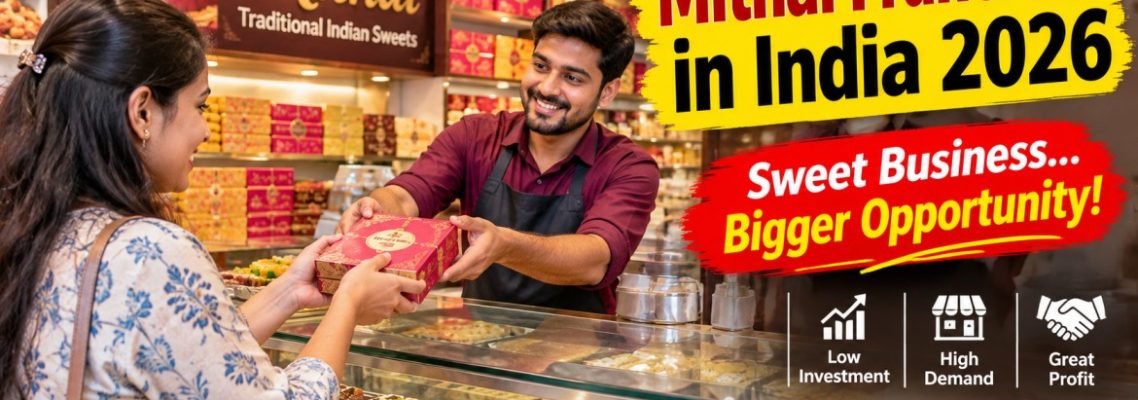
Mithai Franchise in India 2026: Cost, ROI, and the Organised Play in a Traditional Market
A mithai franchise in India typically requires ₹12–₹25 lakh for a kiosk or compact outlet, with payback periods ranging from 14 to 36 months depending on brand, location, and festival-season execution. The organised branded sweets market is valued at ₹8,431 crore in 2025 and is projected to reach ₹30,505 crore by 2034, growing at 15.36% CAGR.
That number matters because the broader mithai market — including unorganised halwais — is worth ₹53,300 crore (roughly USD 6.4 billion). The gap between the organised and unorganised segments is exactly where the franchise opportunity sits.
Why this matters to you: If you are a new business starter with ₹2–₹25 lakh, the mithai category offers something rare — non-discretionary, culturally embedded demand that does not disappear in a slow economy.
Why the Mithai Franchise Model Is Gaining Ground in India
Mithai is not a seasonal indulgence. It marks births, weddings, exam results, festivals, and business deals. That cultural permanence makes the category resistant to the kind of demand collapse that hits discretionary food businesses.
The organised play is simple: a franchise brings brand trust, standardised supply, and a proven outlet format to a category that has historically been dominated by family-run halwai shops with inconsistent quality and no scale.
Why this matters to you: You are not betting on a fad. You are formalising a demand that already exists in your city.
The Market Opportunity in Numbers
India’s organised sweets market is growing at a double-digit pace, while the unorganised segment remains large but fragmented. This creates room for branded mithai outlets in Tier-2 and Tier-3 cities where branded supply is still limited.
Source: Industry estimates and franchise sector reports, 2024–2026.
What “Organised Play” Actually Means for a New Investor
Organised play means you follow a standard outlet format, centralised supply, brand-led marketing, and a defined royalty structure. You trade some margin for faster brand acceptance and a proven operating system.
Why this matters to you: A franchise reduces your trial-and-error risk, but it does not remove operational responsibility.
Mithai Franchise Cost in India: What ₹2 Lakh–₹25 Lakh Really Buys
Not all mithai franchises sit in the same investment band. A compact kiosk from a national brand can start at ₹18–₹25 lakh, while regional and mid-budget brands offer entry points closer to ₹5–₹12 lakh. The table below compares verified 2026 investment ranges from primary franchise sources.
Investment Comparison Table: Haldiram’s vs Bikanervala vs Regional Brands
| Brand | Franchise Fee | Royalty | Total Investment | Space Required | Best For |
|---|---|---|---|---|---|
| Haldiram’s Mithai | ₹8–12L | 5% | ₹18–25L | 250–350 sq ft | Investors with ₹20L+ budget; metro and Tier-1 |
| Bikanervala Sweets | ₹6–10L | 4% | ₹15–22L | 200–300 sq ft | Brand-conscious investors; festival gifting demand |
| Ghasitaram Gifts | ₹4–6L | 3% | ₹12–18L | 180–250 sq ft | Mid-budget; Mumbai and western India |
| Mithaas Sweets | ₹5–8L | 3.5% | ₹13–19L | 200–280 sq ft | Tier-2 cities with strong family footfall |
| Anand Sweets | ₹3–5L | 2% | ₹10–15L | 150–200 sq ft | Budget-conscious first-time franchisees |
| Punjabi Ghasitaram Halwai | Not disclosed | Not disclosed | ₹5–10L | Flexible | ₹5–₹10L budget; residential catchments |
Sources: F&Bos franchise comparison, 2026; Punjabi Ghasitaram Halwai listing. Figures are directional and vary by city tier and outlet format.
The Hidden Costs Nobody Puts in the Brochure
Franchise brochures quote “total investment,” but the real cost structure has three layers. The franchise fee (₹3–₹12L) is a sunk cost. Capex (₹5–₹10L) is your asset. Ongoing deductions quietly reduce your net margin every month.
- Royalty: 2–5% of monthly revenue.
- Ad fund: 1–2% of monthly revenue.
- Supply markup: 10–25% on centrally sourced mithai and dry fruits.
Why this matters to you: A franchise that looks ₹3 lakh cheaper on the fee line can cost you more over three years if the supply markup is higher.
ROI and Payback: Realistic Numbers for a Mithai Franchise
A well-run mithai franchise in India can achieve 15–25% net profit margins in normal months, with festival months pushing margins higher. But the gap between a franchise brochure and a real P&L is wide. The table below uses verified payback ranges from franchise and industry sources.
Three ROI Scenarios: Base, Conservative, and Downside
| Scenario | Monthly Revenue | Monthly Net Profit | Payback Period | What It Means |
|---|---|---|---|---|
| Base case (franchise projection) | ₹3.5–4.5L | ₹80,000–₹1,10,000 | 14–20 months | You hit 60%+ of franchise-average revenue in year one |
| Conservative (70% of projection) | ₹2.5–3L | ₹45,000–₹60,000 | 28–36 months | Realistic for a new market entrant |
| Downside (50% of projection) | ₹1.8–2.2L | ₹15,000–₹25,000 | 60+ months | Location underperforms; exit likely within 24 months |
Source: F&Bos worked P&L model for sweet shop franchises, 2026.
Independent sweet shops break even at 12–24 months with a well-chosen location, but they carry full brand risk and retain 100% of gross margin. Franchises trade some margin for faster brand-led ramp-up — but only if the location and festival execution are right.
Why Franchise Projections Are Often 30–40% Optimistic
Franchise projections usually assume strong footfall from day one and ignore local competition intensity. In reality, first-outlet ramp-up in a new market typically hits 60–75% of projections by month 12.
Why this matters to you: Plan for the conservative case. That is the number your cash flow should survive.
Best Mithai Franchise Brands in India 2026 (And Who They Suit)
The “best” brand is not the biggest brand. It is the one whose fee, royalty, and supply markup leave you with enough margin to survive the first 18 months.
National Heavyweights: Haldiram’s and Bikanervala
Haldiram’s and Bikanervala are the two most recognised names. Haldiram’s kiosk formats break even in 12–18 months, while casual dining formats take 30–36 months. Bikanervala operates roughly 100 outlets with a 45–55% gross margin profile and a 70+ year brand legacy that drives festival-season basket sizes well above standard QSR averages.
Why this matters to you: National brands bring trust, but they also bring higher fees and stricter operating controls.
Regional and Mid-Budget Options for Tier-2 Cities
Punjabi Ghasitaram Halwai (₹5–10L), Mithaas Sweets (₹13–19L), and Anand Sweets (₹10–15L) sit in the budget band that matches the ₹2–₹25 lakh target audience. These brands may not have national recall, but they offer lower entry barriers and stronger local supply chains.
Tier-2 and Tier-3 Cities: The Real Growth Engine for Mithai Franchises
The next wave of mithai expansion is coming from Tier-2 and Tier-3 towns, where consumers are shifting from loose, unbranded sweets to packaged and branded options. India’s confectionery market is projected to reach ₹597 billion by 2033, with a significant share of that growth driven by these cities.
Why Indore, Patna, and Jaipur Are Different from Mumbai
Daily revenue for a small sweet shop in a Tier-2 or Tier-3 city typically ranges from ₹8,000 to ₹25,000, with 30–40% of annual revenue concentrated in the Diwali season alone. Cities like Indore, Patna, and Jaipur offer lower rent and fit-out costs than Mumbai or Delhi, which directly improves payback math.
Why this matters to you: A ₹15 lakh franchise in Indore can generate the same payback timeline as a ₹25 lakh outlet in Mumbai — with less capital at risk.
Daily Revenue Benchmarks You Can Plan Around
Use a conservative daily sales assumption of ₹10,000–₹15,000 for a compact Tier-2 outlet in the first six months. Build your rent, staff, and royalty costs around that number, not around the franchise brochure’s best-case projection.
Franchise vs Independent Sweet Shop: A Side-by-Side Comparison
This comparison helps you decide whether the franchise premium is worth it for your budget and experience level.
| Factor | Independent Shop | Franchise Outlet |
|---|---|---|
| Initial capital | ₹7.5–11L | ₹12–20L |
| Time to profitability | 12–18 months (brand unknown) | 9–14 months (brand leverage) |
| Gross margin retained | 100% | 75–90% (supply markup 10–25%) |
| Monthly ongoing costs | None beyond COGS/rent/staff | ₹15,000–₹40,000 (royalty + ad fund + supply premium) |
| Exit value (Year 3) | ₹6–8L (business + equipment) | ₹3–5L (often non-transferable) |
| Brand risk | Entirely yours | Shared with franchisor |
Source: F&Bos franchise vs independent comparison, 2026.
When the Franchise Premium Is Worth It
The franchise model works if the brand’s supply premium is ≤10% and if your location and operations team can hit 60%+ of franchise-average revenue within 12 months.
When an Independent Halwai Setup Wins
If you already have deep local mithai knowledge and a trusted halwai network, an independent shop may retain more margin. You keep full control of sourcing, pricing, and customer relationships.
Why this matters to you: If you are new to the category, the franchise premium buys you a faster learning curve. If you are an operator, independence may pay better.
Due Diligence Checklist Before You Sign a Mithai Franchise Agreement
India has no franchise disclosure law. The burden of due diligence sits entirely with you. Use this checklist before signing anything.
- ☐ Territory radius: Is the exclusive radius specified in kilometres (typically 1–3 km)? Can the franchisor open a second outlet or a sub-brand in your area?
- ☐ Renewal terms: Is renewal automatic if you meet performance targets? What is the renewal fee (typically 1–2% of investment)? Can they refuse renewal without cause?
- ☐ Transfer rights: Can you sell the outlet? Is there a buyback clause? What is the exit value?
- ☐ Personal guarantee: Is your liability limited to the franchise fee, or does it extend to royalty defaults and litigation?
- ☐ Supply markup: What is the actual premium on centrally sourced mithai, dry fruits, and packaging? Ask for a landed-cost comparison against local suppliers.
- ☐ Festival-season support: Does the franchisor provide advance booking systems, corporate gifting leads, and temporary staffing support for Diwali and Raksha Bandhan?
- ☐ Raw material volatility: Who absorbs the cost shock when ghee, sugar, or dry fruit prices spike?
Why this matters to you: A franchise agreement is a 5–10 year commercial marriage. The clauses you ignore today become the disputes you fight in year three.
The Bottom Line: Is a Mithai Franchise Right for You in 2026?
A mithai franchise is not a passive investment. It rewards operators who understand festival cycles, manage raw material costs tightly, and choose locations based on catchment quality — not rent alone. The organised sweets market is growing at 15.36% CAGR, and Tier-2 cities are the next frontier. But franchise projections overstate reality by 30–40%. Plan for the conservative case, negotiate the supply markup, and go in with your eyes open.
Next step: Compare verified mithai franchise listings with transparent fee and investment data on free-franchise.com.
→ View Mithai Franchise Listings
Frequently Asked Questions
Is a mithai franchise profitable in India?
A well-run mithai franchise can achieve 15–25% net profit margins, with payback periods of 14–36 months depending on brand and location. Festival months, especially Diwali, contribute 30–40% of annual revenue. Profitability depends heavily on location quality and raw material cost control.
How much investment is required for a sweets franchise in India?
Compact kiosk formats start at ₹12–₹20 lakh, while full-service formats can exceed ₹50 lakh. Mid-budget regional brands like Punjabi Ghasitaram Halwai and Anand Sweets offer entry points at ₹5–₹15 lakh. The total investment includes franchise fee, capex, and initial inventory.
Which is the best mithai franchise brand in India?
Haldiram’s and Bikanervala are the most recognised national brands, with kiosk formats breaking even in 12–18 months and ₹15–22 lakh investment ranges respectively. Regional brands offer lower entry costs but less brand pull. The best brand depends on your budget, city tier, and operational involvement.
Can I open a sweet shop franchise in a Tier-2 city like Indore or Patna?
Yes. Tier-2 and Tier-3 cities are the fastest-growing markets for branded sweets, driven by rising disposable incomes and a shift from loose to packaged mithai. Lower rent and fit-out costs improve payback math. Daily revenue for small shops in these cities ranges from ₹8,000 to ₹25,000.
What is the ROI of a Bikanervala franchise?
Bikanervala franchisees typically invest ₹15–₹22 lakh for a compact sweets outlet, with a 4% royalty and gross margins of 45–55%. Payback depends on location, but well-run outlets in Tier-2 cities can recover investment in 24–36 months. Franchise projections should be stress-tested against conservative revenue assumptions.
What are the biggest challenges in running a mithai franchise?
Raw material price volatility (ghee, sugar, dry fruits), festival-season execution pressure, and high franchise supply markups are the three biggest challenges. India also lacks a franchise disclosure law, so due diligence on territory rights and exit clauses is entirely the investor’s responsibility.