

Pharmacy Franchise in India 2026: Chemist Shop vs Medical Store Franchise
November 3, 2026
Pharmacy Franchise in India 2026: Chemist Shop vs Medical Store Franchise
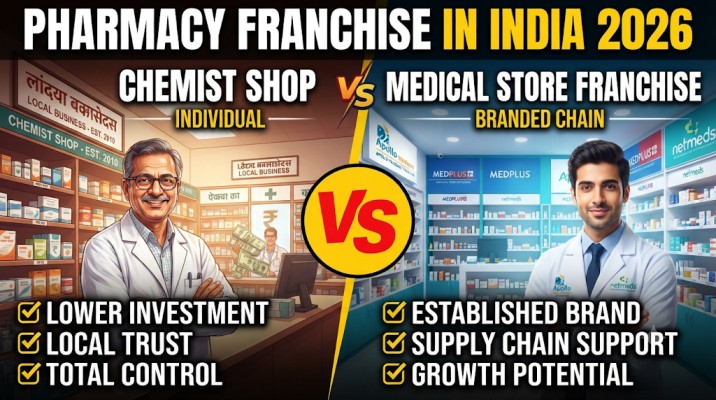
Direct answer: An independent chemist shop typically earns a 15–25% gross margin with lower fixed costs, while a branded medical store franchise (Apollo, MedPlus) earns 13–18% after royalty but brings higher walk-ins and supply-chain support. The better choice depends on whether you want control or brand pull — not on which model sounds cheaper.
Most franchise brochures quote a single investment number. Very few explain that a MedPlus franchisee keeps only 14–14.5% of the 24% pharmacy-level gross margin, while MedPlus retains 9.5–10%[reference:7]. That gap decides your take-home profit.
Direct Answer: Which Model Gives Better Returns in 2026?
For a first-time investor with ₹2–25 lakh, the independent chemist shop offers better net margin per rupee invested (15–25% gross) but demands more operational work — pharmacist hiring, distributor relationships, and location selection. The medical store franchise offers brand trust and a ready supply chain, but royalty and minimum-stock rules compress the margin to 13–18%[reference:8].
If you are a pharmacist yourself, the independent route saves ₹15,000–25,000 per month in salary and keeps the full margin. If you are not a pharmacist and want brand-led footfall, the franchise route reduces licensing friction but costs more in royalty.
What Is a Chemist Shop Franchise?
A chemist shop franchise is a retail pharmacy operating under a brand name — Apollo Pharmacy, MedPlus, or a regional chain. The franchisee runs the store, hires the pharmacist, and follows the company’s pricing and stocking rules. In return, the brand brings customers and negotiates with distributors.
The independent-first model
Most Indian chemists start as independent shops. They obtain a retail drug license (Form 20/21), hire a registered pharmacist, and buy stock from local distributors. Investment is ₹6–12 lakh including licence, interiors, refrigerator, and first stock[reference:9]. The owner keeps the full 15–25% margin but carries all the risk.
Where franchise chemists fit
Franchise chemists suit investors who are not pharmacists and want a tested operating system. The brand handles supply-chain negotiations and marketing. The trade-off is royalty (typically 1–3% of sales) and restrictions on outside stock purchases. MedPlus franchisees, for example, must buy inventory from MedPlus — no outside procurement is allowed[reference:10].
If you value independence and already have a pharmacist in the family, the franchise royalty is an unnecessary cost. If you need brand-led footfall and cannot negotiate with distributors yourself, the franchise premium may be worth it.
What Is a Medical Store Franchise?
“Medical store franchise” is often used interchangeably with “pharmacy franchise,” but the two differ in scale and format. A medical store franchise can be a small 200–400 sq ft outlet under a regional brand, while a large pharmacy franchise (Apollo, MedPlus) may require 300–500 sq ft and a minimum stock commitment.
Brand-led pharmacy chains
Apollo Pharmacy and MedPlus are the two most visible national chains. Apollo Pharmacy franchise investment ranges from ₹10–30 lakh, with 15–20% gross margin on medicines[reference:11]. MedPlus runs a franchise model where the company invests the capex (around ₹10 lakh per store) and the franchisee buys inventory outright[reference:12].
The FOFO and COCO confusion
FOFO (Franchise Owned, Franchise Operated) means you own and run the store. COCO (Company Owned, Company Operated) means the company runs it. Some pharmacy brands use a hybrid where the company funds capex but the franchisee funds inventory. Read the agreement carefully — “franchise” does not mean the same thing across brands.
In the MedPlus model, the company spends ₹10 lakh on fit-out, but you buy the entire inventory upfront. Your working capital requirement is higher than the advertised franchise fee suggests.
Investment Comparison: Chemist Shop vs Medical Store Franchise
The advertised investment is never the full cost. Here is what each model actually demands.
The ₹6–12 lakh independent path
An independent chemist shop in a Tier-2 city (Indore, Patna, Jaipur) can start with ₹6–12 lakh: licence and paperwork ₹5,000–10,000; shutter, racks, signage ₹1.5–3 lakh; refrigerator and billing software ₹1–1.5 lakh; first stock ₹2–4 lakh; and 3–6 months of rent and salaries ₹2–3 lakh[reference:13].
The ₹8–20 lakh franchise path
A branded pharmacy franchise typically requires ₹8–20 lakh, including franchise fee (₹2–5 lakh), branding and fit-out, initial stock, and working capital[reference:14]. Apollo Pharmacy sits at the higher end (₹10–30 lakh) because of brand premium and larger format requirements[reference:15].
What the advertised number leaves out
Most franchise listings do not include the pharmacist’s salary (₹15,000–25,000/month), GST registration, or the cost of holding minimum stock. A ₹10 lakh franchise can easily become a ₹14 lakh commitment once working capital is added.
If your total budget is ₹12 lakh, an ₹8–10 lakh franchise leaves too little buffer. The independent route may allow a larger working-capital cushion.
| Cost Head | Independent Chemist (Estimated) | Medical Store Franchise (Estimated) |
|---|---|---|
| Licence + documentation | ₹5,000–₹10,000 | ₹5,000–₹15,000 |
| Interiors, racks, signage | ₹1.5–₹3 lakh | ₹2–₹5 lakh (brand specs) |
| Refrigerator, software, IT | ₹1–₹1.5 lakh | ₹1–₹2 lakh |
| First stock | ₹2–₹4 lakh | ₹3–₹8 lakh (minimum commitment) |
| Franchise fee | Nil | ₹2–₹5 lakh |
| Working capital (3–6 months) | ₹2–₹3 lakh | ₹3–₹5 lakh |
| Realistic all-in range | ₹6–₹12 lakh | ₹8–₹20 lakh |
Sources: BanglaInfo cost breakdown (Sept 2026); FranchiseBazar investment ranges. Actual figures vary by city and brand.
ROI Comparison: Margins, Payback, and Hidden Costs
Gross margin is not take-home profit. Three costs separate the two models.
Gross margin vs net margin
Independent chemists earn 15–25% gross margin on medicines. Franchise chemists earn 13–18% after royalty[reference:16]. But the franchise brings higher walk-ins and a stronger supply chain, which can offset the lower percentage through higher volume.
The royalty and minimum-stock trap
Royalty of 1–3% sounds small. On ₹8 lakh monthly sales, 2% royalty is ₹16,000 — roughly the salary of a helper. Minimum-stock rules also lock capital: if the brand requires ₹6 lakh in stock and your monthly sales are ₹4 lakh, your inventory turns slower than an independent shop that can order based on demand.
Format-level ROI table
| Model | Typical Investment | Gross Margin | Net Margin (after royalty, salary, rent) | Payback Period |
|---|---|---|---|---|
| Independent chemist (Tier-2) | ₹6–12 lakh | 15–25% | 8–15% (industry estimate) | 18–30 months |
| Apollo Pharmacy franchise | ₹10–30 lakh | 15–20% | 7–12% (industry estimate) | 24–36 months |
| MedPlus franchise (FOFO) | ₹8–15 lakh (inventory-led) | 14–14.5% (franchisee share) | 10–13% store-level EBITDA (MedPlus data) | 12–24 months |
| FOFO pharmacy (regional) | ₹8–9 lakh | 14–18% | 8–12% (industry estimate) | 6–12 months (franchisor projection) |
Sources: MedPlus Q4 FY26 earnings call (store-level EBITDA 13.1% for stores >12 months); BanglaInfo margin comparison; FOFO break-even data from BioSpectrum (Sept 2026). Net margin ranges are industry estimates.
: A franchise with a 24% gross margin looks better than an independent shop at 20% — until you subtract royalty, pharmacist salary, and minimum-stock carrying costs. Model net margin, not gross.
Profit Margin Reality: What You Actually Take Home
A ₹3 lakh monthly-sales independent chemist with 18% gross margin earns ₹54,000 gross. After rent (₹10,000–20,000), pharmacist and helper (₹20,000–35,000), and electricity (₹3,000–5,000), net profit is ₹15,000–30,000[reference:17].
A franchise outlet doing ₹8 lakh monthly sales at 14% franchisee margin earns ₹1,12,000 gross. After rent, staff, royalty, and platform commissions, a well-run MedPlus-style store can retain 10–13% store-level EBITDA — around ₹80,000–₹1,04,000[reference:18]. Higher absolute profit, but higher investment and tighter operating discipline.
The franchise model makes more absolute profit at scale. The independent model makes a higher percentage on lower volume. Choose based on your capital and your tolerance for operational control.
Drug License and Compliance: The Non-Negotiable Step
Every retail pharmacy — independent or franchise — needs a drug license. The franchise does not exempt you from this.
Form 20 and Form 21
Form 20 covers retail sale of general allopathic medicines. Form 21 covers Schedule C/C1 drugs (insulin, vaccines, cold-storage medicines). Wholesale operations need Form 20B/21B[reference:19]. The licence is valid for one shop only and cannot be transferred[reference:20].
The registered pharmacist requirement
A D.Pharm or B.Pharm graduate registered with the State Pharmacy Council must be present full-time. If you are not a pharmacist, budget ₹15,000–25,000 per month for salary[reference:21]. Running a shop without a registered pharmacist violates the Drugs and Cosmetics Act.
Why this matters to you: The pharmacist cost is the same for both models. A franchise does not solve the pharmacist problem — it only solves the brand and supply-chain problem.
Best Cities for Pharmacy Franchises in India (Tier-1 vs Tier-2)
Metro cities (Mumbai, Bangalore, Delhi) offer higher sales per store but also higher rent and competition. Tier-2 cities (Indore, Patna, Jaipur, Bhopal) offer lower rent, lower staff cost, and less branded competition. A ₹8 lakh independent shop in Indore may break even faster than a ₹15 lakh franchise in Mumbai, simply because fixed costs are lower.
If your budget is ₹10–15 lakh, a Tier-2 city gives you more room to absorb early losses and build doctor relationships. If you have ₹25 lakh+ and want brand-led volume, a metro franchise may make sense.
7-Point Checklist Before Choosing a Pharmacy Franchise
- ☐ 1. Confirm the franchisee margin, not the company margin. Ask what percentage of MRP the franchisee retains after royalty. MedPlus: 14–14.5%[reference:22].
- ☐ 2. Check the minimum stock purchase requirement. Higher stock commitment means slower inventory turns.
- ☐ 3. Verify whether outside procurement is allowed. Some franchises prohibit buying from local distributors, which can increase cost.
- ☐ 4. Calculate rent as a percentage of projected sales. Keep it below 8% for a pharmacy.
- ☐ 5. Confirm the pharmacist hiring responsibility. Does the brand provide a pharmacist, or must you hire one?
- ☐ 6. Read the exit clause. What happens to unsold stock and the franchise fee if you exit in year two?
- ☐ 7. Visit three existing franchise outlets. Talk to the operators about actual monthly sales and royalty deductions.
Each checklist item is answerable in one conversation with the franchisor. A franchise that cannot answer items 1, 2, and 3 is not giving you enough information to invest safely.
Red Flags: 6 Warning Signs in a Pharmacy Franchise Offer
- “Up to 30% margin” without specifying franchisee share. Ask for the exact percentage after royalty and before rent.
- No written minimum-stock policy. If the stock commitment is verbal, it can change after you sign.
- Franchise fee is non-refundable and high (₹5 lakh+) with no brand pull in your city. A brand that nobody recognises in Indore or Patna will not bring the walk-ins you are paying for.
- No existing franchisee reference in your state. Ask for two operators in comparable cities and call them independently.
- Pressure to sign before verifying drug licence feasibility. The licence is site-specific. Confirm the premises will pass inspection before paying the franchise fee.
- Royalty quoted on “sales” without defining gross vs net. A 2% royalty on gross sales is larger than 2% on net sales.
Every red flag is answerable in one conversation. A franchisor who avoids two or more is not giving you a safe deal.
FAQ: Pharmacy Franchise in India
Q1: Is a pharmacy franchise more profitable than an independent medical store?
It depends on volume. An independent chemist earns 15–25% gross margin with lower fixed costs. A franchise earns 13–18% after royalty but can generate higher absolute profit through brand-led footfall. At ₹3 lakh monthly sales, independent net profit is ₹15,000–30,000; at ₹8 lakh, a franchise can retain ₹80,000–₹1,04,000 store-level EBITDA.
Q2: How much investment is needed for a chemist shop franchise in India?
A branded pharmacy franchise typically requires ₹8–20 lakh, including franchise fee, fit-out, first stock, and working capital. Apollo Pharmacy sits at ₹10–30 lakh. An independent chemist shop can start at ₹6–12 lakh. The advertised number usually excludes pharmacist salary and 3–6 months of operating costs.
Q3: What is the profit margin of a MedPlus or Apollo Pharmacy franchise?
MedPlus franchisees retain 14–14.5% of MRP after MedPlus retains 9.5–10% of the 24% pharmacy-level gross margin. Apollo Pharmacy franchisees typically earn 15–20% gross margin on medicines. Net margin after rent, salary, and royalty is lower — industry estimates put store-level EBITDA at 10–13% for mature outlets.
Q4: Can I open a medical store without a pharmacist?
No. A retail drug license requires a D.Pharm or B.Pharm graduate registered with the State Pharmacy Council to be present full-time. If you are not a pharmacist, you must budget ₹15,000–25,000 per month for salary. Running a shop without a registered pharmacist violates the Drugs and Cosmetics Act.
Q5: Which is better: PCD pharma franchise or retail medical store?
They are different businesses. A PCD franchise is a wholesale distribution model — you supply doctors and chemists in a territory, with lower investment (₹20,000–₹1 lakh) and higher margins (20–50%). A retail medical store sells directly to walk-in customers, with higher investment (₹6–20 lakh) and lower margins (13–25%). Retail gives daily cash flow; PCD gives territorial scalability.
Q6: How long does it take to break even on a pharmacy franchise?
FOFO pharmacy models project 6–12 months break-even in strong locations. MedPlus-style franchises typically take 12–24 months. Apollo Pharmacy outlets may take 24–36 months because of higher investment and brand royalty. Independent chemist shops usually break even in 18–30 months depending on rent and footfall.
Ready to Compare Pharmacy Franchise Options?
Stop guessing from brochures. View pharmacy franchise listings with real investment ranges, franchisee margin disclosures, and city-wise availability on Free-Franchise.com. Filter by budget, format, and state, then fill the enquiry form to connect with franchisors that match your ₹2–25 lakh plan.
View Pharmacy Franchise List →