

How to Choose a WHO-GMP Certified PCD Pharma Franchise Company
November 3, 2026
How to Choose a WHO-GMP Certified PCD Pharma Franchise Company (2026 Guide)
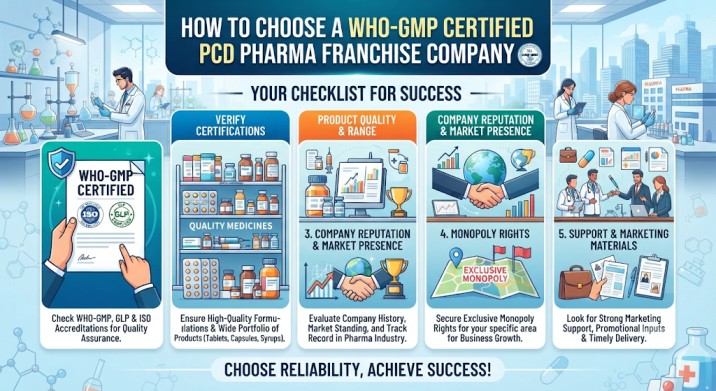
: A WHO-GMP certificate belongs to the manufacturing site, not to the PCD franchise company. Before signing, ask for a copy of the certificate, check the issuing State Drugs Controller, confirm that the product category is covered, and cross-verify the details with State FDA or CDSCO records. A company that hesitates on any of these steps is not a safe partner.
Most PCD franchise brochures say “WHO-GMP certified” in bold. Very few franchise partners actually read the certificate. That single gap is where avoidable risk begins.
Direct Answer: WHO-GMP Certification vs. Company Claim — What to Verify First
WHO-GMP certification is issued to a manufacturing facility after inspection by the State Drugs Controller under the WHO-GMP certification scheme. A PCD franchise company that outsources production does not hold WHO-GMP certification in its own name. It can only claim that its products are manufactured at WHO-GMP-certified sites.
If a franchise company says “we are WHO-GMP certified” without naming the manufacturing site, ask which factory makes the products and whether that factory holds a current certificate. The answer tells you whether the claim is verifiable or merely marketing.
What WHO-GMP Really Means for a PCD Franchise Partner
WHO-GMP (Good Manufacturing Practices) covers how medicines are produced: documented procedures, validated processes, qualified staff, and batch-wise quality control. It protects product quality. It does not protect your territory, your margins, or your supply reliability. Those depend on the franchise agreement.
The certificate belongs to the manufacturing site, not the franchise company
This is the single most misunderstood fact in the PCD pharma business. WHO-GMP certification is site-specific. A company with two manufacturing partners may have one certified site and one non-certified site. Your products could come from either.
When a doctor asks “is this WHO-GMP?”, you need a specific factory name and a specific certificate. “The company said so” is not an answer a prescriber will accept.
Why this distinction protects or exposes your investment
If the manufacturing site loses certification or fails an audit, your supply can stop. A franchise partner who verified the site beforehand can switch products or raise the issue with evidence. A partner who only trusted the brochure has no leverage.
Verification is not a one-time task. Certificate expiry dates matter. Ask for the current certificate and note the renewal date.
PCD Pharma Franchise Investment in India: Real Numbers for ₹2–25 Lakh Budgets
PCD franchise investment ranges are wide because “PCD franchise” covers everything from a single-product territory to a multi-division district monopoly. The advertised entry number is usually the minimum first stock order, not the total cost of running the business.
Single-division vs. multi-division setup
A single-division franchise (for example, only general range or only derma) can start with a first order of ₹25,000–₹1,00,000. A properly set-up single-division franchise typically needs ₹60,000–₹1,00,000 once documentation, initial stock, and promotional materials are included. Multi-division setups run ₹1,50,000–₹3,00,000.
The first order is the smallest cost. Working capital for repeat stock, travel, and credit periods determines whether you survive the first six months.
The ₹25,000 entry trap and the ₹1–3 lakh reality
Several companies advertise ₹10,000–₹25,000 entry packages. That figure buys a small initial stock. It does not cover drug license formalities, GST, storage, delivery, or the months of field work before doctors start prescribing regularly. Industry estimates put a realistic all-in starting budget at ₹75,000–₹3,00,000 depending on scale.
If your total budget is ₹1 lakh, do not spend ₹90,000 on stock. Keep at least ₹30,000–₹50,000 for the first three months of operating costs.
| Cost Head | Single-Division (Estimated) | Multi-Division (Estimated) |
|---|---|---|
| First stock order | ₹25,000–₹1,00,000 | ₹1,00,000–₹2,00,000 |
| Drug license + GST + documentation | ₹10,000–₹25,000 | ₹10,000–₹25,000 |
| Promotional materials (visual aids, bags, samples) | ₹5,000–₹15,000 | ₹10,000–₹25,000 |
| Working capital (3 months) | ₹30,000–₹60,000 | ₹60,000–₹1,50,000 |
| Realistic all-in starting range | ₹75,000–₹1,75,000 | ₹1,50,000–₹3,00,000 |
Sources: cross-referenced estimates from multiple PCD franchise cost guides, 2026. Actual figures vary by company, territory, and product range.
How to Verify WHO-GMP Certification: A 5-Step Process
Verification takes one working day if you know what to ask. These five steps separate a real certificate from a copied line in a brochure.
Step 1 — Read the certificate, not the brochure
Ask for a scanned copy of the WHO-GMP certificate issued to the manufacturing site. Check the company name on the certificate, the site address, the product categories covered, the issue date, and the expiry date. A certificate that expires in three months is not the same as one valid for three years.
Why this matters to you: A certificate covering “tablets and capsules” may not cover syrups or injections. If you plan to sell a range, confirm that the range is on the certificate.
Step 2 — Cross-check with State FDA and CDSCO
The State Drugs Controller issues WHO-GMP certificates after inspection. The Central Drugs Standard Control Organization (CDSCO) maintains lists of licensed manufacturers. Cross-verify the manufacturer’s name and license number against the State FDA database or CDSCO records. If the certificate cannot be traced, treat it as unverified.
Why this matters to you: A PDF can be edited. A regulator’s record cannot. Two minutes of cross-checking is cheaper than a supply disruption in month four.
Step 3 — Confirm the product category is covered
WHO-GMP certificates list the dosage forms and product categories inspected. A certificate for oral solids does not automatically cover topicals, liquids, or injectables. If the franchise company offers a multi-segment range, ask which manufacturing site holds certification for each segment.
Why this matters to you: Selling an uncertified category does not just create a quality risk. It can create a legal problem if a prescriber or chemist asks for documentation.
Step 4 — Ask for the manufacturing license
Ask for the manufacturing license issued by the State Drug Controller for the site producing your products. The license number, manufacturer name, and product permissions should align with the WHO-GMP certificate. A company that cannot produce a manufacturing license for the site it names is not giving you a verifiable chain.
Why this matters to you: The manufacturing license is the base document. WHO-GMP sits on top of it. If the base document is missing, the certification claim has no foundation.
Step 5 — Verify monopoly rights in writing
WHO-GMP protects product quality. Monopoly rights protect your business. Ask for a written area-allotment letter that names the district or territory, the product range covered, the duration of exclusivity, and the conditions under which exclusivity can be withdrawn. Verbal promises of “complete monopoly” are not enforceable.
Why this matters to you: Without written monopoly, the company can appoint a second distributor in your area selling the same brands. Your doctor relationships and field effort then benefit a competitor.
PCD Pharma Franchise Profit Margin: What You Actually Take Home
Product-level gross margins in PCD pharma range from 15% to 50%+ depending on the segment. General medicines typically sit at 15–30%. Chronic-care products run 20–35%. Specialty, derma, and nutraceutical ranges can reach 30–50%.
Net profit is lower. After transport, storage, promotional spend, staff, credit periods, and slow-moving stock, a single-territory PCD partner doing ₹5 lakh in monthly sales at a 20% gross margin may retain ₹40,000–₹60,000 as net profit in a good month. Industry estimates for PCD franchise partner monthly profit range from ₹60,000 to ₹2 lakh+ at scale, compared with ₹20,000–₹40,000 for a small-scale distributor.
Why this matters to you: Gross margin is not take-home profit. Ask the franchisor for the net margin of an existing partner in a comparable territory, not the theoretical gross margin on the product list.
| Segment | Indicative Gross Margin | Net Profit Pressure Point |
|---|---|---|
| General medicines | 15%–30% | High competition, low prescription stickiness |
| Chronic care (cardiac, diabetes) | 20%–35% | Doctor education cycle, credit periods |
| Derma | 30%–50% | Seasonality, sample dependency |
| Nutraceuticals | 30%–50% | Counter trust takes 2–3 quarters to build |
Red Flags: 7 Warning Signs in a PCD Franchise Offer
Most bad PCD partnerships show warning signs before signing. These seven are the ones that cost first-time partners the most money.
- “We are WHO-GMP certified” without naming the manufacturing site. Ask for the site name and certificate. Hesitation is a red flag.
- Monopoly promised verbally but not included in the agreement. If it is not written, it does not exist.
- No manufacturing license copy shared. The base document should be available before you pay.
- Margin quoted as “up to 70%” with no segment breakdown. Ask which products carry which margin and what the net margin looks like after expenses.
- Pressure to place a large first order before territory verification. A legitimate partner will confirm territory availability first.
- No existing partner reference in your state. Ask for two partners in comparable territories and call them independently.
- Certificate expiry within six months and no renewal proof. Short-validity certificates create supply risk.
Why this matters to you: Each red flag can be answered in one conversation. A partner who answers all seven clearly is worth a second meeting. A partner who avoids two or more is not.
Tier-2 vs. Metro: Where PCD Franchises Actually Work
Metro cities have higher doctor density but also more competition per territory. Tier-2 and Tier-3 cities — Indore, Patna, Jaipur, Bhopal, Raipur — are under-served relative to metro markets, and franchise holders face less competition per prescriber. Rajasthan’s Jaipur, Jodhpur, Udaipur, Kota, Ajmer, and Bikaner form strong demand clusters, while Tier-2 towns like Bikaner and Alwar remain under-penetrated.
Why this matters to you: A ₹1 lakh single-division PCD franchise in Indore or Patna may build doctor relationships faster than the same investment in Mumbai, where every company already has multiple representatives. Territory quality matters more than city size.
FAQ: WHO-GMP PCD Pharma Franchise
Q1: How do I verify a WHO-GMP certificate in India?
Ask for the certificate copy issued to the manufacturing site. Check the issuing State Drugs Controller, site name, product categories, and expiry date. Cross-verify the manufacturer’s license number with State FDA or CDSCO records. A certificate that cannot be traced to a regulator’s record is unverified.
Q2: Which PCD pharma franchise is best for beginners?
A single-division franchise with a WHO-GMP-certified manufacturing site, written district monopoly, and a first order under ₹1 lakh is the safest entry. General range and derma segments are common starting points. Avoid multi-division commitments until you have tested doctor response in your territory.
Q3: How much investment is required for a PCD pharma franchise?
A minimum first order starts at ₹25,000. A properly set-up single-division franchise needs ₹60,000–₹1,00,000 including documentation and initial stock. Multi-division setups run ₹1,50,000–₹3,00,000. Working capital for three months adds another ₹30,000–₹60,000 on top.
Q4: What are monopoly rights in a PCD pharma franchise?
Monopoly rights mean the company will not appoint a second franchise partner for the same product range in your defined territory while your agreement is active. It must be written into the agreement with the district or territory named clearly, the product range specified, and the duration stated. Verbal monopoly is not enforceable.
Q5: Can I start a PCD pharma franchise without a drug license?
No. A Drug License (wholesale or retail, as applicable) issued by your State Drug Controller and GST registration are mandatory. You also need a PAN card and business registration. Most franchisors will not process an application without these documents because they are required for lawful distribution.
Q6: What is the profit margin in a PCD pharma franchise?
Product-level gross margins range from 15% to 50%+ by segment: general medicines 15–30%, chronic care 20–35%, derma and nutraceuticals 30–50%. Net profit after transport, storage, promotion, and credit costs is lower. Industry estimates put monthly net profit at ₹60,000–₹2 lakh+ at scale for a working territory.
Ready to Compare WHO-GMP Verified PCD Franchise Options?
Stop relying on brochure claims. View PCD pharma franchise listings with investment ranges, territory details, and certification information on Free-Franchise.com. Filter by budget and state, then fill the enquiry form to connect with franchisors that match your ₹2–25 lakh plan.
View PCD Pharma Franchise List →