


General Range PCD Pharma Franchise: Why It Is the Most Profitable Sub-Sector (2026)
October 31, 2026
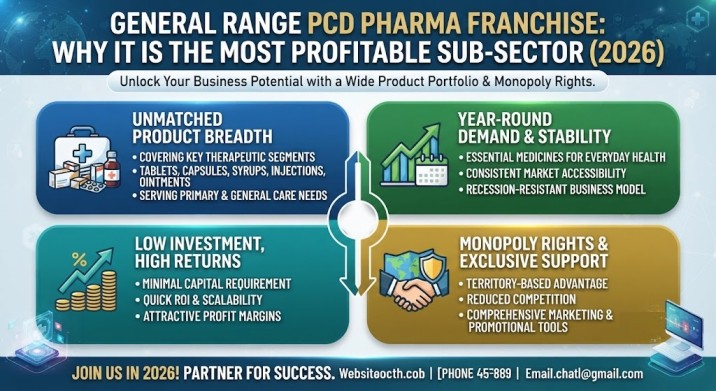
General Range PCD Pharma Franchise: Why It Is the Most Profitable Sub-Sector (2026)
A General Range PCD pharma franchise is considered the most profitable sub-sector for new distributors because it sells the medicines every doctor prescribes every day — antibiotics, painkillers, antacids, and multivitamins — creating high-volume, repeat orders with a realistic investment of ₹60,000–₹1,75,000 and net margins of 20–50%.
Specialty segments like dermatology or cardiac offer higher per-unit margins, but they depend on a handful of specialists. A general range franchise depends on every GP in your district. This guide breaks down why the volume game beats the margin game for most first-time franchise partners.
One-Line Answer: What Makes General Range Different?
General range: You sell what every GP prescribes — antibiotics, analgesics, antacids, cough syrups, and nutraceuticals. The customer base is broad, prescriptions are repeatable, and stock moves fast. Investment starts at ₹60,000.
Specialty range: You sell to a small group of specialists (dermatologists, cardiologists). Margins are higher per unit, but sales depend on a few doctors and the sales cycle is slower.
Why this matters to you: The “most profitable” segment is not the one with the highest margin percentage. It is the one that generates the most cash flow with the least risk. For most first-time distributors, that is general range.
What Is a General Range PCD Pharma Franchise?
Products Included: Antibiotics, Analgesics, Antacids, Syrups, Nutraceuticals
A general range PCD franchise covers the everyday medicines a general physician prescribes in a normal OPD day: tablets and capsules (antibiotics, painkillers, antacids, anti-allergics), syrups and suspensions (cough formulas, digestive syrups, paediatric drops), injectables and ointments (broad-spectrum antibiotics, pain-relief gels), and nutraceuticals (multivitamins, minerals, protein and energy supplements).
These are not rare or specialised molecules. They are high-volume, fast-moving products that chemists stock as a matter of routine.
Who Prescribes Them: Every GP, Every OPD Day
A general range product does not wait for a rare case to walk into a specialist’s clinic. A patient comes in with fever and a sore throat and leaves with an antibiotic, a paracetamol, and probably a pantoprazole. Multiply that by forty patients a day, and you can see why these products sell in volume.
Why this matters to you: The demand for general range medicines does not dip seasonally and does not depend on a few key doctors. Almost every clinic is a potential customer.
Why General Range Is the Most Profitable Sub-Sector
Broader Customer Base: Every Clinic Is a Potential Client
A specialty franchise (derma, gynae, cardiac) depends on a handful of specialists in the city. If two or three of them like your brand, you are doing well. If they do not, there is not much else to fall back on. A general range franchise spreads that risk across every GP, physician, and family clinic in your territory.
Lower Risk: No Dependence on a Handful of Specialists
In a specialty franchise, losing one key prescriber can cut your revenue significantly. In a general range franchise, no single doctor or clinic controls your business. The risk is distributed across dozens of prescribers and hundreds of patients.
Faster Inventory Turnover and Repeat Orders
General range products are high-volume, fast-moving items. Antibiotics, antacids, and painkillers are prescribed constantly. Your stock does not sit in the warehouse waiting for a specialist to write a prescription. It moves quickly, which improves cash flow and reduces the risk of expiry.
Lower Entry Cost Than Specialty Segments
General medicines have the lowest entry cost among PCD segments. Specialty segments — cardiac, diabetic, oncology, injectables, ophthalmic — carry higher per-unit costs and higher investment requirements. A general range franchise lets you start with ₹60,000–₹1,75,000, while a specialty franchise can require significantly more.
Why this matters to you: General range lets you enter the pharma distribution business with lower capital and lower risk. You can add a specialty division later, once you understand the local market and have cash flow.
General Range vs. Specialty PCD: A Side-by-Side Comparison
Investment, Margin, Sales Cycle, and Risk Comparison
| Factor | General Range | Specialty (Derma, Cardiac, Gynae) |
|---|---|---|
| Customer base | Every GP and physician | A few specialists |
| Entry investment | ₹60,000–₹1,75,000 | Higher (varies by segment) |
| Gross margin | 20–50% | 35–60%+ |
| Sales cycle | Fast (high volume, repeat orders) | Slower (dependence on key prescribers) |
| Risk profile | Spread across many doctors | Concentrated in a few specialists |
| Best for | First-time distributors, Tier-2/3 cities | Experienced operators with specialist networks |
Sources: Janus Biotech (Sep 2026), Dazzle Healthcare (Oct 2026), Globus Labs (Mar 2026).
Why this matters to you: General range and specialty are two different business models. If you do not already have deep relationships with specialists, general range is the safer, more profitable starting point.
The Real Investment: Where Your ₹60,000–₹1,75,000 Goes
Initial Stock Order, Drug License, Marketing Material, Working Capital
A realistic breakdown of the setup cost for a general range PCD franchise in 2026:
| Expense | Estimated Amount (₹) | What It Covers |
|---|---|---|
| Initial stock order | ₹30,000–₹1,00,000 | First batch based on local demand |
| Drug licence & registration | ₹10,000–₹20,000 | Wholesale drug licence, GST, local clearances |
| Marketing material | ₹5,000–₹15,000 | Visual aids, sample kits, order books |
| Working capital | ₹15,000–₹30,000 | Office setup, transport, storage, buffer |
| Total | ₹60,000–₹1,75,000 | Enough to start trading |
Source: Janus Biotech (Sep 2026). Most general range partners start at the lower end, working one district rather than a whole state.
Why this matters to you: The ₹25,000 figure you see on some websites is a minimum order, not a full setup. A properly stocked general range franchise with working capital is a ₹60,000–₹1,75,000 investment. Budget for the total.
Profit Margins: Gross vs. Net (What You Actually Keep)
The Four Numbers: Net Rate, PTS, PTR, MRP
Your margin is determined by four prices: the net rate (what the company charges you), the PTS (price to stockist), the PTR (price to retailer), and the MRP (what the patient pays). Your gross margin is the difference between your net rate and the price at which you sell. The MRP sets the ceiling; the retailer and stockist each take a slice.
Gross Margin vs. Net Profit After Promotional Spend
Gross margins on a general range PCD franchise typically run between 20% and 50%. But net profit is lower after promotional spend (5–8% of sales), logistics (2–4%), travel, and credit cycle delays. Realistic net profit after everything is 20–45% of monthly turnover for most partners.
Margin by Product Category
| Product Category | Typical Gross Margin | Why |
|---|---|---|
| Tablets & capsules | 20–30% | High-volume, fast-moving, moderate margin per unit |
| Syrups & suspensions | 25–40% | Slightly higher MRP, lower local price competition |
| Nutraceuticals | 40–50% | Higher perceived value, less price sensitivity |
| Injectables & ointments | 30–45% | Specialised handling, higher per-unit value |
Sources: IVA Healthcare (2026), Janus Biotech (Sep 2026), Industry estimates.
Why this matters to you: A 50% gross margin on nutraceuticals does not mean 50% net profit. After promotional spend, logistics, and credit delays, your real net margin may be 25–35%. Plan your personal income around net, not gross.
Working Capital: The Real First-Year Requirement
The ₹15,000–₹30,000 Monthly Reorder Requirement
The initial stock order is not the only stock cost. To keep products available at chemists and maintain supply when doctors prescribe, you must reorder regularly. Budget ₹15,000–₹30,000 per month depending on territory size and product range.
The 60–90 Day Credit Cycle to Chemists
Chemists and stockists do not pay immediately. You extend credit, and they pay in 30–90 days. This means you are funding the supply chain. Working capital must cover 60–90 days of credit cycle; otherwise you will run out of cash even if sales are growing.
Why this matters to you: Most people who quit a PCD franchise do so because they run out of working capital in the first 6 months, not because the model failed. Budget for the credit cycle before you start.
Tier-2/3 City Reality: Why Indore, Jaipur, and Patna Work
Lower Competition, High Volume, and Steady Demand
In Tier-2 and Tier-3 cities, the number of PCD franchise partners competing for the same doctors is lower than in metros. General range products — antibiotics, painkillers, antacids — are prescribed in every clinic, regardless of city size. The demand is steady and the competition is manageable.
A general range PCD franchise in Jaipur, Indore, or Patna can reach ₹3–6 lakh in monthly secondary sales within 12 months if the partner works the territory seriously, generating ₹75,000–₹2.1 lakh in monthly net profit at a 25–35% net margin.
Why this matters to you: In Tier-2 cities, a general range franchise can break even in 6–12 months because fixed costs are lower and the customer base is broad. The same investment in a metro buys more competition and higher rent.
7-Point Checklist Before Choosing a General Range PCD Franchise
- Is the company WHO-GMP certified and are its products DCGI-approved?
- Is the monopoly territory written into the agreement with named districts and product ranges?
- What is the exact net rate, PTS, PTR, and MRP for each product?
- What is the minimum order value, and can it be increased unilaterally after year one?
- Have I budgeted for 60–90 days of credit cycle and monthly reorders?
- Have I spoken to 3 existing franchise partners about actual monthly sales and net income?
- Do I have a wholesale drug license and GST registration in place before signing?
If the answer to questions 1, 2, or 6 is unclear, do not sign yet.
Final Verdict
If your budget is ₹60,000–₹1,75,000: A general range PCD franchise is the most realistic entry point. The customer base is broad, the products move fast, and the risk is lower than a specialty franchise.
If you have medical representative experience: General range is a natural fit. Your existing doctor relationships are the single biggest factor in early sales.
If you want the highest per-unit margin: Specialty segments (derma, cardiac) offer higher margins, but they require specialist networks and a longer sales cycle. Start with general range, then add a specialty division once you have cash flow.
See verified General Range PCD pharma franchise options:
View franchise list on free-franchise.com →
Frequently Asked Questions (FAQ)
What is a General Range PCD Pharma Franchise?
A General Range PCD franchise gives you the right to promote and distribute everyday medicines — antibiotics, painkillers, antacids, syrups, and nutraceuticals — under a company’s brand in your territory. It is a distribution business, not manufacturing, and the customer base is every GP in your area.
How much investment is required for a General Range PCD franchise?
A realistic setup costs ₹60,000–₹1,75,000, covering initial stock (₹30,000–₹1,00,000), drug licence and GST (₹10,000–₹20,000), marketing material (₹5,000–₹15,000), and working capital (₹15,000–₹30,000). The ₹25,000 figure is a minimum order, not a full setup.
What is the profit margin in a General Range PCD franchise?
Gross margins range from 20% to 50% depending on the product category. Tablets and capsules typically earn 20–30%; nutraceuticals earn 40–50%. Net profit after promotional spend, logistics, and credit delays is typically 20–45% of monthly turnover.
Why is General Range considered more profitable than specialty PCD?
General range is more profitable for most first-time distributors because the customer base is broader (every GP, not a few specialists), inventory moves faster, and the risk is spread across many prescribers. Specialty PCD has higher per-unit margins but depends on a few key doctors and a slower sales cycle.
Is a General Range PCD franchise profitable in Tier-2 cities?
Yes. Tier-2 cities like Indore, Jaipur, and Patna have lower competition and steady demand for everyday medicines. A partner working the territory seriously can reach ₹3–6 lakh monthly secondary sales within 12 months, generating ₹75,000–₹2.1 lakh in monthly net profit.
What is the difference between General Range and Specialty PCD?
General range covers everyday medicines prescribed by any GP — antibiotics, painkillers, antacids, syrups. Specialty covers specific therapeutic areas like dermatology, cardiology, or gynaecology, where sales depend on a smaller group of specialist doctors. General range has lower entry cost and broader demand; specialty has higher per-unit margin and slower sales cycle.