

What Is Micro-Franchising? Start a Business with ₹1–10 Lakh in India (2027)
November 10, 2026
What Is Micro-Franchising? Start a Business with ₹1–10 Lakh in India (2027)
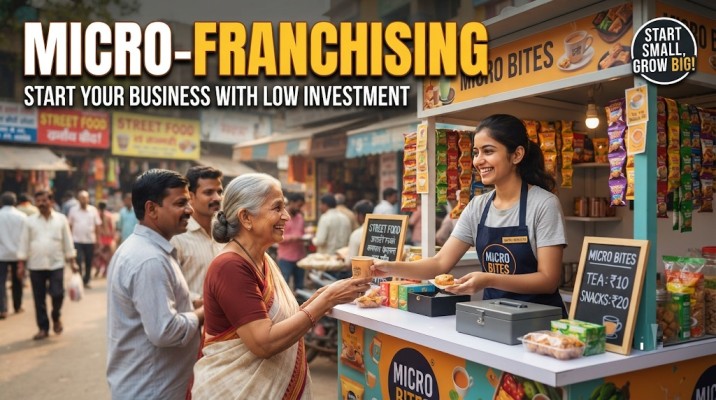
Micro-franchising is a low-investment franchise model where a single outlet, kiosk, or service point can be launched with ₹1–10 lakh instead of the ₹25 lakh–₹1 crore required for a traditional franchise. It is designed for first-time entrepreneurs, Tier-2/3 city residents, and anyone who wants a proven brand system without a large capital commitment.
The segment is growing at 20–25% CAGR, with as much as 65% of new franchise outlets coming from Tier-2 and Tier-3 cities. The appeal is simple: a known brand, a proven system, and a total investment that most salaried professionals can actually fund. This guide breaks down the real costs, ROI, and brands that fit a ₹1–10 lakh budget.
One-Line Answer: What Is a Micro-Franchise?
A micro-franchise is a small-format, low-capital franchise — typically a kiosk, a compact 100–300 sq ft outlet, or a service-based collection point. The brand provides the system, supply chain, and training; the franchisee provides the capital and local management. The total investment is usually under ₹10 lakh**, and the break-even is often within **6–12 months**.
Why this matters to you: A traditional franchise is a ₹25 lakh–₹1 crore decision. A micro-franchise is a ₹1–10 lakh decision. The risk is lower, the payback is faster, and you can start while keeping your current job if you choose a semi-passive format.
Why Micro-Franchising Is Booming in India
20–25% CAGR Forecast for the Segment
Market forecasts indicate that the micro-franchising segment in India will expand at a CAGR of 20–25% over the next five years. The post-COVID shift toward asset-light, digital-first, and lower-risk business models is accelerating the demand for compact franchise formats.
65% of New Franchise Outlets Are Coming from Tier-2 and Tier-3 Cities
As much as 65% of new franchise outlets are projected to come from Tier-2 and Tier-3 cities**. Lower real estate costs, rising aspiration, and limited organised competition are creating stronger ROI in cities that brands previously ignored. Cities like Indore, Jaipur, and Patna are becoming the new battleground for micro-franchise expansion.
The 80–85% Success Rate Advantage
While nearly 90% of Indian start-ups fail within five years**, franchises enjoy an **80–85% success rate** due to structured systems and brand pull. Micro-franchises inherit this structural advantage while keeping the entry cost low. A proven business model — whether it is an Amul outlet or a DTDC counter — has a failure rate of **less than 5% compared to independent startups.
Why this matters to you: You are not buying a lottery ticket. You are buying a proven system with a failure rate that is dramatically lower than starting from scratch.
Micro-Franchise vs Traditional Franchise: The Real Difference
Investment, Space, Operations, and Risk Comparison
| Factor | Micro-Franchise | Traditional Franchise |
|---|---|---|
| Investment range | ₹1–10 lakh | ₹25 lakh–₹1 crore+ |
| Space required | 50–400 sq ft | 400–3,000 sq ft |
| Staff required | 1–3 | 5–20+ |
| Break-even | 6–15 months | 18–36 months |
| Risk level | Low | Medium–high |
| Owner involvement | Part-time to full-time | Full-time management |
| Best for | First-timers, salaried professionals, Tier-2/3 investors | Experienced operators, large capital |
Sources: FranchiseBazar (2026), Sparkleminds (2025), NextWhatBusiness (2027).
Why this matters to you: A micro-franchise is not a “smaller version” of a traditional franchise. It is a different business model — designed for speed, affordability, and lower risk.
The ₹1–10 Lakh Micro-Franchise Landscape: Three Budget Bands
₹1–3 Lakh: Nano-Franchise (Delhivery, Maa Ki Chai)
Delhivery Partner is available for an investment of ₹50,000**. Since 99% of Indian pin codes are accessible through e-commerce, logistics is one of the most secure nano-franchise options.
Maa Ki Chai offers a chef-less chai kiosk at ₹1.7–2.25 lakh**, with **zero royalty**, a **100 sq ft** space requirement, and a **6–10 month ROI timeline**. Monthly revenue: ₹25,000–₹1 lakh. Monthly profit: ₹20,000–₹30,000.
₹3–6 Lakh: Entry-Level Kiosks (Amul, Dr. Lal PathLabs)
Amul Preferred Outlet** (APO) costs approximately **₹1.85–2 lakh** for a 100–150 sq ft space, with **zero royalty**. Blended margin: 7–9% on milk-heavy products; up to 50% on recipe items. Amul Ice Cream Scooping Parlour** costs approximately **₹6 lakh** for a 300+ sq ft space.
Dr. Lal PathLabs collection centre is available at an investment of ₹3–5 lakh** for a **200–300 sq ft** space. It benefits from rising health awareness and generates consistent monthly income from diagnostic tests.
₹6–10 Lakh: Compact QSR and Service Formats (PICO, Tumbledry, DTDC)
The Burger Company PICO is a micro-QSR format with an all-inclusive investment of ₹7.89 lakh plus taxes** for an **80–100 sq ft** outlet. The package covers franchise fee, kitchen equipment, branding, fit-outs, launch marketing, training, and opening stock. Projected break-even: **8–12 months**. Projected monthly revenue: **₹3–4 lakh**.
Tumbledry (dry cleaning and laundry) operates in the ₹7–10 lakh** range for a **250–500 sq ft** store. It benefits from the outsourcing of household chores in urban India.
DTDC Express retail counter is available at ₹1–3.5 lakh** for a small format, with a **₹3.5–6.5 lakh** full DTDC360 store. Payback: **1–2 years**. Monthly income: ₹45,000–₹1.3 lakh.
Investment Comparison Table
| Brand | Investment | Space | Payback | Best For |
|---|---|---|---|---|
| Delhivery Partner | ₹50,000 | Minimal | 3–6 months | Nano-franchise, side-hustle |
| Maa Ki Chai | ₹1.7–2.25 lakh | 100 sq ft | 6–10 months | First-timers, Tier-2/3 |
| Amul Preferred Outlet | ₹1.85–2 lakh | 100–150 sq ft | 1.5–3 years | Zero royalty, brand trust |
| Dr. Lal PathLabs | ₹3–5 lakh | 200–300 sq ft | 12–24 months | Healthcare, recurring demand |
| The Burger Company PICO | ₹7.89 lakh | 80–100 sq ft | 8–12 months | Micro-QSR, high footfall |
| Tumbledry | ₹8–10 lakh | 250–500 sq ft | 18–24 months | Laundry, recurring revenue |
| DTDC Retail Counter | ₹1–3.5 lakh | 100–300 sq ft | 1–2 years | Logistics, proven network |
Sources: FranchiseBazar (2026), Maa Ki Chai (2026), CalcGuru (2026), NextWhatBusiness (2027), ForeFind (2026). Figures are estimates and vary by city, brand, and format.
The Real Investment: Where Your ₹1–10 Lakh Goes
The ₹10 Lakh Capital Trap
Many prospective franchisees fall into the **“₹10 Lakh Capital Trap”**. The mistake is confusing the upfront **franchise fee** with the **total capital expenditure (CapEx)**. An opportunity marketed with a ₹5 lakh franchise fee often requires an additional ₹6 lakh for shop fit-outs, inventory, IT equipment, security deposits, and working capital reserves — pushing the true investment well past ₹11 lakh.
A sustainable ₹10 lakh budget must account for **all-in setup costs plus at least 60–90 days of operational runway**. The advertised franchise fee is not the same as your total investment.
Franchise Fee vs Total CapEx
| Cost Component | Typical Range (₹) | What It Covers |
|---|---|---|
| Franchise fee | ₹50,000–₹5 lakh | Brand licence, training, territory rights |
| Equipment / fit-out | ₹1–4 lakh | Machinery, interiors, signage, furniture |
| Security deposit | ₹50,000–₹1.5 lakh | 2–3 months rent (refundable) |
| Licences (FSSAI, GST, trade) | ₹10,000–₹30,000 | Mandatory registrations |
| Working capital (60–90 days) | ₹50,000–₹2 lakh | Rent, staff, stock, utilities buffer |
| Total all-in CapEx | ₹2.6–12.8 lakh | Depends on brand, city, and format |
Sources: NextWhatBusiness (2027), FranchiseBazar (2026), industry estimates.
Why this matters to you: A ₹5 lakh franchise fee with no working capital buffer is not a ₹5 lakh business — it is a ₹8–10 lakh business waiting to run out of cash. Budget for the all-in number, not the headline price.
ROI and Break-Even: The Real Numbers for Micro-Franchises
6–12 Month Break-Even for Nano-Franchises
Nano-franchises like Delhivery Partner and Maa Ki Chai report break-even in **6–12 months**. Maa Ki Chai specifically reports a **6–10 month ROI timeline**, with most outlets breaking even by month 9. Delhivery Partner, with a ₹50,000 investment and minimal operational overhead, can break even in as little as 3–6 months.
8–12 Month Break-Even for Micro-QSR Formats
The Burger Company PICO is projected to break even within **8–12 months**, generating **₹3–4 lakh in monthly revenue**. DTDC reports a payback of **1–2 years** on its retail counter format. Amul Preferred Outlet, with its thin milk margins, takes longer — typically 1.5–3 years — but offers zero royalty and strong brand trust.
Monthly Profit Scenarios Table
| Format | Monthly Revenue (Est.) | Net Margin | Monthly Net Profit (Est.) |
|---|---|---|---|
| Delhivery Partner | ₹15,000–₹40,000 | 20–30% | ₹5,000–₹12,000 |
| Maa Ki Chai | ₹25,000–₹1 lakh | 25–32% | ₹20,000–₹30,000 |
| Amul Preferred Outlet | ₹1.5–3 lakh | 7–9% | ₹15,000–₹27,000 |
| PICO Micro-QSR | ₹3–4 lakh | 15–20% | ₹45,000–₹80,000 |
| Tumbledry | ₹2–4 lakh | 20–30% | ₹40,000–₹1.2 lakh |
| DTDC Retail Counter | ₹45,000–₹1.3 lakh | 15–25% | ₹10,000–₹30,000 |
Sources: Industry estimates based on FranchiseBazar (2026), Maa Ki Chai (2026), CalcGuru (2026), and ForeFind (2026). Figures assume controlled rent and working capital.
Why this matters to you: A ₹2 lakh chai kiosk at ₹75,000 monthly revenue and 30% net margin can earn ₹22,500 per month. A ₹7.89 lakh PICO outlet at ₹3.5 lakh revenue and 18% margin can earn ₹63,000 per month. The higher investment buys a higher income ceiling.
Top Micro-Franchise Brands in India (2027)
Delhivery Partner (₹50,000, Logistics)
A logistics partner model with an investment of ₹50,000**. Since 99% of Indian pin codes are accessible through e-commerce, logistics is one of the most secure nano-franchise options. Best for: side-hustle, low-risk entry, Tier-2/3 cities.
Maa Ki Chai (₹1.7–2.25 Lakh, Zero Royalty)
A chef-less chai kiosk with a one-time fee of ₹1.7 lakh (promotional) or ₹2 lakh (regular)**. Space: **100 sq ft**. Zero royalty. Monthly revenue: ₹25,000–₹1 lakh. Monthly profit: ₹20,000–₹30,000. ROI: **6–10 months**. Best for: first-timers, Tier-2/3 cities.
Amul (₹2–6 Lakh, Zero Royalty)
Amul Preferred Outlet (APO) costs approximately ₹1.85–2 lakh** for 100–150 sq ft. Ice Cream Scooping Parlour costs approximately **₹6 lakh** for 300+ sq ft. **Zero royalty**. Margins range from **2.5% on pouch milk** to **~50% on recipe items**. Best for: brand trust, long-term stability.
The Burger Company PICO (₹7.89 Lakh, 8–12 Month Payback)
A micro-QSR format with an all-inclusive investment of ₹7.89 lakh plus taxes** for an **80–100 sq ft** outlet. The package covers franchise fee, kitchen equipment, billing system, branding, fit-outs, launch marketing, training, and opening stock. Projected break-even: **8–12 months**. Projected monthly revenue: **₹3–4 lakh**. Best for: high-footfall locations, food entrepreneurs.
Tumbledry (₹8–10 Lakh, Laundry)
A dry cleaning and laundry franchise with an investment of ₹7–10 lakh** for a **250–500 sq ft** store. Benefits from the outsourcing of household chores in urban India. Many customers have purchased this model again. Best for: recurring revenue, Tier-2 cities.
DTDC (₹1–3.5 Lakh Retail Counter)
A courier and express cargo franchise with a small retail counter format at ₹1–3.5 lakh** (Flex/Smile sub-franchise model) and a full DTDC360 store at **₹3.5–6.5 lakh**. Royalty: **8% of revenue**. Payback: **1–2 years**. Best for: proven network, logistics experience.
Brand Comparison Table
| Brand | Investment | Royalty | Payback | Best For |
|---|---|---|---|---|
| Delhivery | ₹50,000 | Not disclosed | 3–6 months | Nano-franchise, side-hustle |
| Maa Ki Chai | ₹1.7–2.25 lakh | 0% | 6–10 months | First-timers, Tier-2/3 |
| Amul | ₹2–6 lakh | 0% | 1.5–3 years | Brand trust, stability |
| PICO | ₹7.89 lakh | Not disclosed | 8–12 months | Micro-QSR, high footfall |
| Tumbledry | ₹8–10 lakh | Not disclosed | 18–24 months | Laundry, recurring revenue |
| DTDC | ₹1–3.5 lakh | 8% | 1–2 years | Logistics, proven network |
Sources: FranchiseBazar (2026), Maa Ki Chai (2026), CalcGuru (2026), NextWhatBusiness (2027), ForeFind (2026). Figures are estimates and vary by city and agreement.
Tier-2 City Advantage: Why Indore, Jaipur, and Patna Work
Lower Rent, Lower Competition, First-Mover Advantage
Growth is shifting to Tier-2 and Tier-3 cities, where brand penetration is still below 30%. Cities like Indore, Jaipur, Coimbatore, and similar markets offer the best mix of rising demand, lower rent, and less competition. The micro-franchise segment is accelerating precisely because these markets do not require the large capital and urban infrastructure of a traditional franchise.
A Maa Ki Chai kiosk in Indore or Jaipur can generate ₹50,000–₹1 lakh in monthly revenue** within 6–9 months if the location has steady footfall (college zone, market, bus stand), generating **₹20,000–₹30,000 in monthly net profit** at a 25–32% net margin. The same ₹2 lakh that barely covers a metro deposit can fund a complete kiosk with working capital in a Tier-2 city.
Why this matters to you: The fastest payback is not in the biggest city. It is in the city where rent is low, competition is low, and the first organised brand in a locality captures the majority of demand.
7-Point Checklist Before Choosing a Micro-Franchise
- Does the all-in investment (fee + fit-out + working capital) fit my budget?
- Is the format a kiosk, counter, or compact store? Does it match my location and skills?
- What is the exact royalty — 0%, 5%, or 8%? Does it apply to gross or net revenue?
- Does the franchise fee include equipment, training, and fit-outs, or are they separate?
- Have I budgeted 60–90 days of working capital?
- Have I spoken to 3 existing franchisees about actual monthly revenue and net profit?
- Is the territory protected in writing, and is the FSSAI licence category correct for my turnover?
If the answer to questions 1, 3, or 5 is unclear, do not sign yet.
Final Verdict
If your budget is ₹50,000–₹2 lakh: Delhivery Partner or Maa Ki Chai is the realistic entry point. Lowest capital, fastest payback, and a proven system. Best for side-hustles and first-time entrepreneurs in Tier-2/3 cities.
If your budget is ₹2–6 lakh: Amul Preferred Outlet offers zero royalty and unmatched brand trust. Dr. Lal PathLabs offers recurring healthcare demand. Payback in 1.5–2.5 years.
If your budget is ₹6–10 lakh: The Burger Company PICO (₹7.89 lakh) or Tumbledry (₹8–10 lakh) offer compact QSR and service formats with 8–12 month payback potential. Best for full-time operators.
If you want the lowest-risk first business: Start with a nano-franchise. Learn the business, build cash flow, and upgrade to a larger format later. The ₹1–10 lakh micro-franchise is not a compromise — it is a smart first step.
See verified micro-franchise options:
View micro-franchise list on free-franchise.com →
Or fill this 2-minute form and get 5 franchise options with full cost and margin breakdowns for your city.
Frequently Asked Questions (FAQ)
What is micro-franchising in simple words?
Micro-franchising is a low-investment franchise model where you can start a small outlet, kiosk, or service point with ₹1–10 lakh instead of the ₹25 lakh+ required for a traditional franchise. The brand provides the system; you provide the capital and local management.
How much does a micro-franchise cost in India?
It ranges from ₹50,000 for a Delhivery Partner to ₹7.89 lakh for a Burger Company PICO outlet to ₹10 lakh for a Tumbledry laundry store. The all-in cost includes the franchise fee, equipment, fit-outs, deposits, licences, and 60–90 days of working capital.
What is the profit margin in a micro-franchise?
Net margins range from 7–9% for a milk-heavy Amul outlet to 25–32% for a Maa Ki Chai kiosk to 15–20% for a PICO micro-QSR. The margin depends on the format, product mix, and whether you process in-house or act as a collection point.
How long does it take to break even in a micro-franchise?
Nano-franchises like Maa Ki Chai report 6–10 month break-even. PICO reports 8–12 months. Tumbledry reports 18–24 months. DTDC reports 1–2 years. Amul Preferred Outlet takes 1.5–3 years because of thin milk margins.
Is micro-franchising profitable in Tier-2 cities?
Yes. Tier-2 cities like Indore, Jaipur, and Patna have lower rent, lower competition, and brand penetration below 30%. A ₹2 lakh chai kiosk can break even in 6–10 months and generate ₹20,000–₹30,000 in monthly net profit.
What is the difference between a micro-franchise and a traditional franchise?
A micro-franchise requires ₹1–10 lakh, 50–400 sq ft, and 1–3 staff, with a 6–15 month break-even. A traditional franchise requires ₹25 lakh–₹1 crore+, 400–3,000 sq ft, 5–20+ staff, and a 18–36 month break-even. Micro-franchises are designed for first-time, lower-capital investors.