


Senior Care Franchise in India 2026: The ₹2 Lakh–₹25 Lakh Opportunity Everyone Is Ignoring
November 4, 2026
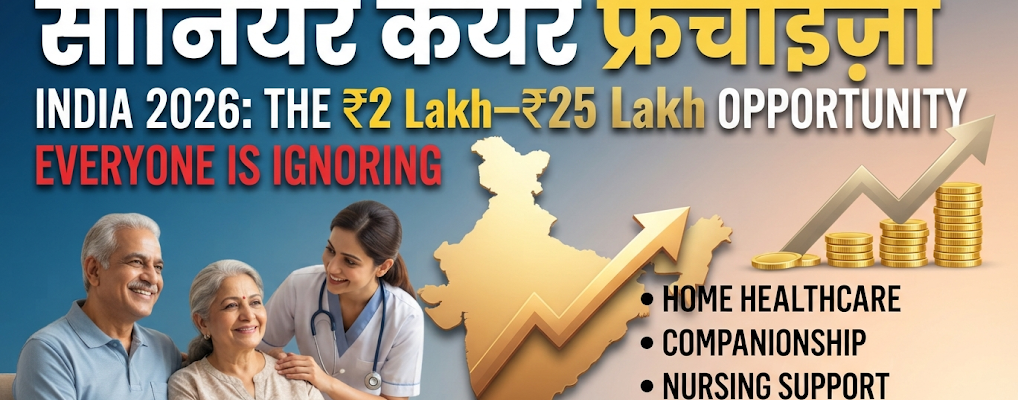
Senior Care Franchise in India 2026: The ₹2 Lakh–₹25 Lakh Opportunity Everyone Is Ignoring
A senior care franchise in India lets you run an assisted living facility, home care service, or elder wellness centre under an established brand. Investment ranges from roughly ₹2 lakh for an asset-light home care model to ₹25 lakh for a full assisted living setup—and demand is rising faster than organised supply.
India’s 60-plus population is estimated at 166.9 million in 2026 and is projected to reach 347 million by 2050, according to the Association of Senior Living India’s Silver Surge 2.0 report[reference:0]. Yet organised senior living penetration is just 1.5%, and assisted living accounts for less than 10% of organised stock—against 24–29% in mature markets[reference:1].
Why Senior Care Is 2026’s Most Underrated Franchise Category
Most new franchise investors look at food, education, or fitness. Almost nobody looks at elder care. That is exactly why the opportunity exists.
The senior living market is valued at around ₹300 billion in 2026 and is expected to cross ₹1 trillion by 2030—nearly four times its current size[reference:2]. Organised assisted-living beds in India number only about 2,100, while an estimated 8.8 million seniors live with dementia[reference:3].
Why this matters to you: You are not entering a crowded market. You are entering a market where supply has barely started.
What Does a Senior Care Franchise in India Actually Look Like?
“Senior care franchise” is an umbrella term. The business model you choose changes your investment, staffing, and risk profile completely.
Four Models You Will Encounter
- Asset-light home care franchise (₹2L–₹10L): A coordination hub that dispatches caregivers, nurses, and physiotherapists to seniors’ homes. No large facility needed. Examples: Drooin Healthcare (₹2L–₹5L), Emoha (₹5L–₹10L)[reference:4][reference:5].
- Senior wellness / daycare centre (₹5L–₹15L): A physical centre offering day programs, physiotherapy, and social engagement. Life Circle Health Services operates in this space at ₹5L–₹10L with a 2–3 year payback[reference:6].
- Assisted living facility (₹15L–₹25L+): A residential setup with 10–30 beds, round-the-clock staff, and care protocols. Requires property, compliance, and higher working capital.
- Large elder care centre (₹50L–₹2Cr): Hospital-adjacent rehabilitation or dementia care. Outside the ₹2L–₹25L budget for most first-time franchisees—but worth knowing so you are not mis-sold[reference:7].
Why this matters to you: A ₹5 lakh home care franchise and a ₹25 lakh assisted living facility are not the same business. Choose the model that matches your capital and your tolerance for fixed costs.
How Much Does a Senior Care Franchise Cost in India? (Real Numbers)
Franchise fees vary by brand, but the total project cost is what matters. Here is the indicative range across the models available in India in 2026.
Investment Table: Senior Care Franchise Formats
| Cost Head | Home Care (Asset-Light) | Wellness / Daycare Centre | Assisted Living (10–30 beds) |
|---|---|---|---|
| Franchise / brand fee | ₹50,000–₹5,00,000 | ₹1,00,000–₹3,00,000 | ₹3,00,000–₹8,00,000 |
| Space deposit & fit-out | ₹50,000–₹1,50,000 | ₹2L–₹5L | ₹5L–₹12L |
| Equipment & furnishing | ₹30,000–₹1L | ₹1L–₹3L | ₹3L–₹6L |
| Working capital (3 months) | ₹50,000–₹1.5L | ₹1L–₹3L | ₹3L–₹6L |
| Indicative total | ₹2L–₹10L | ₹5L–₹15L | ₹15L–₹25L+ |
Sources: Forefind franchise listings for Drooin Healthcare, Emoha, Life Circle, and Transasia Ventures; Smergers listing for TriBeCa Care (₹9L–₹15L, 600–2,000 sq ft, 20% royalty)[reference:8][reference:9][reference:10][reference:11][reference:12].
Why this matters to you: A home care franchise lets you start at ₹2 lakh–₹5 lakh with no large property. An assisted living facility needs ₹15 lakh+ but commands higher monthly revenue per client. Match the model to your cash position.
Which Cities in India Are Best for a Senior Care Franchise?
Metro property costs make assisted living difficult for a ₹25 lakh budget. Tier-2 and Tier-3 cities are where the economics work.
Around 30–40% of new senior living project launches are expected to come from Tier-2/3 cities and spiritual hubs, according to Colliers[reference:13]. Emerging markets include Coimbatore, Jaipur, Dehradun, Vadodara, Indore, Chandigarh, Mysuru, Visakhapatnam, Puducherry, Tirupati, Vrindavan, and Ayodhya[reference:14][reference:15].
Why Tier-2/3 Cities Work for Senior Care
- Lower property costs: Rent and deposit for a 1,000–2,000 sq ft facility are significantly lower than Mumbai or Delhi.
- NRI parent demand: Adult children working abroad or in metros need local, trusted care for parents in smaller cities.
- Less competition: Organised elder care brands are concentrated in metros. Tier-2 cities have demand but almost no branded supply.
Why this matters to you: A ₹15 lakh assisted living facility in Indore or Jaipur can reach break-even faster than a ₹25 lakh facility in Mumbai because the rent-to-revenue ratio is healthier.
What ROI and Payback Can You Realistically Expect?
Payback varies by model. Asset-light home care franchises claim the fastest recovery because fixed costs are low. Assisted living facilities take longer but earn higher monthly fees per resident.
Life Circle Health Services reports a 2–3 year payback[reference:16]. Transasia Ventures estimates 6–12 month break-even for its centre format, driven by renewing memberships[reference:17]. Emoha’s royalty is 5% of revenue, which is among the lowest in the category[reference:18].
ROI Comparison Table: Home Care vs Assisted Living
| Metric | Home Care Franchise | Assisted Living Facility |
|---|---|---|
| Typical investment | ₹2L–₹10L | ₹15L–₹25L+ |
| Fixed monthly cost | Low (coordination hub) | High (rent, staff, utilities) |
| Revenue per client | ₹8,000–₹25,000/month | ₹25,000–₹60,000/month |
| Royalty range | 5%–20% of revenue | 5%–20% of revenue |
| Indicative payback | 1–3 years | 3–5 years |
| Key risk | Caregiver supply & retention | Occupancy ramp-up |
Royalty range references: Emoha 5%[reference:19]; TriBeCa Care 20%[reference:20]. Payback references: Life Circle 2–3 years[reference:21]; Transasia 6–12 months break-even[reference:22]. Industry estimates; actual results vary.
Why this matters to you: Home care pays back faster but earns less per client. Assisted living earns more per client but needs occupancy discipline. Do not pick the model with the biggest revenue number—pick the one your working capital can survive.
Licences and Compliance: What You Actually Need (And What You Don’t)
Here is the uncomfortable truth most franchisors will not lead with: India has no licensing regime for private assisted living facilities. No authority inspects a private assisted living home before it opens, and none can shut it down for failing a standard[reference:23].
What exists is the Minimum Standards for Senior Citizen Homes, issued by the Ministry of Social Justice and Empowerment in March 2024. These are benchmarks, not a licence[reference:24].
Compliance Checklist for Senior Care Franchisees
- ☐ Register under the Maintenance and Welfare of Parents and Senior Citizens Act, 2007 (where applicable)
- ☐ Municipal / local body trade licence
- ☐ Fire safety clearance (mandatory for residential care)
- ☐ Clinical Establishment Act registration if you offer medical procedures
- ☐ GST registration (if turnover exceeds threshold)
- ☐ Staff background verification and caregiver training records
- ☐ Professional indemnity insurance for care staff
Why this matters to you: Low regulation is an entry advantage, but it also means quality is your only defence. One care failure can destroy local trust faster than any competitor.
How to Choose the Right Senior Care Franchise Brand
Do not choose based on the number of cities the brand claims. Choose based on unit economics and caregiver supply.
7 Questions to Ask Before Signing
- What is the all-in project cost, including working capital?
- What royalty is charged—on gross or net revenue?
- How many franchisees are currently profitable, and can I speak to two of them?
- Who recruits and trains caregivers—the franchisor or me?
- What is the caregiver-to-client ratio, and how is it enforced?
- What happens if a client’s care needs escalate beyond my facility’s capability?
- What are the exit terms and territory protection clauses?
Why this matters to you: 75% of senior care providers identified workforce training as their top priority in a PwC–ASLI survey[reference:25]. If the franchisor does not have a caregiver pipeline, you are buying a logo, not a system.
The Policy Tailwind Nobody Is Talking About
The Union Budget 2026–27 includes a plan to train 1.5 lakh caregivers, and health insurance coverage has been expanded for seniors aged 70 and above[reference:26]. Both reduce two of the biggest friction points in elder care: trained staff supply and family willingness to pay.
Why this matters to you: Policy support is arriving at the same time as demographic demand. That combination is rare in Indian franchising.
Next Step: Compare Senior Care Franchise Listings
Do not sign with one brand based on one brochure. Compare at least three senior care franchise models—investment, royalty, payback claims, and caregiver support—side by side.
View verified senior care and assisted living franchise listings on free-franchise.com and fill the enquiry form to get cost sheets from multiple brands. One form, multiple options, no obligation.
Frequently Asked Questions
1. What is the minimum investment for a senior care franchise in India?
Asset-light home care franchises start from ₹2 lakh–₹5 lakh. Wellness centres typically need ₹5 lakh–₹15 lakh. Assisted living facilities with 10–30 beds require ₹15 lakh–₹25 lakh or more, depending on city and property.
2. Is a senior care franchise profitable in India?
Well-run home care franchises report 1–3 year payback, while assisted living facilities typically take 3–5 years. Profitability depends on occupancy, caregiver retention, and local demand—not on the brand alone.
3. Do I need a medical degree to open a senior care franchise?
No, for home care and wellness models. You manage operations, staff, and client relationships; clinical staff handle care delivery. Assisted living facilities may need a medical advisor or tie-up, but the franchisee is not required to be a doctor.
4. Which cities are best for a senior care franchise?
Tier-2 cities such as Coimbatore, Jaipur, Indore, Dehradun, and Vadodara offer lower property costs and growing NRI-parent demand. Around 30–40% of new senior living launches are expected from Tier-2/3 markets.
5. Is assisted living licensed in India?
No. India has no licensing regime for private assisted living facilities. The Minimum Standards for Senior Citizen Homes (March 2024) are voluntary benchmarks, not a licence. Franchisees must still meet local municipal, fire, and clinical establishment rules where applicable.
6. What royalty do senior care franchises charge?
Royalty ranges from 5% to 20% of revenue. Emoha charges 5%, while TriBeCa Care charges 20%. Always confirm whether royalty is calculated on gross or net revenue before signing.