

Rural Healthcare Franchise in India 2026: The ₹2 Lakh–₹25 Lakh Opportunity in Small Towns
November 4, 2026
Rural Healthcare Franchise in India 2026: The ₹2 Lakh–₹25 Lakh Opportunity in Small Towns
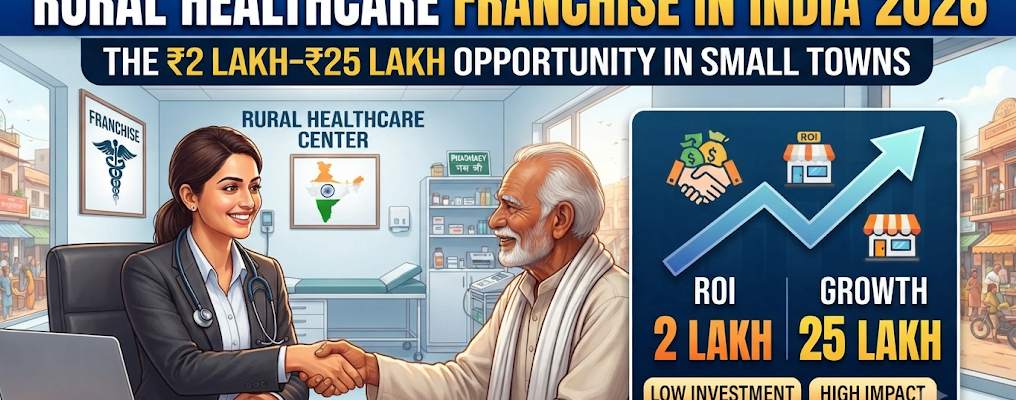
A rural healthcare franchise in India lets you run a branded, asset-light clinic or telemedicine kiosk in a Tier-2 or Tier-3 town using the franchisor’s technology, doctor network, and protocols. Investment starts from roughly ₹2 lakh for a compact digital clinic and can reach ₹25 lakh for a small polyclinic hub—your return depends on local patient volume and doctor connectivity, not on the brand name alone.
The gap is not a theory. Rural India has just 0.9 hospital beds per 10,000 people, against 2.7 in urban areas (Economic Times Health, 2025). Rural CHCs face an 80% shortfall of specialist doctors, with surgeons, physicians, gynaecologists, and paediatricians all in critically low supply (India Today, December 2025). Organised supply has not caught up. That is the business case.
Why Rural Healthcare Is the Real Franchise Opportunity in 2026
Metro healthcare is crowded and expensive. Small-town healthcare is under-served and cost-sensitive—which is exactly why asset-light franchise models are growing.
India’s asset-light hospital services market—which includes franchise-based clinics, telehealth, and hub-and-spoke models—was valued at USD 95.70 million in 2024 and is projected to reach USD 453.75 million by 2030, growing at a 29.74% CAGR (Grand View Research, 2025). Franchise-based clinics are a named business model in this growth.
The Infrastructure Gap in Numbers
- Rural bed density: 0.9 beds per 10,000 people vs. 2.7 urban (ET Health, 2025).
- Specialist shortfall: Almost 80% deficit at rural CHCs; 40% overall doctor deficit (India Today, 2025).
- National doctor ratio hides the gap: India’s 1:811 doctor-population ratio looks healthy on paper, but doctors cluster in metros and Tier-1 cities (India Today, December 2025).
Why this matters to you: A market with an 80% specialist shortfall is not saturated. It is under-built. The constraint is not demand—it is organised, trustworthy supply, which is what a franchise is supposed to provide.
What Is a Rural Healthcare Franchise in India? (Three Models That Fit Your Budget)
A rural healthcare franchise is not a hospital. You are not building a 50-bed facility. You are running a compact, standardised access point for consultation, diagnostics, and medicine dispensing—often supported by remote doctors.
The franchisor provides the technology platform, doctor network, training, and protocols. You provide the premises, staff, and local community trust. In most models, you do not need to be a doctor.
Model 1 — Digital Clinic / Telemedicine Kiosk (₹2L–₹10L)
A 200–500 sq ft centre where a trained operator connects patients to doctors via video. You earn from consultation fees, basic diagnostics, and medicine sales. Emedify’s ConsultNext model operates in this space, designed for peri-urban and rural catchments, with an investment range as low as ₹10,000–₹50,000 for the franchise entry point (Forefind, 2026). ClinicWala lists a setup cost of ₹2–5 lakh for a 500–2,000 sq ft centre (ClinicWala, 2026).
Model 2 — AI Health Point / Micro-Hub (₹4.5L–₹10L)
A technology-heavy kiosk with AI-assisted screening, teleconsultation, and AYUSH guidance. AppNAI’s rural hospital franchise lists an AI Health Point at ₹4.5 lakh, covering 50–100 villages and 1,00,000+ people per hub (LinkedIn / AppNAI, 2026). This is the lowest-cost organised rural model with a defined technology stack.
Model 3 — Mini Polyclinic Hub (₹10L–₹25L)
A 300–1,000 sq ft clinic with one or two consulting rooms, basic diagnostics, and a pharmacy tie-up. Glocal Healthcare operates in this band: ₹10–20 lakh investment, ₹25,000 franchise fee, 5% royalty, and a 1–2 year payback (Forefind, 2026). Its model is explicitly built for semi-urban and rural areas with limited healthcare access.
Why this matters to you: A ₹2 lakh kiosk and a ₹20 lakh mini-polyclinic are different businesses. Start with the model your capital can survive for 12 months without external funding.
How Much Does a Rural Healthcare Franchise Cost in India?
The franchise fee is only one line item. Total project cost includes fit-out, equipment, technology integration, staff training, and working capital. Rural costs are lower than metro costs—but they are not zero.
Pathkind Labs, which explicitly dedicates equal resources to Tier-3 and Tier-4 cities, lists a minimum investment of just ₹45,500 per collection centre (infrastructure cost separate) for a 200–250 sq ft space (Pathkind Labs, 2026). That is a diagnostics-led model, not a full clinic—but it shows how low the entry point can go.
Investment Table: Kiosk vs. Digital Clinic vs. Mini Hub
| Cost Head | Telemedicine Kiosk (Estimated) | Digital Clinic (Estimated) | Mini Polyclinic Hub (Estimated) |
|---|---|---|---|
| Franchise / brand fee | ₹10,000–₹50,000 | ₹25,000–₹1,50,000 | ₹25,000–₹3,00,000 |
| Fit-out & interiors | ₹50,000–₹1,50,000 | ₹1L–₹3L | ₹3L–₹7L |
| Equipment / diagnostics | ₹50,000–₹1L | ₹1L–₹3L | ₹3L–₹6L |
| Technology integration | ₹25,000–₹75,000 | ₹50,000–₹1.5L | ₹50,000–₹1.5L |
| Working capital (3 months) | ₹50,000–₹1L | ₹1L–₹2L | ₹2L–₹4L |
| Indicative total | ₹2L–₹5L | ₹4L–₹10L | ₹10L–₹25L |
Sources: Forefind listings for Emedify and Glocal Healthcare; ClinicWala setup cost; AppNAI AI Health Point pricing; Pathkind Labs minimum investment. Figures are indicative and vary by town and property.
What the Franchise Fee Does and Does Not Cover
The fee buys the brand, technology platform, doctor network access, training, and protocols. It does not buy you patients. Local demand generation—campaigns, doctor referrals, community trust—is the franchisee’s job. It also does not transfer licences; those remain your responsibility.
Why this matters to you: A ₹4.5 lakh AI Health Point and a ₹20 lakh mini-hub are different risk profiles. The lower-cost model is not “less serious”—it is a faster way to test demand before committing larger capital.
What ROI and Payback Can You Realistically Expect?
No franchisor can guarantee a return. The most credible public benchmark in the rural clinic category is Glocal Healthcare’s listed 1–2 year payback, with a franchise fee of just ₹25,000 and 5% royalty (Forefind, 2026). Emedify’s model reports an indicative monthly revenue range of ₹1.5 lakh to ₹7.5 lakh, though actual performance depends on patient footfall (Forefind, 2026).
The real ROI driver in rural healthcare is repeat patient volume. A one-time consultation earns a small fee. A family that returns for diagnostics, follow-ups, and medicines over 12 months is the actual revenue unit. The model works when the kiosk becomes the first point of contact for 50–100 households in its catchment.
ROI Table: Franchise vs. Independent Rural Clinic
| Metric | Franchise (Indicative) | Independent (Indicative) |
|---|---|---|
| Brand trust at launch | Immediate (brand recall) | Slow (built through referrals) |
| Doctor access | Ready network (teleconsultation) | Must recruit locally |
| Technology & protocols | Provided | Self-built |
| Royalty | 2%–5% of revenue | Nil |
| Typical payback (estimate) | 1–2 years | 2–4+ years |
| Biggest risk | Low footfall if brand is unknown locally | Doctor recruitment and care quality |
Payback reference: Glocal Healthcare 1–2 years; Meeram Health Care 1–2 years with 2% royalty. Royalty range reflects rural clinic models (Glocal 5%, Meeram 2%). Industry estimates; actual results vary.
The Patient Volume Math That Decides Your Profit
Assume 20 patients per day at an average billing of ₹250 (consultation + basic diagnostics). That is roughly ₹1.5 lakh monthly revenue. Staff salaries, rent, and technology costs may absorb 50–60%. The remaining surplus must cover royalty and capital recovery. If footfall drops to 10 patients per day, the business struggles to break even.
Why this matters to you: Rural healthcare ROI is not driven by price—it is driven by daily footfall × catchment trust. A franchise that cannot help you become the default clinic for 50 villages is selling a logo, not a demand engine.
Which Small Towns and States Are Best for a Rural Healthcare Franchise?
The strongest markets are not the biggest cities. They are district headquarters and Tier-3 towns where patients currently travel 30–60 km for a specialist consultation.
AppNAI’s rural hospital franchise is opening applications across Odisha, Jharkhand, Chhattisgarh, West Bengal, and Andhra Pradesh, with its first hub in Baripada, Odisha (LinkedIn / AppNAI, 2026). Glocal Healthcare explicitly targets semi-urban and rural areas with limited access to healthcare facilities (Forefind, 2026).
Tier-3 City Advantages (Patna, Indore, Jaipur, Baripada)
- Patna / Lucknow: Large catchment populations with weak specialist density; patients already pay out of pocket for private consultations.
- Indore / Jaipur: Growing middle-class spending, lower commercial rent than Mumbai or Delhi, and a culture of private healthcare consumption.
- Baripada (Odisha) / Jharkhand districts: The nearest specialist can be three hours away; a teleconsultation hub with basic diagnostics solves a real access problem (AppNAI, 2026).
- Coimbatore / Visakhapatnam: Tier-2 manufacturing and trading hubs with families willing to pay for organised, branded care.
Why this matters to you: A ₹5 lakh digital clinic in Patna or Indore can break even faster than a ₹20 lakh clinic in Mumbai because rent is lower, competition is thinner, and the specialist gap is wider.
Licences and Compliance: The Rural Franchise Checklist
A franchise agreement does not make you legally compliant. Rural clinics face fewer inspections than metro hospitals, but the core registrations still apply.
Compliance Checklist for a Rural Healthcare Franchise
- ☐ Clinical Establishment Act registration (state-specific, required if you provide medical treatment)
- ☐ Municipal / local body trade licence
- ☐ Fire safety clearance (for any enclosed clinic space)
- ☐ Bio-medical waste authorization (Pollution Control Board) if you generate clinical waste
- ☐ GST registration (if turnover exceeds threshold)
- ☐ Doctor registration verification (NMC / State Medical Council) for any on-site doctor
- ☐ Telemedicine Practice Guidelines compliance (for video consultations)
- ☐ ABDM / digital health consent if the franchisor promises integrated records
- ☐ Professional indemnity insurance for clinical staff
Why this matters to you: A missing biomedical-waste authorization or an unverified doctor can shut your clinic down faster than low footfall. Budget ₹50,000–₹1.5 lakh for compliance before opening.
How to Choose the Right Rural Healthcare Franchise Brand
Do not choose based on the number of outlets. Choose based on doctor network depth, technology reliability, and local demand support.
7 Questions to Ask Before You Sign
- What is the all-in project cost, including technology, equipment, and working capital?
- What royalty is charged—2%, 5%, or higher—and on gross or net revenue?
- Who owns the doctor network, and how many doctors are available for my time zone?
- What happens if the technology platform fails for a week—who supports me locally?
- Can I speak to two franchisees in Tier-3 towns about daily footfall and payback?
- Does the brand provide a local marketing playbook, or is demand generation entirely my problem?
- What are the territory protection and exit terms?
Why this matters to you: A rural franchise without a reliable doctor network is a video-calling booth, not a healthcare business. The network is the product.
The Government Tailwind Nobody Is Talking About
The public system is also opening space for private participation. As of November 2025, around 1.82 lakh Ayushman Arogya Mandirs are operational (Drishti IAS, 2025). In Gurgaon, a private healthcare company was awarded a ₹26.2 crore contract to set up and manage 30 Ayushman Arogya Mandirs for two years (Times of India, October 2026).
This does not mean every franchisee gets a government contract. It means the policy direction is toward public-private partnership in primary care—and franchise models with documented protocols are better positioned to participate.
Why this matters to you: Government-backed primary care expansion validates the rural clinic model. It reduces the risk that you are building in a market the state later crowds out.
Next Step: Compare Rural Healthcare Franchise Listings
Do not finalise a franchise from one brochure. Compare at least three models—telemedicine kiosk, digital clinic, and mini-hub—side by side. Ask each brand for unit-level economics in a Tier-3 town, not a metro success story.
View verified rural and small-town healthcare franchise listings on free-franchise.com and fill the enquiry form to get cost sheets from multiple brands. One form, multiple options, no obligation.