


Pest Control Franchise in India
November 11, 2026
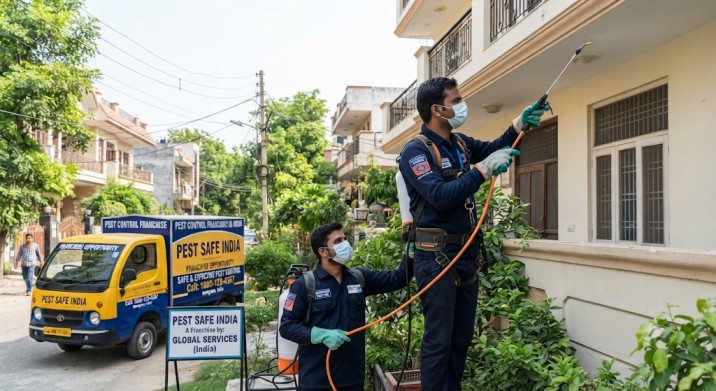
Pest Control Franchise in India: The Overlooked Opportunity (2027 Guide)
A pest control franchise in India can be started with ₹1–5 lakh for an asset-light service model, or ₹10–30 lakh for a full-service branch. India’s pest control market reached USD 1.7 billion in 2023 and is projected to reach USD 3.03 billion by 2032**, growing at **6.30% CAGR** — but **55–60% of the market is still unorganised**, dominated by 15,000+ local players with no brand, no training, and no accountability.
This is the overlooked opportunity. While food and retail franchises compete in saturated markets, pest control offers recurring AMC revenue**, low operational complexity, and a market where organised brands are still rare — especially in Tier-2 cities. Brands like HiCare (₹5–10 lakh), Pest Vigil (₹2–5 lakh), and Pecopp (₹10–20 lakh) offer franchise models that fit a ₹2–25 lakh budget. This guide breaks down the real costs, margins, and brands.
One-Line Answer: Why Pest Control Is an Overlooked Franchise
The 55–60% unorganised market gap: Most pest control in India is still done by local, unlicensed operators using unregulated chemicals. Only 40–45% of demand is met by professional services. A branded franchise brings standardisation, safety, and accountability to a market that currently runs on word-of-mouth and lowest-quote pricing.
The ₹2 lakh entry point with recurring revenue: An asset-light service franchise can start at ₹2–5 lakh** (Pest Vigil, Pesto Relief). Revenue comes from **Annual Maintenance Contracts (AMCs)** — monthly or quarterly service agreements that renew automatically. A franchisee with 15–20 institutional clients has a predictable monthly income base.
Why this matters to you: A food franchise sells a meal once. A pest control franchise sells a service that customers need again next quarter, next year, and every year after that. That is the structural advantage of the recurring model.
The Market Opportunity: A $3 Billion Industry Going Organised
USD 1.7 Billion (2023) → USD 3.03 Billion (2032)
India’s pest control market reached USD 1.7 billion in 2023 and is expected to reach USD 3.03 billion by 2032**, exhibiting a growth rate (CAGR) of **6.30% during 2024–2032** . The broader market is expanding at a CAGR of around **8.7% during 2026–2032**, driven by rising hygiene awareness, health concerns, and growing demand from residential and commercial sectors .
55–60% of the Market Is Still Unorganised
In a market where 55–60% is unorganised**, only **40–45% of demand is met by professional services** . The pest control market in India has around 15,000 players**, both organised and unorganised, but the market remains unorganized due to low entry barriers and insufficient regulations in licensing . Many still resort to DIY methods or unlicensed operators, risking ineffective and unsafe results.
15,000 Players — But Very Few Branded Franchises
Despite 15,000 players, the number of branded, franchise-model pest control companies is small. The leading companies include Rentokil PCI, HiCare, Truly Nolen, Godrej Pest Control, and Pest Control India . But most of these operate through direct branches or master franchises, not individual unit franchises. This is the gap: a first-time entrepreneur in Indore or Jaipur has very few branded pest control franchise options compared to food or retail.
Why this matters to you: You are not entering a saturated market. You are entering a market where the organised share is still small and growing — especially in Tier-2 cities.
Why Recurring Revenue Changes the Franchise Maths
Annual Maintenance Contracts (AMCs) vs One-Time Treatments
A one-time pest treatment generates revenue once. But a customer who books a treatment today is a candidate for a monthly or quarterly maintenance contract**. AMCs for residential societies, offices, restaurants, hospitals, and warehouses generate predictable income across the contract period. Revenue streams include **service fees, recurring maintenance contracts, and package plans** .
The 15–20 Client Portfolio Model
Pesto Relief notes that the engagement which converts into a long-term client is rarely the one that ends after a single visit; it is the one where the franchisee proactively checks back in to confirm the treatment held . A franchisee who builds a portfolio of 15–20 institutional clients** on monthly or quarterly agreements is not managing a project pipeline — they are managing a **recurring revenue base** that requires maintenance rather than constant regeneration.
Recurring Revenue vs Project-Based Income
Project-based work (one-time fumigation, post-construction treatment) generates higher per-engagement revenue but requires continuous new client acquisition. AMC contracts generate lower per-visit billing but produce predictable monthly revenue that compounds as the client base grows. The most stable pest control franchises build a hybrid: a recurring AMC base plus project work as a supplement.
Why this matters to you: The difference between a franchise that pays you once and a franchise that pays you every month is the client mix. Prioritise recurring AMCs from day one.
The Three Pest Control Franchise Models Under ₹25 Lakh
Asset-Light Service Franchise (₹1–5 Lakh)
The lowest-investment entry. You operate a small service point (100 sq ft) and manage technicians who deliver the service. Pest Vigil** operates at **₹2–5 lakh** with a **₹4 lakh franchise fee** and **30% royalty**, a **100 sq ft** space requirement, and a **9–11 month payback** . Pesto Relief Services** operates at **₹1–2 lakh** with a **101–500 sq ft** area . ASN Pest Control** operates at **₹2–5 lakh** . Best for first-timers and Tier-2 cities.
Mid-Tier Service Hub (₹5–10 Lakh)
A service hub with a small team and basic equipment. HiCare** operates at **₹5–10 lakh** for a **350 sq ft** space, with 50+ franchise outlets . HiCare is India’s only HACCP-certified pest service provider, with a presence in **200+ cities** and **25,000+ businesses** . Best for operators who want a proven national brand with a mid-range investment.
Full-Service Branch / Retail Model (₹10–30 Lakh)
A larger format with a retail component, a broader service portfolio, and a bigger team. Pecopp** operates at **₹10–20 lakh** for a **250–300 sq ft** space, with a **₹4.5 lakh brand fee**, **98% ROI**, and a **1–2 year payback** . Pecopp has over 50 years of experience (since 1970) and is ISO 9001:2008 certified . Moskitraps** operates at **₹20–30 lakh** with a **₹4 lakh franchise fee** and **15% royalty**, a **300–800 sq ft** space requirement, and a **2–3 year payback** . It is a pest control product and solution brand focused on devices (mosquito traps, rodent control, bird control) . Best for operators who want a product-plus-service retail model.
Comparison Table: Investment, Space, Payback
| Model | Investment | Space | Payback | Best For |
|---|---|---|---|---|
| Asset-Light Service | ₹1–5 lakh | 100–500 sq ft | 9–18 months | First-timers, Tier-2 cities |
| Mid-Tier Service Hub | ₹5–10 lakh | 350 sq ft | 12–24 months | National brand, proven system |
| Full-Service / Retail | ₹10–30 lakh | 250–800 sq ft | 1–3 years | Product+service, retail model |
Sources: Pest Vigil / ForeFind (2026), HiCare / FranchiseIndia (2026), Pecopp / TheBizNus (2026), Moskitraps / ForeFind (2026), Pesto Relief / ForeFind (2026). Figures are estimates and vary by city, brand, and format.
The Real Investment: Where Your ₹2–30 Lakh Goes
Franchise Fee, Equipment, Deposit, Working Capital
| Cost Component | Pest Vigil (₹) | HiCare (₹) | Pecopp (₹) |
|---|---|---|---|
| Franchise fee | ₹4,00,000 | Included | ₹4,50,000 |
| Equipment / setup | ₹50,000–₹1 lakh | Included | ₹3–5 lakh |
| Security deposit | ₹20,000–₹50,000 | ₹50,000–₹1 lakh | ₹1–2 lakh |
| Working capital (2–3 months) | ₹50,000–₹1 lakh | ₹1–2 lakh | ₹2–4 lakh |
| Total | ₹2–5 lakh | ₹5–10 lakh | ₹10–20 lakh |
Sources: Pest Vigil / ForeFind (2026), HiCare / FranchiseIndia (2026), Pecopp / TheBizNus (2026). Figures are estimates and vary by city and agreement.
Why this matters to you: The franchise fee is only 20–40% of the total cost. Equipment and working capital make up the rest. A ₹4 lakh franchise fee with no working capital buffer is not a ₹4 lakh business — it is a ₹6–8 lakh business waiting to run out of cash.
Profit Margins and ROI: The Real Numbers
98% ROI for Pecopp; 136% for Candoo Crew
Pecopp reports a 98% return on investment** and a **1–2 year payback** . Candoo Crew (a property care platform that includes pest control) reports an estimated **136% annual ROI** under realistic scenarios, with a **15% royalty** . Pest Vigil reports a **9–11 month payback** . Moskitraps reports a **2–3 year payback** . The variation depends on the format, city, and operator’s sales effort.
6–24 Month Payback Depending on Format
Asset-light service franchises (Pest Vigil) can break even in 9–11 months**. Mid-tier hubs (HiCare) typically take **12–24 months**. Full-service retail models (Pecopp, Moskitraps) take **1–3 years**. The fastest paybacks are in the lower-capex, service-only formats.
Monthly Profit Scenarios Table
| Format | Monthly Revenue (Est.) | Net Margin | Monthly Net Profit (Est.) |
|---|---|---|---|
| Asset-Light Service | ₹50,000–₹1.5 lakh | 25–35% | ₹15,000–₹50,000 |
| Mid-Tier Service Hub | ₹1–2 lakh | 20–30% | ₹20,000–₹60,000 |
| Full-Service / Retail | ₹2–4 lakh | 25–40% | ₹50,000–₹1.6 lakh |
Sources: Industry estimates based on Pest Vigil / ForeFind (2026), Pecopp / TheBizNus (2026), and Candoo Crew / Franchisezing (2026). Figures assume controlled overhead and a recurring AMC client base.
Why this matters to you: A ₹2 lakh Pest Vigil outlet at ₹1 lakh monthly revenue and 30% net margin can earn ₹30,000 per month. A ₹10 lakh Pecopp branch at ₹2.5 lakh revenue and 35% margin can earn ₹87,500 per month. The higher investment buys a higher income ceiling.
Top Pest Control Franchise Brands Under ₹30 Lakh (2027)
HiCare (₹5–10 Lakh)
India’s leading and most trusted pest control brand (since 2004), with a presence in 200+ cities**, **25,000+ businesses**, and **50+ franchise outlets** . It is India’s only **HACCP-certified** pest service provider . Investment: **₹5–10 lakh** for a **350 sq ft** space . Best for: operators who want a proven national brand with strong residential and commercial trust.
Pest Vigil (₹2–5 Lakh)
A Delhi/NCR-based pest control service brand (since 1999, franchising since 2020). Investment: ₹2–5 lakh**. Franchise fee: **₹4 lakh**. Royalty: **30%**. Space: **100 sq ft**. Payback: **9–11 months**. Best for: first-timers who want the lowest entry point with a recurring service model.
Pecopp (₹10–20 Lakh)
A Mumbai-based pest control company with over 50 years of experience** (since 1970). Investment: **₹10–20 lakh**. Brand fee: **₹4.5 lakh**. ROI: **98%**. Payback: **1–2 years**. Space: **250–300 sq ft**. It is ISO 9001:2008 certified and a member of IPCA and NPMA . Best for: operators who want a legacy brand with a proven track record.
Moskitraps (₹20–30 Lakh)
A pest control product and solution brand (founded 2019, franchising since 2022) focused on devices: mosquito traps, rodent control, bird control, and outdoor pest solutions. Investment: ₹20–30 lakh**. Franchise fee: **₹4 lakh**. Royalty: **15%**. Space: **300–800 sq ft**. Payback: **2–3 years**. Best for: operators who want a retail-plus-service model.
Pesto Relief Services (₹1–2 Lakh)
An ultra-low-investment pest control service franchise. Investment: **₹1–2 lakh**. Space: **101–500 sq ft**. Best for: the absolute lowest-capital entry into the pest control business.
Brand Comparison Table
| Brand | Investment | Franchise Fee | Royalty | Payback |
|---|---|---|---|---|
| Pesto Relief | ₹1–2 lakh | Included | Not disclosed | 12–18 months |
| Pest Vigil | ₹2–5 lakh | ₹4 lakh | 30% | 9–11 months |
| HiCare | ₹5–10 lakh | Included | Not disclosed | 12–24 months |
| Pecopp | ₹10–20 lakh | ₹4.5 lakh | Not disclosed | 1–2 years |
| Moskitraps | ₹20–30 lakh | ₹4 lakh | 15% | 2–3 years |
Sources: ForeFind (2026), HiCare / FranchiseIndia (2026), Pecopp / TheBizNus (2026). Figures are estimates and vary by city and agreement.
Tier-2 City Advantage: Why Indore, Jaipur, and Patna Work
Lower Rent, Lower Competition, First-Mover Advantage
Most Tier-2 cities have very few branded pest control franchises**. IPCC has direct branches in **64+ cities including Tier-2**, but most of its competitors operate through master franchises or direct branches, not individual unit franchises . This means a first-time entrepreneur in Indore or Jaipur has very few branded options to choose from — and the first organised brand in a locality captures the majority of demand.
A 100–350 sq ft service hub in Indore or Jaipur costs ₹8,000–₹20,000 per month** in rent, versus ₹30,000–₹60,000+ in a metro. A Pest Vigil or HiCare outlet in a Tier-2 city can generate **₹80,000–₹1.5 lakh in monthly revenue** within 6–9 months if the location has steady residential and commercial demand, generating **₹20,000–₹50,000 in monthly net profit** at a 25–35% net margin.
Why this matters to you: The same ₹2–5 lakh that barely covers a metro deposit can fund a complete service hub with working capital in a Tier-2 city. Lower rent means faster break-even and higher net margin on the same revenue. And the first-mover advantage is real.
7-Point Checklist Before Choosing a Pest Control Franchise
- Does the all-in investment fit my budget, or am I stretching to the last rupee?
- Is the format an asset-light service, mid-tier hub, or full-service branch? Does it match my location and skills?
- What is the exact royalty — 15%, 30%, or a revenue share? Does it apply to gross or net revenue?
- Does the franchisor provide lead generation, or must I acquire all clients myself?
- Have I budgeted ₹50,000–₹2 lakh for working capital and 2–3 months of operating costs?
- Have I spoken to 3 existing franchisees about actual monthly revenue and net profit?
- Is the territory protected in writing, and is the HACCP/FSSAI licence category correct for my clients?
If the answer to questions 1, 3, or 5 is unclear, do not sign yet.
Final Verdict
If your budget is ₹1–5 lakh: Pesto Relief or Pest Vigil is the realistic entry point. Lowest capital, recurring AMC revenue, and 9–18 month payback. Best for first-time operators in Tier-2 cities.
If your budget is ₹5–10 lakh: HiCare offers a proven national brand with HACCP certification and 200+ city presence. Payback in 12–24 months.
If your budget is ₹10–20 lakh: Pecopp offers a legacy brand (since 1970) with a 98% ROI claim and a 1–2 year payback. Best for operators who want a proven track record.
If your budget is ₹20–30 lakh: Moskitraps offers a product-plus-service retail model with a 15% royalty. Best for operators who want a device-based pest control business.
See verified pest control franchise options:
View pest control franchise list on free-franchise.com →
Or fill this 2-minute form and get 5 franchise options with full cost and margin breakdowns for your city.
Frequently Asked Questions (FAQ)
What is the best pest control franchise for a ₹2 lakh budget?
Pesto Relief Services starts at ₹1–2 lakh, and Pest Vigil starts at ₹2–5 lakh with a ₹4 lakh franchise fee and a 9–11 month payback. Both are asset-light service models where you build a client base and the brand supports delivery. They are best suited to first-time operators in Tier-2 cities.
How much does a pest control franchise cost in India?
It ranges from ₹1–2 lakh (Pesto Relief) to ₹2–5 lakh (Pest Vigil), ₹5–10 lakh (HiCare), ₹10–20 lakh (Pecopp), and ₹20–30 lakh (Moskitraps). The all-in cost includes the franchise fee, equipment, deposit, and 2–3 months of working capital.
What is the profit margin in a pest control franchise?
Net margins range from 20–35% for asset-light service models to 25–40% for full-service branches. Pecopp reports a 98% ROI, Candoo Crew reports 136% annual ROI, and Pest Vigil reports a 9–11 month payback. The margin depends on the format and client mix.
How long does it take to break even in a pest control franchise?
Asset-light service franchises break even in 9–18 months. Mid-tier hubs take 12–24 months. Full-service retail models take 1–3 years. Pest Vigil reports 9–11 months. Pecopp reports 1–2 years. Moskitraps reports 2–3 years.
Is a pest control franchise profitable in Tier-2 cities?
Yes. Tier-2 cities like Indore, Jaipur, and Patna have lower rent, lower competition, and very few branded pest control franchises. A 100–350 sq ft service hub can break even in 9–18 months and generate ₹20,000–₹50,000 in monthly net profit.
What is the difference between an asset-light and a full-service pest control franchise?
An asset-light franchise (₹1–5 lakh) is a service point with a small team and basic equipment; the focus is on scheduling, technicians, and AMC contracts. A full-service branch (₹10–30 lakh) includes a retail component, a broader service portfolio, and a larger team. Asset-light has lower capex; full-service has higher revenue ceilings.