


Neuro PCD Pharma Franchise in India
November 2, 2026
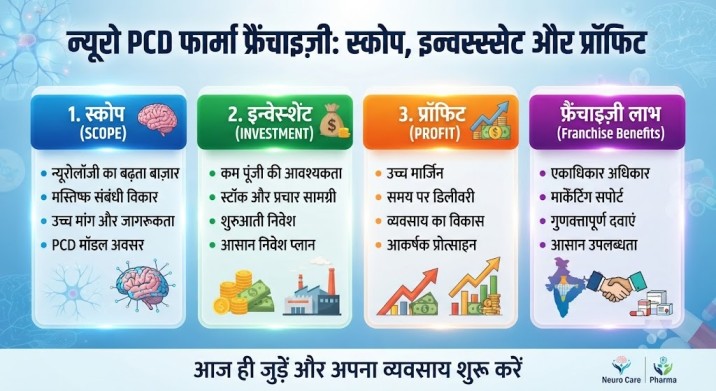
Neuro PCD Pharma Franchise in India: Scope, Investment & Profit (2026)
A neuro PCD pharma franchise in India can be started with ₹25,000–₹1,00,000 for a single territory, or up to ₹1,50,000 for a wider product range and multi-district coverage. Gross margins run 20–50%, and the segment is growing at 12% CAGR because neurological and psychiatric medicines are prescribed for months or years — not days.
India has over 30 million people affected by neurological disorders, and the CNS pharmaceutical market is valued at over ₹16,000 crore. This guide breaks down the real costs, margins, monopoly verification steps, and the working capital trap that catches most first-time neuro distributors.
One-Line Answer: What Does a Neuro PCD Franchise Cost?
Minimum entry: ₹25,000 for a single territory with a limited product range.
Properly set up single territory: ₹50,000–₹1,00,000.
Multi-district or full-range: ₹1,00,000–₹1,50,000+.
Why this matters to you: The ₹25,000 figure is real, but it buys a very narrow range. A properly stocked neuro franchise with promotional material and working capital is a ₹50,000–₹1,00,000 investment. Budget for the total, not the headline minimum.
What Is a Neuro PCD Pharma Franchise?
Propaganda Cum Distribution Explained
PCD stands for Propaganda Cum Distribution. A pharmaceutical company owns the brand and manufactures the products. You get the exclusive right to market and distribute that neuro range in a defined territory. You buy at the company’s net rate and sell to chemists and stockists at PTS or PTR. The difference is your margin.
You do not manufacture anything. You do not need a factory. You need a wholesale drug licence, GST registration, and a field plan for visiting neurologists, psychiatrists, and physicians.
What Makes Neuro Different from General PCD
A general PCD franchise sells antibiotics, painkillers, and antacids — commodity products with many generic alternatives, price-sensitive customers, and low brand loyalty. A neuro PCD franchise sells specialised medicines for epilepsy, depression, neuropathic pain, and migraine where brand reputation and therapeutic continuity support long-term prescriptions. The prescriber base is concentrated among neurologists, psychiatrists, and a growing number of general physicians and orthopaedists who prescribe neuropathic pain combinations.
Product Categories: Anti-Epileptics, Antidepressants, Neuropathic Pain, Nootropics
A well-built neuro PCD portfolio covers:
- Anti-epileptics: Levetiracetam, sodium valproate, phenytoin combinations.
- Antidepressants & antipsychotics: Escitalopram, duloxetine, olanzapine, risperidone.
- Neuropathic pain: Pregabalin and gabapentin combinations with methylcobalamin or nortriptyline.
- Migraine & vertigo: Flunarizine, propranolol, betahistine, cinnarizine.
- Nootropics & supplements: Citicoline, piracetam, methylcobalamin.
Why this matters to you: The product range is not exotic. These are the formulations every neurologist and psychiatrist prescribes daily. Your job is not to create demand — it is to capture prescriptions that already exist and keep them refilling.
Why Neuro Is India’s Fastest-Growing PCD Segment
30 Million+ Patients with Neurological Disorders
More than 30 million people in India are affected by neurological disorders, including migraines, epilepsy, Parkinson’s disease, anxiety, and depression. Rising awareness of mental health, lifestyle stress, and an ageing population are all expanding the patient base.
₹16,000 Crore CNS Pharmaceutical Market
The CNS (central nervous system) pharmaceutical market in India is valued at over ₹16,000 crore. Neurological and psychiatric conditions are rising fast, driving strong demand for anti-epileptic, antidepressant, neuropathic pain, and cognitive health medicines. Government initiatives like the National Mental Health Programme (NMHP) are also expanding mental health infrastructure and demand.
12% CAGR Growth in Neuro Medicines
India’s neuro medicine industry has seen a 12% CAGR growth in recent years. This is significantly faster than the overall pharmaceutical market, driven by lifestyle disorders, mental illness, and growing specialist access in Tier-2 and Tier-3 towns.
The Chronic Refill Advantage
Neuro-psychiatry is a chronic-therapy segment. Epilepsy, depression, anxiety, neuropathic pain, and migraine prophylaxis are treated for months or years, not days. The prescription is rarely changed once the patient is stable. A neurologist or psychiatrist who writes your brand today is still writing it next year — so every conversion compounds.
Why this matters to you: You are building a distribution business on a growing, chronic-care segment. The neuro margin advantage is real — but it is an operating advantage. It only shows up if you actually do the doctor visits and keep stock available.
The Real Investment: Where Your ₹25,000–₹1,50,000 Goes
Initial Stock Order, Drug Licence, Promotional Material, Working Capital
| Cost Component | Estimated Amount (₹) | What It Covers |
|---|---|---|
| Initial stock order | ₹25,000–₹1,00,000 | First batch of neuro and psychiatry formulations |
| Wholesale drug licence | ₹5,000–₹15,000 | Form 20B/21B from State Drug Controller |
| GST registration | ₹500–₹2,000 | Mandatory for commercial invoicing |
| Promotional material | ₹5,000–₹20,000 | Visual aids, samples, product literature, detailing bags |
| Working capital (2–3 months) | ₹15,000–₹30,000 | Reorder cycles, travel, field expenses, credit cycle buffer |
| Total | ₹25,000–₹1,50,000 | Depends on territory size and product range breadth |
Sources: Lifecare Neuro (2026), Seclis Labs (2026), Medfence Labs (2026). Figures are estimates and vary by brand, territory, and product mix.
Why this matters to you: The initial stock order gets all the attention. The working capital needed to sustain the next two or three months gets ignored — and that is exactly when partners hit a wall. Set aside capital for at least two additional reorder cycles before you start.
Profit Margins: Gross vs. Net (What You Actually Keep)
The Four Numbers: Net Rate, PTS, PTR, MRP
Your margin is determined by four prices: the net rate (what the company charges you), the PTS (price to stockist), the PTR (price to retailer), and the MRP (what the patient pays). Your gross margin is the difference between your net rate and the price at which you sell. The MRP sets the ceiling; the retailer and stockist each take a slice.
Margin by Product Category
| Product Category | Typical Gross Margin |
|---|---|
| Anti-epileptics | 20–35% |
| Antidepressants & antipsychotics | 25–45% |
| Neuropathic pain combinations | 35–50% |
| Migraine & vertigo products | 30–45% |
| Nootropics & neuro-nutraceuticals | 40–50% |
Sources: Janus Biotech (2025), Seclis Labs (2026), Vibcare (2026).
The DPCO Ceiling Price Caveat
Several core neuro-psychiatry molecules — levetiracetam, sodium valproate, phenytoin, fluoxetine, amitriptyline, olanzapine, and risperidone — are on the National List of Essential Medicines (NLEM). The scheduled strengths carry a government-fixed ceiling price, which caps the spread on those specific products. The combinations and non-listed molecules are priced normally. Every DPCO item should be flagged on the net-rate list before you compute margin. A company that does not flag DPCO items before you order is not being straight with you.
Why this matters to you: Plan your personal income around net, not gross. On NLEM molecules, the repeat volume — not the margin per strip — is the reason to stock them. On non-scheduled combinations and nutraceuticals, the margin is where you make your money.
Monopoly Rights: How to Verify Before You Sign
What Monopoly Actually Means
Monopoly rights mean the company will not appoint another franchise partner for the same product range in your defined territory. One partner, one area, one range. With monopoly rights, you are not competing internally with another distributor of the same company for the same neurologists and psychiatrists.
The 5-Point Monopoly Checklist
- Named territory: District, city, or taluk — written into the agreement, not “as discussed.”
- Product range: Which neuro SKUs and divisions are covered. A company may have monopoly and open divisions.
- Duration: Is exclusivity annual, permanent, or tied to minimum order conditions?
- Non-appointment clause: A written commitment that the company will not appoint another partner for the same range in your area.
- Breach consequences: What happens if the company violates the monopoly? What is your remedy?
Red Flags in Neuro Franchise Agreements
- Verbal monopoly promises. If it is not written, it is not enforceable.
- Vague territory descriptions. “Your area” is not a territory.
- No breach clause. A monopoly without consequences is a suggestion.
- Unilateral MOQ increases. Check whether the company can raise minimum order quantities after year one.
Why this matters to you: Monopoly rights are the entire reason the neuro PCD model works. Without written exclusivity, you are just another distributor competing on price against your own brand’s other partners.
Working Capital: The Real First-Year Requirement
The 60–90 Day Credit Cycle
Chemists and stockists do not pay immediately. You extend credit, and they pay in 60–90 days. This means you are funding the supply chain. Working capital must cover 60–90 days of credit cycle; otherwise you will run out of cash even if sales are growing.
Why Two Extra Reorder Cycles Matter
The initial stock order gets all the planning attention. The working capital needed to sustain the next two or three months gets ignored, and that is exactly when partners hit a wall. Set aside capital for at least two additional reorder cycles before you start. This buffer is what keeps the business alive during the slow early phase when prescriptions are still building.
Why this matters to you: Most people who quit a neuro PCD franchise do so because they run out of working capital in the first 6 months, not because the model failed. Budget for the credit cycle before you start.
Tier-2/3 City Scope: Why Indore, Jaipur, and Patna Work
Lower Competition, Fewer Specialists, Faster Activation
In Tier-2 and Tier-3 cities, the number of PCD franchise partners competing for the same neurologists and psychiatrists is lower than in metros. The demand for neuro and psychiatric medicines is growing as specialist access expands beyond big cities. A district with 3–5 active neurologists and psychiatrists and low PCD competition can generate steady revenue faster than a metro where 20 operators fight over the same doctors.
A neuro PCD franchise in a Tier-2 city can reach ₹40,000–₹80,000 in monthly revenue within 6–9 months if the partner works the territory seriously, generating ₹15,000–₹35,000 in monthly net profit at a 25–45% net margin.
Why this matters to you: The “best” territory is not the biggest city. It is the district where you can activate 5–10 prescribers with minimal competition and keep them supplied consistently.
How to Start: A Step-by-Step Roadmap
Step 1 — Territory Mapping
Before another sales call, list every neurology clinic, psychiatry clinic, and pharmacy in your area. Rank them by likely patient volume. Work that list deliberately. Reactive outreach — visiting whoever is available instead of whoever is relevant — wastes your most valuable early weeks.
Step 2 — Shortlist 3 WHO-GMP Companies
Use a checklist: WHO-GMP certification, DCGI-approved formulations, monopoly terms in writing, DPCO flagging on the net-rate list, dispatch turnaround, and marketing support. Ask for a draft agreement early. A genuine company will share it before you pay anything.
Step 3 — Negotiate Written Monopoly
Lock district-wise monopoly in writing, with clear net rates, PTR, MRP, and minimum order obligations. Do not accept verbal exclusivity. If it is not in the agreement, it does not exist.
Step 4 — Place a Focused First Order
Start with two or three formulations that match the doctors you will visit, not the full 200-SKU catalogue. A prescriber handed twenty options remembers none of them. A prescriber handed two, with a clear reason to try each, remembers both. Get those moving, then expand.
Step 5 — Activate 10 Prescribers in 90 Days
By day 30, you should have logged real conversations with at least ten prescribers. By day 60, several should have converted into actual prescriptions. By day 90, a repeat pattern should be visible. If none of these hit, do not wait for month four — fix the territory plan, the product focus, or the literature.
Why this matters to you: Depth beats breadth in your first ten relationships. Ten prescribers who genuinely trust you outperform fifty who met you once.
7-Point Checklist Before Choosing a Neuro PCD Franchise
- Is the company WHO-GMP certified and are its products DCGI-approved?
- Is the monopoly territory written with named districts and product ranges?
- Are DPCO/NLEM products clearly flagged on the net-rate list?
- What is the minimum order value, and can it be increased unilaterally after year one?
- Have I budgeted for 60–90 days of credit cycle and two extra reorder cycles?
- Have I spoken to 3 existing franchise partners about actual doctor activation and monthly income?
- Do I have a wholesale drug licence (Form 20B/21B) and GST registration before signing?
If the answer to questions 1, 2, or 6 is unclear, do not sign yet.
Final Verdict
If your budget is ₹25,000–₹1 lakh: A single-territory neuro PCD franchise is a real entry point, but it is a starter range. You will need to reinvest profits into expanding the product portfolio. Plan for ₹50,000–₹1 lakh total including working capital.
If your budget is ₹1–1.5 lakh: A multi-district or full-range neuro franchise gives you enough product range and working capital to survive the first 6 months. This is the realistic entry point for a full-time operator.
If you have neurologist or psychiatrist relationships: Neuro PCD is a natural fit. Your existing doctor network is the single biggest factor in early activation.
If you want a chronic-care, repeat-prescription business: Neuro beats general PCD on retention and per-prescriber volume. The trade-off is a narrower prescriber base and the need for written monopoly protection.
See verified neuro PCD pharma franchise options:
View franchise list on free-franchise.com →
Frequently Asked Questions (FAQ)
What is a neuro PCD pharma franchise?
It is a PCD (Propaganda Cum Distribution) franchise focused on neurological and psychiatric medicines — anti-epileptics, antidepressants, neuropathic pain combinations, and nootropics. The company manufactures and owns the brand; you get exclusive rights to market and distribute that range in a defined territory.
How much does a neuro PCD franchise cost in India?
A single territory starts at ₹25,000–₹1,00,000. A wider range or multi-district setup runs ₹1,00,000–₹1,50,000+. Add ₹15,000–₹30,000 for working capital and two extra reorder cycles. The ₹25,000 figure is a minimum order, not a full setup.
What is the profit margin in a neuro PCD franchise?
Gross margins range from 20% to 50% depending on the product category. Anti-epileptics earn 20–35%; antidepressants 25–45%; neuropathic pain combinations 35–50%; nutraceuticals 40–50%. Net profit after promotional spend and credit cycle delays is typically 25–45% of monthly turnover.
How do monopoly rights work in a neuro PCD franchise?
Monopoly rights mean the company will not appoint another franchise partner for the same product range in your defined territory. They must be written into the agreement with a named district, product range, duration, and breach consequences. Verbal exclusivity is not enforceable.
Is a neuro PCD franchise profitable in Tier-2 cities?
Yes. Tier-2 cities like Indore, Jaipur, and Patna have lower competition and growing specialist access. A partner with 5–8 active neurologists and psychiatrists can generate ₹40,000–₹80,000 monthly revenue within 6–9 months, earning ₹15,000–₹35,000 monthly net profit.
What is the DPCO caveat in neuro PCD franchises?
Several core neuro molecules (levetiracetam, sodium valproate, fluoxetine, olanzapine) are on the NLEM list, and their scheduled strengths carry a government-fixed ceiling price. This caps the margin on those specific products. Non-scheduled combinations and nutraceuticals are priced normally and carry higher margins.