


Low Cost Franchise vs Own Business in India: Which Path Fits Your ₹2–25 Lakh Budget?
October 16, 2026
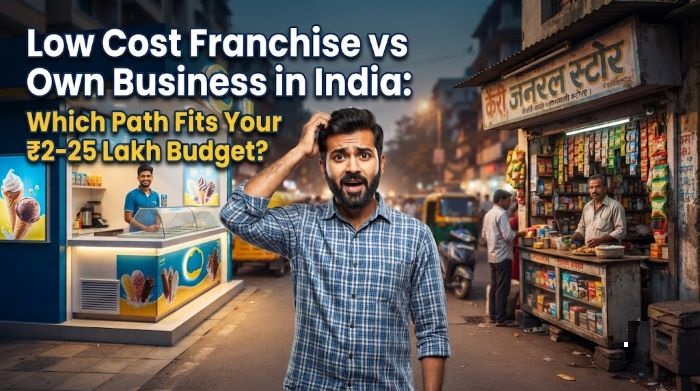
Low Cost Franchise vs Own Business in India: Which Path Fits Your ₹2–25 Lakh Budget?
If your budget is ₹2–25 lakh and you want to start a business in India, a low-cost franchise usually reduces your risk but limits your control. Starting your own business gives you full freedom but demands you build everything from scratch — brand, systems, and customer trust.
That’s the honest answer in two sentences.
Now let’s break it down like a mentor would — with real numbers, Indian context, and no fluff.
The Real Question: What Are You Buying — A Brand or Freedom?
A franchise is not a business. It’s a license to operate someone else’s business system. You pay for the brand, the training, the supply chain, and the playbook. In return, you follow their rules.
Your own business is the opposite. You are the brand. You are the system. You are the playbook — at least until you build one.
Why this matters to you: Most first-time entrepreneurs in India overestimate their ability to build a brand from zero. Franchises exist because that skill is rare and expensive to learn through failure.
Investment Reality Check: Where Your ₹2–25 Lakh Actually Goes
Franchise Cost Structure
A low-cost franchise in India typically has three cost layers:
- Franchise fee (one-time): ₹50,000–₹5 lakh
- Setup cost (interiors, equipment, deposit): ₹1–15 lakh
- Royalty (ongoing): 0–8% of monthly sales
- Marketing fee (ongoing): 1–3% of sales
Amul charges zero royalty, which is why their ₹2–6 lakh franchise model is one of the most attractive low-cost options in India. Most other brands charge 4–8%.
Own Business Cost Structure
Your costs are less predictable:
- Setup: Same range (₹1–15 lakh)
- Branding: ₹50,000–₹3 lakh (logo, packaging, signage, initial marketing)
- Trial-and-error cost: The hidden killer. Every wrong product, wrong price, wrong location is money burned.
- No royalty: You keep 100% of profit, but you also fund 100% of mistakes.
Investment Comparison Table: ₹2–25 Lakh Scenarios
| Budget | Franchise Path (Example) | Own Business Path | Key Difference |
|---|---|---|---|
| ₹2 lakh | Amul Kiosk / Railway Parlour | Local tea stall / tiffin service | Franchise gives brand trust; own gives full margin |
| ₹5 lakh | Amul Ice Cream Parlour / Small QSR | Small café / tailoring unit | Franchise has proven footfall drivers |
| ₹10 lakh | Preschool franchise (Kidzee tier) | Boutique / cloud kitchen | Franchise offers curriculum + parent trust |
| ₹25 lakh | Mid-tier food franchise | Restaurant with own brand | Franchise = lower risk, capped upside |
Source: FranchiseBazar, Zee News, NDTV (2025–2026)
Why this matters to you: At ₹2–5 lakh, the franchise premium is small. At ₹10 lakh+, the royalty burden compounds. Choose your budget band carefully.
Failure Rates in India: What the Data Actually Says
Franchise Survival Rates
Industry estimates place franchise success rates at 80–85%, compared to roughly 20% for independent startups in India. In the food sector specifically, only 15% of franchises fail within 5 years, while 50% of independent restaurants fail within 2 years.
The reasons are structural, not magical:
- Proven location selection
- Supply chain at lower cost
- Training that reduces operational errors
- Brand pull that reduces customer acquisition cost
Independent Business Failure Data
Government data shows 39,446 MSMEs shut down in FY 2024–25, nearly double the previous year. DPIIT estimates suggest ~90% of Indian startups fail within five years.
Not every own-business is a “startup” in the tech sense. But the pattern holds across small retail and service businesses: the first 18 months are brutal.
Why the Gap Exists — and When It Doesn’t
The gap exists because most first-time entrepreneurs underestimate three things: customer acquisition cost, working capital needs, and the time it takes to build trust.
The gap disappears when:
- You already have deep industry experience
- You have a captive customer base
- You are entering a niche where no franchise brand exists
Why this matters to you: If this is your first business and you don’t have a customer list, the franchise risk reduction is real, not marketing spin.
ROI and Break-Even: Franchise vs Own Business by City
ROI depends less on the model and more on rent, footfall, and local competition. A ₹5 lakh franchise in Indore can outperform a ₹15 lakh franchise in Mumbai if the rent-to-revenue ratio is better.
City-Wise Scenarios (Estimated)
| City | Rent (500 sq ft) | Franchise Break-Even (Est.) | Own Business Break-Even (Est.) |
|---|---|---|---|
| Mumbai | ₹80,000–1.5 lakh/month | 12–18 months | 18–30 months |
| Indore | ₹25,000–45,000/month | 8–12 months | 12–20 months |
| Jaipur | ₹30,000–50,000/month | 9–14 months | 14–22 months |
| Patna | ₹18,000–35,000/month | 7–11 months | 10–18 months |
Source: Industry estimates based on FranchiseBazar and local commercial rent data (2025–2026).
Low-cost franchises often break even within 6–12 months in Tier-2 cities because both setup cost and rent are lower.
ROI Comparison Table
| Factor | Franchise | Own Business |
|---|---|---|
| Net margin (food) | 15–22% | 20–30% |
| Royalty drag | 4–8% of sales | 0% |
| Marketing cost | Shared / national | 100% self-funded |
| Payback (Tier-2) | 8–14 months | 12–24 months |
| Upside ceiling | Brand-capped | Unlimited |
Why this matters to you: Franchise ROI is more predictable. Own-business ROI is higher if you survive the first year. Most don’t.
Control, Creativity, and Exit: The Non-Money Factors
Who Should NOT Buy a Franchise
- You want to change the menu, pricing, or store design.
- You hate reporting to a regional manager.
- You plan to exit in 2–3 years (franchise resale is restricted).
- You believe your idea is genuinely better than what the market offers.
Who Should NOT Start Alone
- This is your first business and you have no industry experience.
- You don’t have 12 months of personal runway.
- You cannot afford to lose your entire investment.
- You need brand trust to get customers through the door on day one.
Why this matters to you: The franchise vs own business decision is not about money alone. It’s about temperament. A creative person inside a franchise system is miserable. A risk-averse person running an independent brand is anxious every month.
The Hybrid Path Nobody Talks About
A growing number of Indian entrepreneurs are doing this:
Step 1: Buy a low-cost franchise (₹2–5 lakh range).
Step 2: Learn the systems — supply chain, staffing, marketing, compliance.
Step 3: After 2–3 years, launch your own brand in a different category or micro-market.
This works when:
- The franchise agreement has a clean exit clause
- You are not bound by a non-compete that blocks your next move
- You have built cash reserves from the franchise
It backfires when:
- You signed a 5-year agreement with heavy penalties
- You try to copy the franchisor’s product exactly (legal risk)
- You launch too early, before you have operational mastery
Why this matters to you: The franchise vs own business question is not binary. You can use one to fund and train for the other.
Checklist: 7 Questions Before You Choose
- Do I have 6–12 months of personal expenses saved separately?
- Have I spoken to at least 3 existing franchisees (or 3 own-business owners in my category)?
- Is my monthly rent less than 15% of expected monthly revenue?
- Can I survive if revenue is 40% below my estimate for the first 6 months?
- Does the franchise agreement allow me to exit without destroying my savings?
- If I start alone, do I have a customer acquisition plan that costs less than ₹150 per customer?
- Am I choosing this because it fits my skills — or because I’m afraid of the other option?
If you answered “no” to questions 1, 4, or 5, do not invest yet.
Final Verdict: It Depends on Three Things
Choose a low-cost franchise if:
- You are a first-time entrepreneur
- Your budget is ₹2–10 lakh
- You want a proven system and are okay with limited control
Choose your own business if:
- You have industry experience or a ready customer base
- Your budget is ₹10–25 lakh and you can absorb a longer break-even
- You value freedom more than predictability
Choose neither yet if:
- You don’t have 6 months of runway
- You haven’t spoken to people who have actually done it
The best business model in India is the one you can still operate in month 18.
Ready to explore verified low-cost franchise options in your city?
View franchise opportunities on free-franchise.com →
FAQ
Is a franchise more profitable than starting your own business?
Not necessarily. Franchises have lower failure rates and faster break-even, but royalties (4–8%) and franchise fees reduce net margins. Independent businesses can earn higher margins if they survive the first 18 months. Profitability depends more on your execution than the model itself.
What is the failure rate of franchises in India?
Industry estimates place franchise failure rates at 15–20% within the first five years. By contrast, independent restaurants see 50% failure within two years, and government data shows 39,446 MSME shutdowns in FY 2024–25. Franchises are not risk-free, but the structured support reduces common early-stage mistakes.
Which is safer: franchise or own business?
A franchise is safer for a first-time entrepreneur with no industry experience. The brand, training, and supply chain reduce operational risk. Your own business is safer if you already have deep category knowledge, a customer base, and enough capital to survive 12 months of low revenue.
How much investment is needed for a low-cost franchise in India?
Low-cost franchises in India start at ₹50,000 (service-based models like Delhivery partner) and go up to ₹5 lakh for food kiosks and dairy outlets. Amul outlets require ₹2–6 lakh with zero royalty. A workable budget for a first franchise is ₹2–5 lakh, including setup and 3 months of working capital.
Can I convert my own business into a franchise later?
Yes. Many Indian brands started as single outlets and later franchised. You need a proven unit economics model, documented SOPs, a training program, and at least 2–3 profitable outlets before you can franchise credibly. Expect 18–36 months of preparation.
What is the biggest mistake first-time franchise buyers make?
Underestimating working capital. The franchise fee and setup cost are visible. The hidden cost is the 3–6 months of rent, salaries, and supplies before revenue stabilizes. Most franchise failures in India are cash-flow failures, not brand failures.
Should I choose a franchise or own business in a Tier-2 city?
In Tier-2 cities like Indore, Jaipur, and Patna, low-cost franchises often outperform because rent is lower and brand trust matters more where local competition is fragmented. Own-business works better if you already have a strong local network or a unique product that no franchise offers.