

Last-Mile Delivery Franchise in India: Start with ₹50,000
November 16, 2026
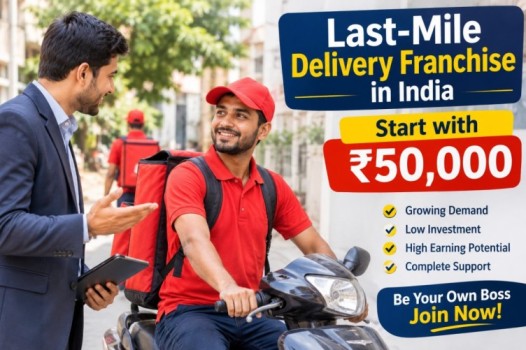
Last-Mile Delivery Franchise in India: Start with ₹50,000 (2027 Guide)
A last-mile delivery franchise in India can be started with ₹50,000 for a drop-point or booking counter, or ₹2–15 lakh for a delivery hub or full-scale franchise centre. India’s last-mile delivery market is projected to expand from USD 7.96 billion in 2026 to USD 14.45 billion by 2031, growing at a CAGR of 12.67%** — and **Tier-2 and Tier-3 cities now account for over 40% of total shipment volumes**.
The ₹50,000 entry point is real. Delhivery’s Cosmos drop-point format starts at ₹50,000** with **200+ sq ft** space . DTDC’s Flex Partner model starts at **₹1.5–2 lakh** . Shadowfax’s delivery hub requires **₹5–15 lakh** and **500–600 sq ft** . Ecom Express delivery centres operate at **₹2–5 lakh** . This guide breaks down the real costs, the per-parcel economics, the hidden royalties, and the brands that fit a ₹50,000–₹15 lakh budget.
One-Line Answer: What Does a Last-Mile Delivery Franchise Cost in 2027?
₹50,000–₹2 lakh (drop-point / booking counter): A small shopfront that collects and drops parcels. Delhivery Cosmos** starts at **₹50,000** with **200+ sq ft** . Ekart Delivery Partner** starts at **₹50,000–₹3 lakh** . DTDC Flex Partner** operates at **₹1.5–2 lakh** . Best for first-timers and Tier-2/3 city operators.
₹2–5 lakh (delivery centre): A local hub that receives, sorts, and delivers parcels in an assigned territory. Ecom Express** operates at **₹2–5 lakh** with **300–400 sq ft** space . Delhivery Constellation (Delivery Centre)** starts at **₹5 lakh** with **800+ sq ft**, a **₹2 lakh franchise fee**, and **10% royalty** . Best for operators who want a delivery-focused business.
₹5–15 lakh (full-scale hub): A larger facility with sorting space, staff, and a delivery fleet. Shadowfax** operates at **₹5–15 lakh** with **500–600 sq ft** space and a revenue-sharing model . Delhivery Constellation** at the higher end. Best for experienced operators with larger capital and access to high-volume territories.
Why this matters to you: The ₹50,000 budget is the realistic entry point for a drop-point. The ₹5–15 lakh budget opens up a full delivery hub. Choose the format before you choose the brand.
Why Last-Mile Delivery Is Booming in India in 2027
USD 7.96 Billion Market in 2026 → USD 14.45 Billion by 2031
India’s last-mile delivery market is projected to expand from USD 7.51 billion in 2025** and **USD 7.96 billion in 2026** to **USD 14.45 billion by 2031**, registering a **CAGR of 12.67%** between 2026 and 2031 . The e-commerce last-mile segment alone is growing at **15.63% CAGR**, from **USD 3.66 billion in 2026** to **USD 7.57 billion by 2031** .
40%+ of Shipments Now Come from Tier-2/3 Cities
Tier-2 and Tier-3 cities are pushing over 40% of total shipment volumes** now . Tier-2 and Tier-3 GMV expanded by **42% in 2025**, far outstripping metro growth . Flipkart’s Ekart expanded its pin-code coverage from **19,000 to 23,500**, compressing two-day delivery coverage across **Jaipur, Lucknow, and Visakhapatnam** . Cities like Jodhpur, Varanasi, Coimbatore, and Nagpur are no longer fringe markets — they are growth engines.
1,489 Dark Stores and the Quick-Commerce Wave
Dark-store count hit 1,489 by March 2026**, up **67% in fifteen months** as Blinkit, Zepto, and Swiggy Instamart raced to maintain 10–15-minute delivery promises . Every dark store needs a local last-mile partner for hyperlocal deliveries. The quick-commerce wave has created a new, high-frequency revenue stream for delivery franchises.
Why this matters to you: You are not entering a saturated market. You are entering a market where the organised share is still small and growing — especially in Tier-2 cities.
The Three Last-Mile Franchise Models Under ₹15 Lakh
Drop-Point / Booking Counter (₹50,000–₹2 Lakh)
The lowest-investment entry. A small shopfront that collects parcels from customers and hands them to the brand’s network, or receives parcels for last-mile delivery. Delhivery Cosmos** starts at **₹50,000** with **200+ sq ft** . Ekart Delivery Partner** starts at **₹50,000–₹3 lakh** . DTDC Flex Partner** operates at **₹1.5–2 lakh** . Best for first-timers, Tier-2/3 city operators, and anyone with a small shopfront who wants to add parcel services.
Delivery Centre / Hub (₹2–8 Lakh)
A local hub that receives, sorts, and delivers parcels in an assigned territory. Ecom Express** operates at **₹2–5 lakh** with **300–400 sq ft** . The company covers **27,000+ PIN codes** and appoints franchises in Tier-2/3 towns . Delhivery Constellation (Delivery Centre)** starts at **₹5 lakh** with **800+ sq ft**, a **₹2 lakh franchise fee**, **10% royalty**, and a **15–25% net margin** . Best for operators who want a delivery-focused business with a proven brand.
Full-Scale Hub (₹8–15 Lakh)
A larger facility with sorting space, staff, and a delivery fleet. Shadowfax** operates at **₹5–15 lakh** with **500–600 sq ft** space and a revenue-sharing model . The company does not publish an official franchise fee, but third-party estimates range from **₹50,000 to ₹10 lakh** — always get the terms in writing . Delhivery Constellation** at the higher end of this range. Best for experienced operators with larger capital and access to high-volume territories.
Comparison Table: Investment, Space, Payback
| Model | Investment | Space | Payback | Best For |
|---|---|---|---|---|
| Drop-Point / Counter | ₹50,000–₹2 lakh | 200–300 sq ft | 6–12 months | First-timers, Tier-2/3 cities |
| Delivery Centre / Hub | ₹2–8 lakh | 300–800 sq ft | 8–18 months | Delivery-focused operators |
| Full-Scale Hub | ₹8–15 lakh | 500–1,000 sq ft | 12–24 months | Experienced operators, high volume |
Sources: FranchiseBazar (Oct 2026), BizFit (Nov 2026), The Business Talky (Aug 2026), NextWhatBusiness (Oct 2026). Figures are estimates and vary by city, brand, and format.
The Real Investment: Where Your ₹50,000–₹15 Lakh Goes
Franchise Fee, Office Setup, Equipment, Working Capital
| Cost Component | Drop-Point (₹) | Delivery Centre (₹) | Full Hub (₹) |
|---|---|---|---|
| Franchise fee | ₹0–₹50,000 | ₹50,000–₹2 lakh | ₹1–2 lakh |
| Office setup & interior | ₹30,000–₹1 lakh | ₹50,000–₹1.5 lakh | ₹1–3 lakh |
| Equipment (scanner, printer, CCTV) | ₹20,000–₹50,000 | ₹50,000–₹1 lakh | ₹1–2 lakh |
| Security deposit | ₹10,000–₹50,000 | ₹25,000–₹1 lakh | ₹1–2 lakh |
| Working capital (3–6 months) | ₹30,000–₹1 lakh | ₹1–3 lakh | ₹2–5 lakh |
| Total | ₹50,000–₹2 lakh | ₹2–8 lakh | ₹8–15 lakh |
Sources: FranchiseBazar (Oct 2026), BizFit (Nov 2026), The Business Talky (Aug 2026), NextWhatBusiness (Oct 2026). Figures are estimates and vary by city and agreement.
The Hidden Costs Nobody Budgets For
Royalty: Delhivery charges 10% revenue royalty** on its Constellation format . On ₹2 lakh monthly revenue, that is ₹20,000 per month — ₹2.4 lakh per year. Some brands use revenue-sharing instead of a fixed royalty. Always calculate the annual rupee impact.
Vehicle and fuel: ₹50,000–₹2 lakh for bikes or vans. Delivery partners need their own vehicles in many models. Fuel and maintenance are recurring monthly costs.
Staff: ₹50,000–₹2 lakh for recruitment and training. A delivery hub needs at least a centre manager and one delivery executive . Staff turnover in logistics is high — budget for replacement.
Working capital: ₹30,000–₹5 lakh. Customers pay per parcel, but salaries, rent, and fuel are monthly. A hub doing 2,000 deliveries a month may have ₹1–2 lakh locked up in receivables.
Why this matters to you: The franchise fee is only 20–50% of the total cost for drop-points. Royalty and working capital make up the bulk over time. A ₹50,000 franchise fee with no working capital buffer is not a ₹50,000 business — it is a ₹2–3 lakh business waiting to run out of cash.
Profit Margins and ROI: The Real Numbers
₹10–35 Per Parcel and 15–25% Net Margins
Delivery partners earn ₹10–35 per parcel** depending on weight, distance, and COD/non-COD . Ekart** pays **₹10–50 per delivery** . Ecom Express** pays **₹10–35 per parcel** . Net margins are typically **15–25%** after deducting fuel, staff, rent, and vehicle maintenance . Blue Dart’s real net margins are 12–20%**, not the inflated 35–45% figures sometimes quoted online . DTDC last-mile exclusive store owners report earning **upward of ₹25,000 per month** .
6–18 Month Payback Depending on Model
Drop-points and small counters can break even in **6–12 months**. Delivery centres take **8–18 months**. Full hubs take **12–24 months**. Delhivery reports a **6–12 month break-even** on its Constellation format . The fastest paybacks are in the lower-capex drop-point models.
Monthly Profit Scenarios Table
| Model | Monthly Revenue (Est.) | Net Margin | Monthly Net Profit (Est.) |
|---|---|---|---|
| Drop-Point | ₹30,000–₹80,000 | 20–30% | ₹6,000–₹24,000 |
| Delivery Centre | ₹1–3 lakh | 15–25% | ₹15,000–₹75,000 |
| Full Hub | ₹3–6 lakh | 15–25% | ₹45,000–₹1.5 lakh |
Sources: Industry estimates based on NextWhatBusiness (Oct 2026), BizFit (Nov 2026), and FranchiseBazar (Oct 2026). Figures assume steady parcel volume and controlled overhead.
Why this matters to you: A drop-point at ₹50,000 monthly revenue and 25% net margin can earn ₹12,500 per month. A delivery centre at ₹2 lakh revenue and 20% margin can earn ₹40,000 per month. The higher investment buys a higher income ceiling.
Top Last-Mile Delivery Franchise Brands in India (2027)
Delhivery (₹50,000 Cosmos Drop-Point)
India’s largest e-commerce logistics provider with 4,960 delivery centres** (694 franchise, 4,266 company-owned) and 18,700+ pin codes** . Cosmos (Drop Point)** starts at **₹50,000** with **200+ sq ft** . Constellation (Delivery Centre)** starts at **₹5 lakh** with **800+ sq ft**, a **₹2 lakh franchise fee**, **10% royalty**, and a **15–25% net margin** . Break-even: **6–12 months** . Best for operators who want the lowest entry point and the largest network.
Shadowfax (₹5–15 Lakh Delivery Hub)
A tech-driven logistics company (founded 2015) serving Flipkart, Meesho, Myntra, Nykaa, Ajio, and others . The company offers two formats: Channel Partner** (shipping store) and **Delivery Franchise Partner** (last-mile hub) . Investment: **₹5–15 lakh** . Space: **500–600 sq ft** . Shadowfax does not publish an official franchise fee, but third-party estimates range from **₹50,000 to ₹10 lakh** — get the terms in writing . Revenue comes from parcel volume and delivery performance . Best for hands-on operators who want an operations-focused business.
Ecom Express (₹2–5 Lakh Delivery Centre)
An e-commerce logistics provider (founded 2012, acquired by Delhivery in 2025 for ₹1,400 crore) covering **27,000+ PIN codes** . Investment: **₹2–5 lakh** . Franchise fee: **₹50,000–₹1 lakh** . Royalty: **~10%** (franchisee keeps ~90%) . Space: **300–400 sq ft** . Best for operators in Tier-2/3 cities where Ecom Express is expanding its franchise network .
Ekart (₹50,000–₹3 Lakh Delivery Partner)
Flipkart’s logistics arm (founded 2009) with thousands of delivery hubs nationwide . Delivery Partner** model: **₹50,000–₹3 lakh** . Standard Franchise/Counter**: **₹2–6 lakh** . Hub & Spoke**: **₹5–20 lakh** . Ekart does not run a classic franchise; partners are paid per parcel (**₹10–50 per delivery**) with no published royalty . Best for operators who want a per-parcel income model without a franchise fee.
DTDC (₹1.5–6 Lakh)
A legacy courier brand (since 1990) with **16,500+ channel partners** and **14,000+ pin codes** . Models: Flex Partner** at **₹1.5–2 lakh**, **Smile Partner** at **₹2–3 lakh**, **Smile+ Partner** at **₹3–4 lakh**, **DTDC360 Partner** at **₹4–6 lakh**, and **Enterprise Partner** at **₹4–6 lakh+** . Minimum space: **250 sq ft** . DTDC last-mile exclusive store owners report earning **upward of ₹25,000 per month** . Best for operators who want a proven brand with a low entry point.
Brand Comparison Table
| Brand | Investment | Model | Royalty | Best For |
|---|---|---|---|---|
| Delhivery (Cosmos) | ₹50,000 | Drop Point | Not specified | Lowest entry, largest network |
| Ekart | ₹50,000–₹3 lakh | Delivery Partner | None (per-parcel) | Per-parcel income, no fee |
| DTDC | ₹1.5–6 lakh | Flex to Enterprise | Not specified | Proven brand, low entry |
| Ecom Express | ₹2–5 lakh | Delivery Centre | ~10% | Tier-2/3 expansion |
| Delhivery (Constellation) | ₹5 lakh | Delivery Centre | 10% | Larger hub, higher volume |
| Shadowfax | ₹5–15 lakh | Delivery Hub | Revenue share | Operations-focused |
Sources: BizFit (Nov 2026), NextWhatBusiness (Oct 2026), The Business Talky (Aug 2026), FranchiseBazar (Oct 2026). Figures are estimates and vary by city and agreement.
What ₹50,000 Cannot Buy: The Full Hub Reality
Shadowfax and Delhivery Constellation at ₹5–15 Lakh
Shadowfax requires ₹5–15 lakh** for a delivery hub with **500–600 sq ft** space . Delhivery’s Constellation format starts at **₹5 lakh** with **800+ sq ft** . The ₹50,000 budget cannot cover these formats. But the drop-point model lets you learn the business — parcel handling, customer service, local logistics — before committing ₹5–15 lakh.
Why the Drop-Point Route Is Smarter
A ₹50,000 drop-point lets you build a customer base and understand local parcel volumes without the burden of a full hub, staff, and delivery fleet. If the drop-point works, you can upgrade to a delivery centre later using accumulated profits. If it does not, the loss is manageable. Starting with a full hub on a ₹50,000 budget is not possible without underfunding the business.
Why this matters to you: The ₹50,000 budget is a learning budget. It buys a drop-point, not a hub. Treat it as your entry into the last-mile delivery business, not your final destination.
Tier-2 City Advantage: Why Indore, Jaipur, and Patna Work
42% GMV Growth in Tier-2/3 Cities
Tier-2 and Tier-3 GMV expanded by 42% in 2025**, far outstripping metro growth . Smaller cities and towns now account for **40%+ of total shipment volume** . Flipkart’s Ekart expanded its pin-code coverage from **19,000 to 23,500**, compressing two-day delivery coverage across **Jaipur, Lucknow, and Visakhapatnam** . ElasticRun’s kirana network model has reduced last-mile costs by **30% in Uttar Pradesh and Bihar** .
A drop-point or delivery centre in a Tier-2 city can generate ₹50,000–₹2 lakh in monthly revenue** within 3–6 months if the location has steady e-commerce parcel volume, generating **₹10,000–₹40,000 in monthly net profit** at a 15–25% net margin. The first organised delivery partner in a district captures the majority of demand simply because there is nothing else competing at that level.
Why this matters to you: The same ₹50,000 that barely covers a metro shop deposit can fund a complete drop-point with working capital in a Tier-2 city. Lower rent means faster break-even and higher net margin on the same revenue.
7-Point Checklist Before Choosing a Last-Mile Franchise
- Does the all-in investment (fee + setup + working capital) fit my budget?
- Is the model a drop-point, delivery centre, or full hub? Does it match my location and skills?
- What is the exact royalty or revenue share? Does it apply to gross or net revenue?
- Does the franchisor provide a written term sheet, or are you relying on third-party estimates?
- Have I budgeted ₹30,000–₹5 lakh for working capital and vehicle costs?
- Have I spoken to 3 existing franchisees about actual monthly parcel volume and net profit?
- Is the territory protected in writing, and does the brand have a local parcel pipeline I can serve?
If the answer to questions 1, 3, or 4 is unclear, do not sign yet.
Final Verdict
If your budget is ₹50,000–₹2 lakh: Delhivery Cosmos, Ekart Delivery Partner, or DTDC Flex Partner is the realistic entry point. Drop-point model, 6–12 month payback, and low capital. Best for first-time operators in Tier-2 cities.
If your budget is ₹2–5 lakh: Ecom Express or Delhivery Constellation offers a delivery centre with a proven brand and a 15–25% net margin. Best for operators who want a delivery-focused business.
If your budget is ₹5–15 lakh: Shadowfax or a larger Delhivery hub offers a full-scale delivery centre with higher revenue potential. Best for experienced operators with access to high-volume territories.
If you want the lowest-risk first business: Start with a drop-point. Learn the parcel business, build cash flow, and upgrade to a delivery centre later. The ₹50,000 entry is not a compromise — it is a smart first step.
See verified last-mile delivery franchise options:
View last-mile delivery franchise list on free-franchise.com →
Or fill this 2-minute form and get 5 franchise options with full cost and margin breakdowns for your city.
Frequently Asked Questions (FAQ)
What is the best last-mile delivery franchise for a ₹50,000 budget?
Delhivery’s Cosmos drop-point starts at ₹50,000 with 200+ sq ft space. Ekart’s Delivery Partner model starts at ₹50,000–₹3 lakh. DTDC’s Flex Partner operates at ₹1.5–2 lakh. These are drop-point or counter models, not full delivery hubs.
How much does a last-mile delivery franchise cost in India?
It ranges from ₹50,000 for a drop-point (Delhivery Cosmos) to ₹2–5 lakh for a delivery centre (Ecom Express), ₹5–15 lakh for a full hub (Shadowfax, Delhivery Constellation), and ₹5–20 lakh+ for larger hub-and-spoke models (Ekart). The all-in cost includes the franchise fee, setup, equipment, and working capital.
What is the profit margin in a last-mile delivery franchise?
Net margins are typically 15–25%. Delivery partners earn ₹10–35 per parcel depending on weight, distance, and COD. DTDC exclusive store owners report earning upward of ₹25,000 per month. A delivery centre at ₹2 lakh monthly revenue and 20% net margin can earn ₹40,000 per month.
How long does it take to break even in a last-mile delivery franchise?
Drop-points and small counters can break even in 6–12 months. Delivery centres take 8–18 months. Full hubs take 12–24 months. Delhivery reports a 6–12 month break-even on its Constellation format. The fastest paybacks are in the lower-capex drop-point models.
Is a last-mile delivery franchise profitable in Tier-2 cities?
Yes. Tier-2 and Tier-3 cities now account for over 40% of total shipment volume, and Tier-2/3 GMV expanded by 42% in 2025. A drop-point or delivery centre in Indore or Jaipur can break even in 6–12 months and generate ₹10,000–₹40,000 in monthly net profit.
What is the difference between a drop-point and a delivery hub?
A drop-point (₹50,000–₹2 lakh) is a small shopfront that collects and drops parcels — no staff or delivery fleet required. A delivery hub (₹5–15 lakh) has sorting space, a centre manager, delivery executives, and vehicles. Drop-points have lower capex and faster payback; hubs have higher revenue ceilings.