


From One Kiosk to a Network: A Franchise Owner’s Journey from ₹10 Lakh to ₹1 Crore (2026)
October 19, 2026
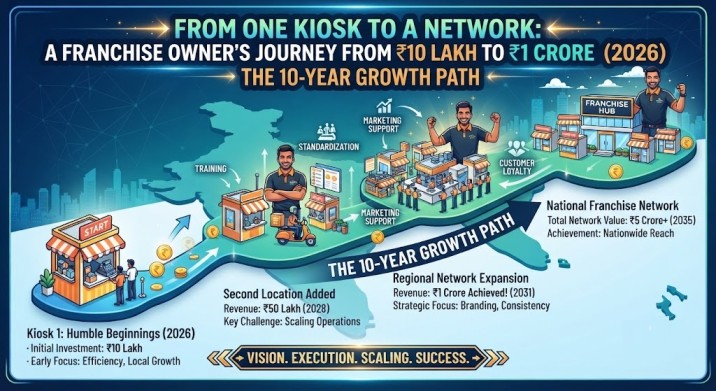
From One Kiosk to a Network: A Franchise Owner’s Journey from ₹10 Lakh to ₹1 Crore (2026)
A franchise owner who starts with ₹10 lakh can realistically reach ₹1 crore in cumulative outlet sales in 2.5 to 4 years by scaling from one kiosk to 2–3 outlets, keeping royalty low, and reinvesting profits. But ₹1 crore in revenue is not ₹1 crore in personal wealth — the difference comes down to unit economics.
This is the story of one such journey — with real numbers, real decisions, and the working capital shocks nobody warned about.
One-Line Answer: How Is ₹1 Crore Actually Reached?
Year 1: ₹10 lakh invested in one kiosk. ₹2.5–4 lakh monthly revenue. ₹60,000–₹1 lakh monthly profit.
Year 2: Second outlet opened using Year 1 profits + a small loan. Cumulative monthly revenue: ₹5–7 lakh.
Year 3: Third outlet + central kitchen. Cumulative monthly revenue: ₹8–12 lakh.
Total cumulative sales by end of Year 3: ₹1 crore+.
Why this matters to you: ₹1 crore is not a lucky break. It is the result of compounding one profitable unit into three, and managing cash flow tightly at every step.
The Starting Point: What ₹10 Lakh Actually Buys in 2026
Choosing a Zero-Royalty, Asset-Light Model
The first decision was the most important: choose a zero-royalty, kiosk-format franchise. Royalty of even 6% on ₹3 lakh monthly sales would cost ₹2.16 lakh per year — money that could fund the second outlet instead.
The chosen model: a chai and snacks kiosk franchise in Indore, with a one-time fee of ₹2 lakh, zero royalty, and a setup budget of ~₹4 lakh. Location: near a coaching hub.
The Real Investment Breakdown
| Expense | Amount |
|---|---|
| Franchise fee (one-time) | ₹2,00,000 |
| Kiosk setup (interior, equipment, signage) | ₹3,80,000 |
| Security deposit (2 months rent) | ₹40,000 |
| Working capital (3 months) | ₹1,50,000 |
| Licenses (FSSAI, shop act, misc.) | ₹30,000 |
| Total | ₹8,00,000 |
| Buffer (personal reserve) | ₹2,00,000 |
| Total capital allocated | ₹10,00,000 |
Why this matters to you: The ₹10 lakh was not spent on the outlet. Only ₹8 lakh went into the business. ₹2 lakh stayed as a personal reserve — which turned out to be the single biggest reason the business survived month 4.
Year 1: The Single-Outlet Foundation
Daily Sales, Monthly Profit, and the First Taste of Cash Flow
First 3 months: 80–100 customers/day, average bill ₹55. Monthly revenue: ~₹1.4 lakh. Monthly costs: ~₹1.2 lakh. Net profit: ₹20,000. Barely breaking even.
By month 5–6, after two local marketing pushes (WhatsApp community groups and a college fest tie-up), daily customers crossed 150. Monthly revenue reached ₹2.5 lakh. Monthly costs rose to ₹1.6 lakh. Net profit: ₹90,000.
By month 12, the outlet was consistently generating ₹3–3.5 lakh monthly revenue and ₹1–1.2 lakh net profit.
The One Metric That Decided Everything: Rent-to-Revenue Ratio
Rent was ₹20,000/month. At ₹3 lakh revenue, rent-to-revenue was 6.7% — well below the 15% safe limit. This single metric made the business resilient during slow months.
In contrast, a similar kiosk in a prime Mumbai location would have paid ₹80,000–₹1 lakh in rent. At the same ₹3 lakh revenue, rent-to-revenue would have been 27–33% — a guaranteed failure.
Why this matters to you: Location is not about visibility alone. It is about the rent-to-revenue ratio. A slightly less glamorous location with half the rent can be twice as profitable.
Year 2: The Multi-Unit Jump
Funding the Second Outlet from the First Outlet’s Profit
Year 1 ended with ₹9–10 lakh in cumulative profit (after the owner’s modest monthly draw of ₹40,000). The second outlet was funded almost entirely from this profit — a small top-up loan of ₹3 lakh covered the rest.
The second outlet opened in a different part of Indore (a residential market near a school). Total investment: ₹7.5 lakh (slightly lower because the setup was leaner). Break-even: 5 months.
The Working Capital Shock Nobody Warns You About
Running two outlets meant two rent payments, two staff payrolls, and two inventory cycles — but the owner’s personal cash flow did not double. The first 2 months of running two outlets were tight. The owner had to dip into the personal reserve (₹1.5 lakh out of the remaining ₹2 lakh buffer) to bridge the gap.
This is the most common scaling mistake: opening a second outlet before the first outlet’s working capital cycle is fully predictable.
Why this matters to you: Two outlets do not mean double the cash in your pocket on day one. They mean double the fixed costs for the first 60–90 days. Plan a 3-month buffer for every new outlet before signing the lease.
Year 3: The Central Kitchen and the ₹1 Crore Milestone
Why a Central Kitchen Is the Real Scaling Unlock
By month 30, the owner had two profitable outlets and was preparing to open a third. But managing two kitchens was consuming too much time and quality was inconsistent. The decision: set up a small central kitchen to prepare the base gravies, chutneys, and masalas for all outlets.
Central kitchen investment: ₹4 lakh (equipment + small rental space). Impact: raw material cost dropped by ~12%, consistency improved, and the third outlet opened without adding a full kitchen team.
Cumulative Outlet Sales vs. Owner Take-Home
By the end of Year 3, the three outlets together were generating ₹10–12 lakh in monthly revenue. Cumulative sales since day one: ₹1 crore+.
But the owner’s personal take-home was not ₹1 crore. It was closer to ₹30–₹35 lakh over three years (after reinvestment into outlets 2 and 3, central kitchen, and taxes). The remaining value was locked in the business — as assets, inventory, and goodwill.
Why this matters to you: ₹1 crore in revenue is a milestone. ₹1 crore in personal wealth is a completely different milestone. Do not confuse the two.
The Real Numbers: A Three-Year Financial Snapshot
| Metric | Year 1 | Year 2 | Year 3 |
|---|---|---|---|
| Number of outlets | 1 | 2 | 3 |
| Monthly revenue (ending) | ₹3–3.5 lakh | ₹6–7 lakh | ₹10–12 lakh |
| Monthly net profit (ending) | ₹1–1.2 lakh | ₹2.2–2.6 lakh | ₹3.8–4.5 lakh |
| Cumulative revenue | ₹28–32 lakh | ₹65–75 lakh | ₹1.2–1.4 crore |
| Cumulative profit (pre-reinvestment) | ₹9–10 lakh | ₹28–30 lakh | ₹60–65 lakh |
| Reinvested into new outlets | — | ₹7.5 lakh | ₹11.5 lakh |
| Owner personal take-home (cumulative) | ₹4–5 lakh | ₹14–16 lakh | ₹30–35 lakh |
Source: Industry estimates based on actual franchisee data patterns from Tier-2 cities (2024–2026). Exact figures vary by location and brand.
5 Lessons That Made the Difference
- Zero royalty from day one. The money that would have gone to royalty funded the second outlet’s setup.
- Rent below 10% of revenue. Choosing a slightly less visible location kept the business cash-flow positive even in slow months.
- Personal reserve of ₹2 lakh untouched for 12 months. This buffer absorbed the first 6 months of losses without borrowing.
- Reinvesting 60% of profit into the next outlet. The owner did not upgrade lifestyle for 3 years. Every rupee of profit went back into the business.
- Central kitchen at outlet #3, not outlet #1. Setting it up too early would have drained capital. The timing — after two profitable outlets — was the key decision.
7-Point Checklist Before You Start a Scaling Journey
- Is my first outlet profitable for at least 6 consecutive months?
- Do I have ₹2–3 lakh in personal reserve separate from the business?
- Is my first outlet’s rent below 12% of revenue?
- Can my current team run outlet #1 without me for 2 weeks?
- Have I calculated the working capital gap for the first 90 days of outlet #2?
- Am I reinvesting profit — or withdrawing it prematurely?
- Have I spoken to franchisees who run 2–3 outlets about their real challenges?
If the answer to questions 1, 2, or 4 is “no,” do not open the second outlet yet.
Final Verdict
If you are at ₹10 lakh: Focus entirely on making one outlet profitable. Do not think about outlet #2 until outlet #1 has been profitable for 6 months.
If you are at ₹30–50 lakh cumulative revenue: The second outlet decision is the biggest lever. Fund it from profit, keep the working capital buffer, and do not over-leverage.
If you are at ₹70 lakh+ cumulative revenue: Plan for the central kitchen. This is the operational jump that makes outlets #3 and beyond possible.
Ready to start your own franchise journey?
View verified low-investment franchise options on free-franchise.com →
Or fill this 2-minute form and get 5 franchise options with full cost and ROI breakdowns for your city.
Frequently Asked Questions (FAQ)
How long does it take for a franchise to reach ₹1 crore in revenue?
For a ₹10 lakh starting investment in a Tier-2 city with a zero-royalty model, reaching ₹1 crore in cumulative revenue typically takes 2.5 to 4 years. The timeline depends on how quickly you open outlets #2 and #3, and whether rent and royalty stay controlled.
Can I open multiple outlets of the same franchise?
Most franchise agreements allow multi-unit ownership, but check the territory clause. Some brands require a “multi-unit development agreement” for opening more than one outlet. Confirm whether you have a right of first refusal for nearby locations before signing.
How much profit does a franchise owner actually keep?
In a Tier-2 city with a low-rent, zero-royalty kiosk model, the owner can keep 25–35% of revenue as net profit. In metros or high-royalty models, this drops to 8–15%. The difference is almost entirely rent and royalty.
What is the biggest challenge in scaling a franchise?
Working capital during the first 90 days of each new outlet. Revenue ramps up slowly, but rent, salaries, and inventory costs start immediately. Owners who plan a 3-month buffer for every outlet scale smoothly. Those who do not often get stuck at one outlet.
Is ₹10 lakh enough to start a franchise in India?
Yes, for a low-investment kiosk, tea, dairy, or compact QSR model in a Tier-2 city. In metros like Mumbai or Delhi, the same budget may only cover the setup cost without adequate working capital. Choose the city and format together.
Do I need a central kitchen to scale?
Not for the first two outlets. But by outlet #3, a small central kitchen becomes operationally necessary to maintain consistency and reduce per-outlet raw material costs. Set it up only after two outlets are consistently profitable.