

EV Charging Station Franchise in India: Start with ₹5 Lakh (2027 Guide)
November 13, 2026
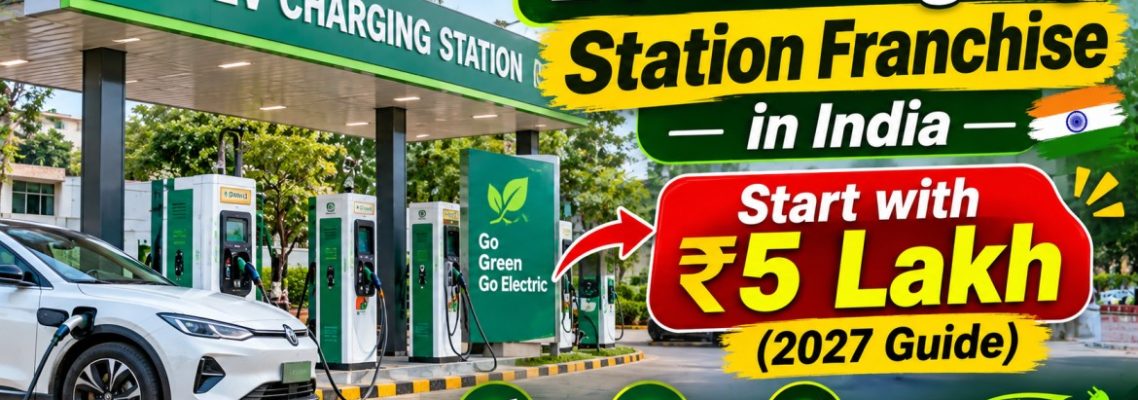
EV Charging Station Franchise in India: Start with ₹5 Lakh (2027 Guide)
An EV charging station franchise in India can be started with ₹5–10 lakh for an AC-only setup, or ₹12–25 lakh for a mixed AC + DC configuration. India had 52,718 public EV charging stations as of July 2026, of which 16,561 had fast-charging facilities — but the country needs a 5x expansion by 2030, and the government has allocated ₹2,000 crore under PM E-DRIVE to support around 72,000 public charging stations.
The ₹5 lakh entry point is real. Tata Power EZ Charge requires ₹5–8 lakh for a basic setup with no registration fee. Statiq’s EV Mitra programme starts at ₹8–20 lakh with SBI financing up to ₹5 crore at 8–10% interest. ChargeZone operates on a DOCO model starting at ₹1 crore for highway superchargers. This guide breaks down the real costs, the subsidy stack, the hidden transformer trap, and the brands that fit a ₹5–25 lakh budget.
One-Line Answer: What Does an EV Charging Franchise Cost in 2027?
₹5–10 lakh (AC-only): 1–2 AC chargers (7.2 kW each), basic civil work, and a DISCOM connection. Suitable for residential societies, small commercial spaces, and Tier-2 city parking lots. Tata Power EZ Charge starts here. Monthly revenue: ₹25,000–₹40,000. Payback: 18–30 months.
₹12–25 lakh (AC + DC mixed): 2 AC chargers plus one 30–60 kW DC fast charger. Suitable for shopping areas, restaurants, and commercial car parks. Monthly revenue: ₹60,000–₹1.5 lakh. Payback: 22–30 months.
₹25 lakh–₹1 crore+ (DC fast hub): Multiple DC fast chargers (60 kW+) for highways and fleet hubs. ChargeZone’s DOCO model starts at ₹1 crore. Statiq’s FOCO model ranges from ₹30 lakh to ₹3 crore. Monthly revenue: ₹1–1.5 lakh+. Payback: 30–36 months.
Why this matters to you: The ₹5 lakh budget is a real entry point — but it buys an AC setup, not a fast-charging hub. If you want to serve high-traffic highway customers, you need ₹25 lakh or more. Choose the format before you choose the brand.
Why 2027 Is the Year to Enter EV Charging in India
52,718 Public Stations — and a 5x Gap to 2030
India had 52,718 public EV charging stations as of July 2026, of which 16,561 had fast-charging facilities for cars. But the country has just 1 public charging station per 235 EVs — a supply gap that spells opportunity for first movers. The public charging network needs to grow 5x by 2030 to keep pace with EV adoption.
PM E-DRIVE: ₹2,000 Crore for 72,000 Charging Stations
The PM E-DRIVE scheme, approved in October 2024 with a total outlay of ₹10,912 crore, has allocated ₹2,000 crore specifically for public EV charging stations. The scheme aims to support around 72,000 public charging stations nationally. As of 28 September 2026, ₹851 crore had been approved for 8,147 chargers to 3 oil marketing companies and 10 states.
The ₹5 Lakh Franchise Model Is Now Real
In February 2026, Startup Stairs, AVPL, and Victory Electric Vehicles announced a franchise model offering investment opportunities at ₹5 lakh and ₹10 lakh to support self-employment in the EV sector. Franchise India lists EV charging station opportunities from ₹5–10 lakh (EV Urjaa, ARENQ) to ₹10–20 lakh. The low-investment segment is no longer hypothetical — it is operational.
Why this matters to you: The market is growing, the government is funding it, and the entry point has dropped to ₹5 lakh. You do not need to wait for the market to mature — you can enter now at the ground floor.
The Government Subsidy Stack: PM E-DRIVE and State Top-Ups
PM E-DRIVE: ₹2,000 Crore for Public Charging
PM E-DRIVE allocates ₹2,000 crore for EV public charging stations on a pan-India basis. The scheme also supports e-buses, e-trucks, e-ambulances, and testing infrastructure. Note: the money often flows through government and PSU-led projects rather than as a direct rebate to individual franchisees — so you must check your eligibility with your franchisor.
State Subsidies: 25% Capital Support in Karnataka and Haryana
State governments add their own incentives on top of the central scheme. States like Karnataka and Haryana offer 25% capital subsidies on charger equipment** (with caps). Delhi, Maharashtra, Gujarat, and Tamil Nadu** also provide capital subsidies and electricity-duty relief. The exact subsidy varies by state and charger type — always verify with your DISCOM and state nodal agency.
The DISCOM Tariff Advantage: ₹5.5–8 per Unit
Concessional EV tariffs keep input costs at ₹5.5–8 per unit in most states, compared to commercial tariffs that can be higher. This is the single biggest operating-cost advantage of an EV charging business — you buy electricity at a concessional rate and sell it at the retail charging rate (typically ₹12–25 per unit for DC fast charging).
What the Subsidy Does Not Cover (The Transformer Trap)
This is the hidden cost that most first-time investors miss. The PM E-DRIVE capex subsidy may cover 40% of your charger hardware cost, but the transformer upgrade** is often not covered. One operator reported that transformer upgrades at two stations cost **₹18–22 lakh each**. Grid connection is the single biggest swing factor: a site 200 meters from a capable feeder and a site 2 kilometers away differ by tens of lakhs. Always get a DISCOM connection quote before signing the franchise agreement.
Why this matters to you: The subsidy helps, but it does not eliminate the risk. Budget for the transformer upgrade separately, or choose a site that already has adequate electrical capacity.
The Three EV Charging Franchise Models Under ₹25 Lakh
AC-Only Setup (₹5–10 Lakh)
The lowest-investment entry. One or two AC chargers (7.2 kW each) for residential societies, small commercial parking lots, or Tier-2 city locations. Tata Power EZ Charge requires ₹5–8 lakh for a basic setup with no registration fee**. Statiq EV Mitra** starts at ₹8–20 lakh. MobiLane** operates at ₹10–20 lakh for AC charging. Monthly revenue: ₹25,000–₹40,000**. Payback: **18–30 months. Best for first-timers and locations with long-parking customers (offices, apartments, hotels).
AC + DC Mixed Setup (₹12–25 Lakh)
A mix of AC chargers and one 30–60 kW DC fast charger. Suitable for shopping areas, restaurants, and commercial car parks with higher EV traffic. Investment: ₹12–25 lakh**. Monthly revenue: **₹60,000–₹1.5 lakh**. Payback: **22–30 months**. Best for operators who want a balance of lower capex and higher revenue.
DC Fast-Charging Hub (₹25 Lakh–₹1 Crore+)
Multiple DC fast chargers (60 kW+) for highways, fleet hubs, and high-traffic corridors. ChargeZone** operates on a DOCO model starting at **₹1 crore**. Statiq** FOCO model ranges from **₹30 lakh to ₹3 crore**. ZEON Charging** offers Starter at **₹20–24 lakh**, Growth at **₹70 lakh–₹2 crore**, and Hypercharger at **₹2–4 crore**. Monthly revenue: **₹1–1.5 lakh+**. Payback: **30–36 months**. Best for experienced operators with access to highway land and working capital.
Comparison Table: Investment, Revenue, Payback
| Model | Investment | Monthly Revenue | Payback | Best For |
|---|---|---|---|---|
| AC-Only | ₹5–10 lakh | ₹25,000–₹40,000 | 18–30 months | Residential, offices, Tier-2 |
| AC + DC Mixed | ₹12–25 lakh | ₹60,000–₹1.5 lakh | 22–30 months | Shopping areas, commercial car parks |
| DC Fast Hub | ₹25 lakh–₹1 crore+ | ₹1–1.5 lakh+ | 30–36 months | Highways, fleet hubs |
Sources: Ecozaar (Aug 2026), FranchiseBazar (Sep 2026), AnariCharge (Sep 2026), Launchlify (Sep 2026). Figures are estimates and vary by location, DISCOM, and brand.
The Real Investment: Where Your ₹5–25 Lakh Goes
Franchise Fee, Charger Hardware, Electrical Infrastructure, Working Capital
| Cost Component | AC-Only (₹) | AC + DC Mixed (₹) |
|---|---|---|
| Franchise / network fee | ₹1–3 lakh | ₹2–5 lakh |
| AC charger (7.2 kW) | ₹80,000–₹1.5 lakh per unit | ₹80,000–₹1.5 lakh per unit |
| DC fast charger (30–60 kW) | — | ₹8–15 lakh per unit |
| Electrical infrastructure (transformer, cabling) | ₹1–3 lakh | ₹5–10 lakh |
| Civil works & site development | ₹50,000–₹1 lakh | ₹2–5 lakh |
| Software & networking | ₹50,000–₹1 lakh | ₹50,000–₹1 lakh |
| Licences & approvals | ₹50,000–₹1 lakh | ₹50,000–₹1 lakh |
| Working capital (3–6 months) | ₹2–3 lakh | ₹3–5 lakh |
| Total | ₹5–10 lakh | ₹12–25 lakh |
Sources: Savekar (Jan 2026), Ecozaar (Aug 2026), AnariCharge (Sep 2026). Figures are estimates and vary by city and DISCOM.
The Hidden Costs Nobody Budgets For
Transformer upgrade: ₹5–30 lakh depending on feeder distance and load. The widest range in the project — and the one that decides payback more than any brand.
Land lease or deposit: ₹2–15 lakh. Highway sites cost more; petrol-pump partnerships often work on zero-rent + revenue share.
Demand charges: DISCOM fixed charges vary by sanctioned load. These are recurring monthly costs, not one-time.
Working capital: EV charging jobs pay per session, but electricity bills come monthly. A dealer doing 300 kWh/day may have ₹2–5 lakh locked up in billing cycles.
Why this matters to you: The franchise fee is only 10–30% of the total cost. Electrical infrastructure and working capital make up the bulk. A ₹5 lakh franchise fee with no transformer budget is not a ₹5 lakh business — it is a ₹15–20 lakh business waiting to run out of cash.
Profit Margins and ROI: The Real Numbers
₹60,000–₹1.5 Lakh Monthly Profit for Well-Placed Stations
An EV charging station franchise in India can generate ₹60,000 to ₹1.5 lakh per month depending on location, charger type, and utilisation rate. Most well-placed stations break even within 18–30 months. For a ₹25 lakh investment with monthly revenues of ₹80,000 and operating costs of ₹25,000, net monthly profit is roughly ₹55,000 — putting break-even at around 22–24 months.
18–30 Month Break-Even for Lean Models
Tata Power EZ Charge’s basic setup (₹5–8 lakh) can break even in 18–30 months**. Statiq EV Mitra reports a break-even of **12–24 months** with monthly profit of **₹40,000–₹90,000**. ChargeZone’s larger DC hubs take **30–36 months** but generate higher absolute returns.
Monthly Profit Scenarios Table
| Model | Monthly Revenue (Est.) | Operating Costs | Monthly Net Profit (Est.) |
|---|---|---|---|
| AC-Only (Tata Power) | ₹25,000–₹40,000 | ₹8,000–₹15,000 | ₹15,000–₹25,000 |
| AC + DC Mixed | ₹60,000–₹1.5 lakh | ₹20,000–₹50,000 | ₹40,000–₹1 lakh |
| DC Fast Hub | ₹1–1.5 lakh+ | ₹30,000–₹60,000 | ₹70,000–₹1 lakh+ |
Sources: Ecozaar (Aug 2026), Launchlify (Sep 2026), Statiq (Sep 2026). Figures assume concessional DISCOM tariff and steady utilisation.
Why this matters to you: An AC-only station at ₹35,000 monthly revenue and ₹12,000 operating costs earns ₹23,000 per month. A mixed AC + DC setup at ₹1 lakh revenue and ₹35,000 costs earns ₹65,000 per month. The higher investment buys a higher income ceiling.
Top EV Charging Franchise Brands in India (2027)
Tata Power EZ Charge (₹5–8 Lakh Entry)
India’s largest EV charging network with 5,500+ public points across 630+ cities**. Basic setup: **₹5–8 lakh** with **no registration fee**. Revenue share: **15–20%**. Setup time: **30–45 days**. Support level: **High**. Best for: brand-focused investors who want the lowest entry point and strong urban presence.
Statiq EV Mitra (₹8–20 Lakh, SBI-Funded)
A tech-first operator with the EV Mitra programme. Investment: ₹8–20 lakh**. Space: 400–800 sq ft**. Monthly profit: **₹40,000–₹90,000**. Break-even: **12–24 months**. SBI financing up to ₹5 crore at 8–10% interest. Best for: apartments, offices, and city hubs with hands-on or FOCO models.
ChargeZone (₹25 Lakh–₹10 Crore)
A fast-charging specialist with a DOCO (Dealer Owned, Company Operated) model**. Fast charging: **₹25 lakh–₹1 crore**. Supercharging: **₹1–10 crore**. Loans available from **₹10 lakh to ₹10 crore** with repayment up to 7 years. Targets 1,000+ highway supercharging stations by FY2027**. Best for: highways and large sites.
Ather Grid (₹8–15 Lakh)
A two-wheeler-focused charging network. Investment: ₹8–15 lakh**. Revenue share: 18–22%**. Setup time: 45–60 days**. Best for: cities with high electric two-wheeler density.
BPCL (₹15–30 Lakh)
A petrol-pump partnership model. Investment: ₹15–30 lakh**. Revenue share: 20–25%**. Setup time: 60–90 days**. Best for: existing fuel retail locations adding EV charging.
Brand Comparison Table
| Brand | Investment | Model | Revenue Share | Best For |
|---|---|---|---|---|
| Tata Power EZ Charge | ₹5–8 lakh (basic) | FOCO / Hybrid | 15–20% | Urban brand trust |
| Statiq EV Mitra | ₹8–20 lakh | FOCO | Platform fee | Apartments, offices |
| ChargeZone | ₹25 lakh–₹10 crore | DOCO | Revenue share | Highways, large sites |
| Ather Grid | ₹8–15 lakh | Franchise | 18–22% | 2W charging |
| BPCL | ₹15–30 lakh | Partnership | 20–25% | Fuel stations |
Sources: Glance Trends (Apr 2026), Ecozaar (Aug 2026), Launchlify (Sep 2026), Statiq (Sep 2026). Figures are estimates and vary by city and agreement.
What ₹5 Lakh Cannot Buy: The DC Fast-Charging Reality
DC Fast Chargers Start at ₹12–18 Lakh Per Unit
A single 60 kW DC fast charger costs ₹12–18 lakh** for hardware alone, before installation and grid connection. The transformer upgrade can add **₹5–30 lakh. The ₹5 lakh budget cannot cover this format. If you want to serve highway customers who need a 30-minute charge, you need ₹25 lakh or more.
Why the AC-First Route Is Smarter
An AC-only station at ₹5–8 lakh lets you learn the business — DISCOM processes, app integration, customer behaviour — without committing ₹25 lakh. If the AC station works, you can add a DC fast charger later using accumulated profits. If it does not, the loss is manageable. Starting with a DC hub on a ₹5 lakh budget is not possible without underfunding the business.
Why this matters to you: The ₹5 lakh budget is a learning budget. It buys an AC station, not a highway hub. Treat it as your entry into the EV charging business, not your final destination.
Tier-2 City Advantage: Why Indore, Jaipur, and Patna Work
Lower Land Cost, Lower Competition, 1 Charger Per 235 EVs
Tier-2 cities offer a structural advantage for EV charging franchises. Land lease or purchase costs ₹2–5 lakh annually in Tier-2 cities, versus ₹8–15 lakh in metros like Mumbai or Delhi. Competition from organised charging networks is lower, and EV adoption is rising. With India having just 1 public charging station per 235 EVs** nationally, the first organised station in a Tier-2 district captures the majority of demand simply because there is nothing else competing at that level.
An AC-only station in Indore or Jaipur can generate ₹25,000–₹40,000 in monthly revenue** within 6–9 months if the location has steady residential and commercial demand, generating **₹15,000–₹25,000 in monthly net profit** at a 40–50% net margin. A mixed AC + DC setup can generate ₹60,000–₹1 lakh monthly revenue and ₹40,000–₹65,000 in monthly net profit.
Why this matters to you: The same ₹5–8 lakh that barely covers a metro land deposit can fund a complete AC station with working capital in a Tier-2 city. Lower land cost means faster break-even and higher net margin on the same revenue.
7-Point Checklist Before Choosing an EV Charging Franchise
- Does the all-in investment (fee + hardware + transformer + working capital) fit my budget?
- Is the model AC-only, AC + DC, or DC fast hub? Does it match my location and target customers?
- What is the exact revenue share or platform fee? Does it apply to gross or net revenue?
- Does the franchisor help with DISCOM connection and PM E-DRIVE subsidy application?
- Have I budgeted ₹2–5 lakh for working capital and 3–6 months of electricity bills?
- Have I spoken to 3 existing franchisees about actual monthly sessions and net profit?
- Is the territory protected in writing, and does the site have adequate electrical capacity for future expansion?
If the answer to questions 1, 3, or 5 is unclear, do not sign yet.
Final Verdict
If your budget is ₹5–10 lakh: Tata Power EZ Charge or Statiq EV Mitra is the realistic entry point. AC-only setup, 18–30 month payback, and a proven brand. Best for first-time operators in Tier-2 cities.
If your budget is ₹12–25 lakh: An AC + DC mixed setup offers a balance of lower capex and higher revenue. Suitable for shopping areas, restaurants, and commercial car parks.
If your budget is ₹25 lakh–₹1 crore: ChargeZone or Statiq FOCO offers a DC fast-charging hub for highways and fleet hubs. Best for experienced operators with access to high-traffic land.
If you want the lowest-risk first business: Start with an AC-only station. Learn the business, build cash flow, and upgrade to DC fast charging later. The ₹5 lakh entry is not a compromise — it is a smart first step.
See verified EV charging franchise options:
View EV charging franchise list on free-franchise.com →
Or fill this 2-minute form and get 5 franchise options with full cost and subsidy-eligibility breakdowns for your city.
Frequently Asked Questions (FAQ)
What is the best EV charging franchise for a ₹5 lakh budget?
Tata Power EZ Charge starts at ₹5–8 lakh for a basic AC setup with no registration fee. Statiq EV Mitra starts at ₹8–20 lakh with SBI financing. These are AC-only or mixed setups, not DC fast-charging hubs. They are best suited to residential societies, offices, and Tier-2 city locations.
How much does an EV charging station franchise cost in India?
It ranges from ₹5–10 lakh for an AC-only setup to ₹12–25 lakh for a mixed AC + DC configuration, and ₹25 lakh–₹1 crore+ for a DC fast-charging hub. ChargeZone’s DOCO model starts at ₹1 crore; Statiq’s FOCO model ranges from ₹30 lakh to ₹3 crore. The all-in cost includes the franchise fee, charger hardware, electrical infrastructure, and working capital.
What is the profit margin in an EV charging franchise?
An AC-only station can earn ₹15,000–₹25,000 per month at a 40–50% net margin. A mixed AC + DC setup can earn ₹40,000–₹1 lakh per month. A DC fast hub can earn ₹70,000–₹1 lakh+ per month. The margin depends on utilisation, electricity tariff, and charger type.
How long does it take to break even in an EV charging franchise?
Lean AC-only models can break even in 18–30 months. Statiq EV Mitra reports 12–24 months. A ₹25 lakh mixed setup can break even in 22–24 months. DC fast hubs take 30–36 months. The fastest paybacks are in the lower-capex, AC-first models.
Is an EV charging franchise profitable in Tier-2 cities?
Yes. Tier-2 cities like Indore, Jaipur, and Patna have lower land costs (₹2–5 lakh annually vs ₹8–15 lakh in metros), lower competition, and rising EV adoption. With India having just 1 public charging station per 235 EVs, the first organised station in a district captures the majority of demand.
What is the PM E-DRIVE subsidy for EV charging stations?
PM E-DRIVE has allocated ₹2,000 crore for public EV charging stations, targeting around 72,000 stations nationally. States like Karnataka and Haryana add 25% capital subsidies on charger equipment. Concessional EV tariffs keep input costs at ₹5.5–8 per unit. The subsidy often flows through government and PSU-led projects, so verify eligibility with your franchisor.