
Bangalore Food Franchise 2026: Best Options and Real ROI Explained
October 19, 2026
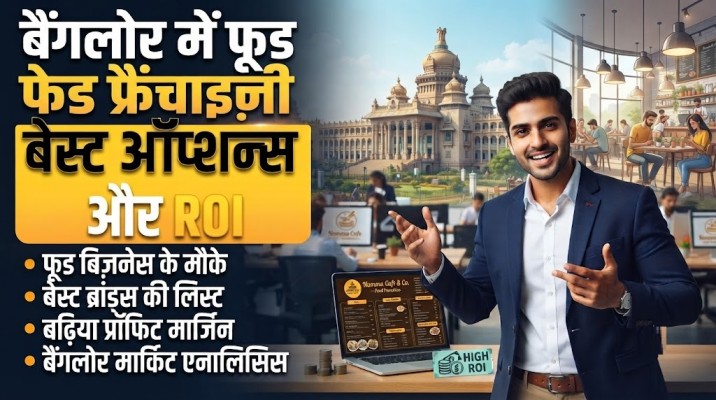
Bangalore Food Franchise 2026: Best Options and Real ROI Explained
In Bangalore, a kiosk or micro-QSR franchise (₹5–12 lakh investment) typically delivers the fastest payback — 8 to 15 months — while a mid-range QSR (₹15–40 lakh) gives 18–30% annual returns after stabilisation. Cloud kitchens sit in between on investment but carry higher delivery-commission risk. The “best” ROI depends on your capital, location, and how honestly you calculate net margin, not gross margin.
Most franchise brochures show 60–75% gross margins. Real net margins in Indian food franchises are 6–35%, and rent alone can eat 15–20% of revenue if you pick the wrong location[reference:0]. This guide uses format-level numbers, not brand hype.
Quick Answer: Which Food Franchise Format Gives the Best ROI in Bangalore?
For a first-time investor with ₹2–25 lakh budget, the kiosk and micro-QSR format offers the best risk-adjusted ROI in Bangalore. The Burger Company’s PICO model, for example, requires ₹7.89 lakh plus taxes for an 80–100 sq ft outlet and projects 8–12 months payback with ₹3–4 lakh monthly revenue A mid-range QSR needs deeper pockets and longer patience: 18–30 months payback is realistic, with 18–30% annual returns for well-run outlet.
If your budget is under ₹15 lakh, chasing a “branded QSR” may stretch working capital to breaking point. Smaller formats survive on lower fixed costs.
Bangalore’s Food Franchise Market in 2026: Why It Still Works
Bangalore’s demand base is unusually deep. The city has over 12 lakh students and a large IT professional population that eats out frequently and orders delivery through Swiggy and Zomato India’s overall foodservice market is valued at USD 85–114 billion and projected to grow at 10–11% CAGR through 2031 The organized QSR segment alone is estimated at USD 30.37 billion in 2026, growing at 9.25% CAGR
Demand Drivers: IT Crowd, Students, and Delivery Apps
Whitefield, Electronic City, and the ORR belt generate predictable weekday lunch demand. College zones bring high-frequency, price-sensitive buyers. Delivery apps let a small outlet in HSR Layout serve customers kilometres away, reducing dependence on high-street rent. Location strategy should match format — a kiosk near a tech park is not the same business as a cloud kitchen in a residential cluster.
What Has Changed for Franchise Investors in 2026
Micro-QSR formats are expected to contribute 25–30% of new QSR openings by 2030, driven by rising real estate costs and demand for grab-and-go dining]. At the same time, investors are more cautious: only 40% of franchise outlets survive beyond their second year, largely because of cost-structure mistakes, not lack of demand: The format you choose in 2026 matters more than the brand’s logo.
4 Food Franchise Formats in Bangalore — Compared by Investment and ROI
Not all food franchises carry the same risk. Here is how the four main formats stack up for a ₹2–25 lakh budget.
Kiosk and Micro-QSR (₹5–12 Lakh)
Smallest footprint (80–300 sq ft), no full kitchen, menu optimised for speed. The Burger Company PICO: ₹7.89 lakh all-inclusive, 8–12 months payback, ₹3–4 lakh monthly revenue[reference:9]. FirstWave Fries in Bengaluru: ₹5–10 lakh investment range[reference:10]. Break-even is typically 12–20 months for kiosk formats This is the only format where a ₹10 lakh budget can realistically recover capital within a year — if footfall is proven.
Cloud Kitchen Franchise (₹5–18 Lakh)
Delivery-only, 250–600 sq ft, lower rent than high-street. Kouzina’s partner franchise model requires ₹12–18 lakh per kitchen, with 15% profit margin and 12–15% royalty on monthly sales[reference:12]. A cloud kitchen in a Tier-2 Bangalore locality can start under ₹8 lakh. Payback usually wraps up in the second year. Why this matters to you: Cloud kitchens look cheap but delivery platforms take 25% of revenue — model that before signing.
Mid-Range QSR (₹15–40 Lakh)
300–800 sq ft, dine-in plus delivery, stronger brand pull. Wow! Momo kiosk model: ~₹20–25 lakh; La Pino’z Pizza: ₹30–40 lakh; Subway total setup: ~₹25–35 lakh with 8% royalty[reference:15]. Net margins for mid-scale QSR typically run 15–22%, with break-even at 18–30 months. Why this matters to you: This is the most crowded investment band — differentiation and location quality decide survival.
Dine-In Restaurant Franchise (₹50 Lakh+)
Full-service, 1,000+ sq ft, higher brand recall but slowest capital recovery. Rameshwaram Cafe franchise investment is estimated at ₹80 lakh–₹1.2 crore. Casual dining break-even is often three years or more when metro rents are involved Outside most first-time budgets in the ₹2–25 lakh range — useful as a long-term benchmark, not an entry point.
Investment vs ROI Table: Bangalore Food Franchise Formats
| Format | Typical Investment (₹) | Space | Payback Period | Realistic Net Margin | Best Bangalore Zone |
|---|---|---|---|---|---|
| Kiosk / Micro-QSR | 5–12 lakh | 80–300 sq ft | 8–15 months | 10–25% | Tech parks, malls, college gates |
| Cloud Kitchen | 5–18 lakh | 250–600 sq ft | 12–24 months | 6–15% | HSR Layout, Bellandur, residential clusters |
| Mid-Range QSR | 15–40 lakh | 300–800 sq ft | 18–30 months | 15–22% | Indiranagar, Koramangala, ORR |
| Dine-In Franchise | 50 lakh+ | 1,000+ sq ft | 24–36+ months | 10–18% | High-street, premium malls |
Sources: format-level disclosures from franchisebazar.com, indiaretailing.com, and tandooriwala.com (2025–2026). Net margin ranges are industry estimates; individual outlet performance varies.
Why this matters to you: The cheapest format does not always have the best ROI, but in Bangalore’s rent-heavy market, lower fixed cost consistently improves survival odds for first-time owners.
What Actually Decides Your ROI (Not the Brand Brochure)
Three cost lines separate a profitable franchise from a struggling one. Most investors focus on franchise fee; operators focus on these three.
Rent: The Silent Profit Killer in Bangalore
Bengaluru’s Brigade Road averages ₹300–600 per sq ft monthly; prime Mumbai locations can touch ₹750–1,300 per sq ft[reference:20]. The critical rule: rent should stay below 15% of monthly revenue. Once it crosses 18%, even strong sales struggle to compensate. A ₹1 lakh monthly rent on a ₹6 lakh revenue outlet is 16.7% — already in the danger zone. Choose the zone before the brand.
Royalty and Delivery Commissions
Most food franchises charge 3–8% royalty on gross sales, plus 2–3% marketing fees[reference:22]. On ₹8 lakh monthly sales, a 6% royalty alone is ₹48,000; with a 2% marketing fee, ₹64,000 leaves before rent or salaries are paid[reference:23]. Delivery platforms take another ~25% of order value[reference:24]. Why this matters to you: A franchise with 8% royalty and heavy delivery dependence can lose 30%+ of revenue before food cost — model this before comparing brands.
Working Capital: The Gap Most First-Time Investors Miss
Industry guidance recommends a 6-month working capital buffer covering rent, payroll, and supplier payments[reference:25]. An outlet doing “reasonable numbers in month two” can still fail if cash reserve is thin[reference:26]. Why this matters to you: If your total budget is ₹10 lakh, do not spend ₹9 lakh on setup — keep at least ₹2–3 lakh for the first six months of operations.
Tier-2 and Tier-3 Cities vs Bangalore: Where Should You Start?
| Factor | Bangalore (Tier-1) | Tier-2/3 (Indore, Jaipur, Patna) |
|---|---|---|
| Monthly rent (200–400 sq ft) | ₹60,000–₹2,60,000 | ₹6,000–₹80,000 |
| Break-even expectation | 18–30 months (QSR) | 78% operators expect within 2 years |
| Competition intensity | High (every brand wants Bangalore) | Lower, but growing |
| Delivery demand | Very high | Moderate but rising |
A Grant Thornton Bharat–NRAI report found 78% of operators in Tier-II and Tier-III cities expected to break even within two years, while metro operators consistently take longer — the gap is almost entirely rent and operating cost[reference:27]. Why this matters to you: If you can operate outside Bangalore, the same brand and format may deliver faster payback on a smaller investment. If you must be in Bangalore, choose the lowest-rent format that fits your menu.
Step-by-Step Checklist Before You Sign a Franchise Agreement
- ☐ Verify FSSAI license requirement. Basic registration for turnover under ₹12 lakh; State license for ₹12 lakh–₹20 crore; Central license above ₹20 crore[reference:28].
- ☐ Check BBMP trade license and fire safety NOC. Mandatory for Bangalore food outlets[reference:29].
- ☐ Get the franchise disclosure document (FDD) in writing. Ask for unit-level P&L of 2–3 existing outlets, not company-level revenue.
- ☐ Calculate rent as % of projected revenue. If it exceeds 15%, renegotiate or change location[reference:30].
- ☐ Model royalty + marketing fee + delivery commission together. A 6% royalty plus 2% marketing plus 25% delivery commission = 33% of revenue before food cost.
- ☐ Confirm working capital buffer. Minimum 3–6 months of fixed costs beyond setup budget[reference:31].
- ☐ Visit 3 existing franchise outlets unannounced. Talk to the operator, not the sales team.
- ☐ Check exit and renewal terms. Franchise term, renewal fee, and transfer clause.
Why this matters to you: A franchise agreement is a long-term financial commitment. The checklist takes two weeks and can save two years of losses.
Frequently Asked Questions
Q1: What is the most profitable food franchise in Bangalore?
Profitability depends on format and execution, not brand alone. Kiosk and micro-QSR formats show the fastest payback (8–15 months) on low investment. Mid-range QSRs deliver higher absolute profit per outlet but need 18–30 months to stabilise. A well-run outlet in any format can reach 18–30% annual returns[reference:32].
Q2: How much investment is needed for a food franchise in Bangalore?
Entry-level kiosks start at ₹5–12 lakh. Cloud kitchens: ₹5–18 lakh. Mid-range QSR: ₹15–40 lakh. Dine-in franchises: ₹50 lakh+. Your budget should include 3–6 months of working capital beyond the setup cost, not just the franchise fee and equipment[reference:33].
Q3: What is the ROI of a food franchise in India?
Stabilised, well-run food franchises typically deliver 18–30% annual returns[reference:34]. Payback ranges: kiosk 12–20 months, mid-scale QSR 18–30 months, cloud kitchen into the second year, casual dining around three years. Industry estimates put food franchise ROI at 25–45% with 18–36 months payback for ₹10–50 lakh investments[reference:35].
Q4: Which food franchise gives the fastest payback in India?
Kiosk and micro-QSR formats consistently show the shortest payback — 8–15 months in strong locations. The Burger Company PICO projects 8–12 months; Waffle Co partners recover capital in 12–15 months[reference:36][reference:37]. Cloud kitchens and mid-range QSRs take longer but can deliver higher absolute monthly profit.
Q5: Can I start a food franchise under ₹5 lakh in Bangalore?
A full branded franchise under ₹5 lakh is rare, but cart/stall formats and some cloud-kitchen partnerships can start near that range. Street-food carts in Bangalore run ₹1.5–4 lakh; kiosks ₹4–8 lakh[reference:38]. Under ₹5 lakh, expect limited brand support and higher dependence on location.
Q6: How long does it take to break even on a Bangalore food franchise?
Kiosk/express: 12–20 months. Mid-scale QSR: 18–30 months. Cloud kitchen: second year. Dessert/bakery: 14–30 months. Dine-in: 24–36+ months[reference:39]. Bangalore rents push break-even longer than Tier-2 cities for the same format.
Ready to Compare Bangalore Food Franchise Options?
Stop guessing from brochures. View verified franchise listings with real investment ranges and format details on Free-Franchise.com. Filter by budget, format, and city — then fill the enquiry form to get connected with franchisors that match your ₹2–25 lakh budget.
Apply Bangalore Food Franchise →