


Jewellery Franchise in India (2027)
November 17, 2026
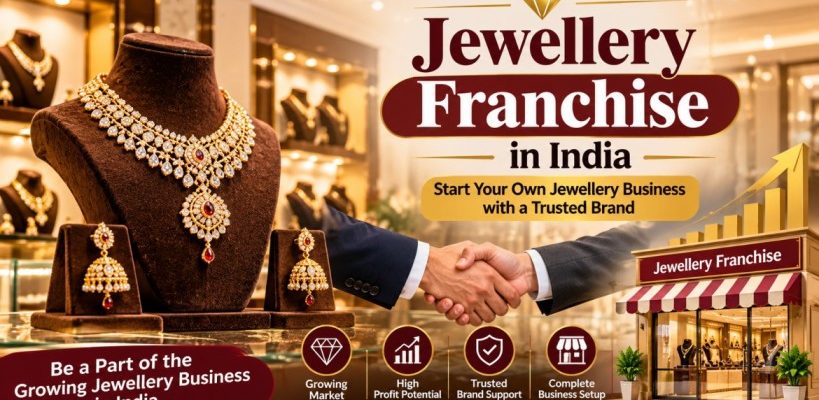
Jewellery Franchise in India (2027): High-Investment, High-Trust — and Where ₹2–25 Lakh Fits
A jewellery franchise in India is a high-investment, high-trust business because customers buy brand trust before they buy gold. In 2027, organised gold showrooms start at ₹2 crore+ (Tanishq, Kalyan, Malabar), while fashion, imitation and silver jewellery franchises start at ₹2–25 lakh.
Most “jewellery franchise” searches mix ₹50,000 kiosks with ₹10 crore showrooms. That hides the real decision: do you want a low-capital fashion jewellery business or a high-trust precious jewellery showroom? This guide separates the two using published brand data and 2027 industry estimates.
Why Jewellery Is a High-Trust, High-Investment Franchise
Jewellery is not a normal retail category. A family spending ₹2 lakh on a necklace is not experimenting. They are buying a name they already trust.
Trust is the real product
Building that trust independently takes 15–20 years, according to franchise industry analysis. That is why customers walk into Tanishq, Kalyan or Malabar without asking “who owns this store?” The franchise fee buys that pre-built trust.[reference:0]
Why this matters to you: If your budget is ₹10 lakh, you cannot buy a Tanishq-level trust brand. You must choose a segment where trust is built faster — fashion, imitation or silver.
Why capital requirements jump
Precious jewellery inventory is expensive and price-volatile. Gold sat above ₹1.24 lakh per 10 grams for most of 2025, and buyers responded by going lighter or waiting.[reference:1] A showroom must hold enough stock to look credible, which is why working capital alone can run into crores.
Why this matters to you: In precious jewellery, your money is locked in stock. In fashion jewellery, stock moves faster and costs less per unit.
Where ₹2–25 Lakh Actually Fits: Fashion, Imitation and Silver
For a ₹2–25 lakh budget, the practical entry is fashion jewellery, imitation jewellery, designer jewellery or silver jewellery — not a gold showroom.
Fashion and imitation jewellery (₹1–10 lakh)
This segment has the lowest entry and the fastest stock rotation. Diagold (designer/fashion jewellery) lists ₹2–5 lakh investment with a ₹51,000 franchise fee and approximately 1-year payback.[reference:2] Sakhi Jewellers lists ₹50,000–₹2 lakh with a ₹15,000 fee and 3–6 month payback.[reference:3] Friss India’s FOFO imitation jewellery model is ₹10 lakh including a ₹2.5 lakh fee, with 45% margin and 24-month ROI.[reference:4]
Why this matters to you: A ₹5–10 lakh fashion jewellery franchise lets you test retail without blocking ₹50 lakh in gold inventory.
Silver and designer jewellery (₹2–30 lakh)
Silver sits between fashion and precious. PNGS Gargi’s silver franchise investment is ₹25–30 lakh, with 55% gross margin on silver.[reference:5] Voylla (fashion/imitation) starts at ₹12 lakh for a kiosk and ₹20 lakh for an exclusive outlet, with 35–50% gross margins.[reference:6][reference:7] Orafo Jewels lists ₹30–50 lakh, slightly above this band.[reference:8]
Why this matters to you: If you have ₹25 lakh, silver gives you a “real jewellery” feel with a fraction of gold’s working-capital burden.
Kiosk and shop-in-shop models
Kiosks reduce rent and fit-out cost. Voylla’s kiosk format is ₹12–15 lakh, and Neeta Boochra’s shop-in-shop model is ₹50 lakh (above this budget).[reference:9][reference:10] For ₹2–25 lakh, a 100–300 sq ft kiosk in a mall or high street is the realistic format.
Why this matters to you: A kiosk lowers your fixed cost and lets you exit faster if the location underperforms.
High-Investment Benchmarks: What Tanishq, Kalyan and Malabar Cost in 2027
These brands are included as benchmarks, not recommendations for a ₹2–25 lakh budget.
| Brand | Indicative Investment (2027) | Model / Space | Royalty (reported) | Source |
|---|---|---|---|---|
| Tanishq | ₹2.5–5 crore+ (some listings ₹5–10 crore) | FOCO; 2,000–5,000 sq ft | 8% | IndiaFranchiseBlog / Forefind[reference:12] |
| Kalyan Jewellers | ₹2 crore+ | FOCO; large showroom | 0% | IndiaFranchiseBlog |
| Malabar Gold & Diamonds | ₹2 crore+ | FOCO; large showroom | 6% | IndiaFranchiseBlog |
| CaratLane | ₹50 lakh–₹1.5 crore | FOCO; smaller format | 5% | IndiaFranchiseBlog / Bizfit[reference:16] |
| GIVA | ₹50 lakh–₹1 crore | FOCO / FOFO; fashion silver | 5% | FranchiseBazar[reference:17] |
| Senco Gold | ₹1 crore+ | FOCO; East India strength | 7% | IndiaFranchiseBlog |
Why this matters to you: These numbers confirm that a ₹2–25 lakh budget cannot enter precious gold franchising. Use them to set expectations, not to apply.
Investment vs ROI Comparison Table (2027 Estimates)
| Model | Indicative Investment | Gross Margin | Payback (reported/estimated) | Best For |
|---|---|---|---|---|
| Sakhi Jewellers (designer) | ₹50,000–₹2 lakh | Not disclosed; 10% royalty | 3–6 months (reported) | ₹2–5 lakh first-time budget |
| Diagold (fashion/designer) | ₹2–5 lakh | Not disclosed | ~1 year (reported) | Small store, Tier-2 city |
| Anvi Jewellery (fashion) | ₹2–5 lakh | Not disclosed | Not specified | Design-led local market |
| Friss India (imitation FOFO) | ₹10 lakh | 45% | 24 months (reported) | Online + offline hybrid |
| Voylla (kiosk) | ₹12–15 lakh | 35–50% | Not specified | Mall kiosk, high footfall |
| Voylla (exclusive outlet) | ₹20–30 lakh | 35–50% | Not specified | High-street brand store |
| PNGS Gargi (silver) | ₹25–30 lakh | 55% (silver) | 20–25% ROI within 2 years (owned store benchmark) | Upper end of ₹25 lakh budget |
Why this matters to you: Fashion and imitation models give faster payback; silver gives better margin but needs ₹25 lakh+. Choose based on cash flow, not vanity.
Why Tier-2 and Tier-3 Cities Matter More in 2027
Organised jewellery retail is moving beyond metros. Tier-2 towns in Gujarat, Rajasthan and Maharashtra are growing faster for branded jewellery than most people expect.[reference:19] Limelight Diamonds is targeting 200+ stores by 2027, citing faster breakeven in Tier-2 cities.
India’s jewellery market is estimated at USD 95 billion in 2025, heading past USD 151 billion by 2034 at roughly 5.3% annual growth (IMARC, cited by FranchiseBazar).[reference:21] Technavio projects USD 31 billion incremental growth at 6.6% CAGR from 2025 to 2030.[reference:22]
Why this matters to you: Rent in Indore, Jaipur or Patna is a fraction of Mumbai or Delhi. A ₹10 lakh fashion jewellery kiosk can break even faster in a Tier-2 city because fixed costs are lower.
6-Point Checklist Before You Sign a Jewellery Franchise Agreement
- Verify the total investment, not the franchise fee. Ask for a written breakup: fee, interiors, opening stock, working capital, security deposit and royalty.
- Confirm hallmarking and buyback terms. For silver or precious jewellery, ask who bears the cost of hallmarking and what buyback percentage applies.
- Check stock liability. In fashion jewellery, dead stock is your biggest risk. Ask whether the brand offers stock replacement or sale-or-return.
- Read the royalty clause carefully. A 10% royalty on a 35% margin leaves you with 25% before rent and salaries.
- Speak to 2 existing franchisees in similar cities. Ask about actual monthly sales, stock replacement speed and brand support.
- Confirm the exit clause. Ask what happens to unsold stock, signage and deposit if you exit after 2 years.
Why this matters to you: Most jewellery franchise failures are cash-flow failures caused by slow stock rotation and underestimated working capital — not brand failures.
Franchise vs Independent Jewellery Store: What Changes
| Factor | Jewellery Franchise (₹2–25 lakh) | Independent Store |
|---|---|---|
| Brand trust | Instant recall in the chosen segment | Must build from zero (15–20 years for precious) |
| Stock cost | Lower per unit in fashion/imitation | Fully on you |
| Stock risk | Some brands offer replacement support | Dead stock is your loss |
| Margin | 35–55% (fashion/silver) | Can be higher, but slower turnover |
| Setup time | 30–60 days | 3–6 months (sourcing, branding, fit-out) |
| Control | Brand guidelines apply | Full control |
Why this matters to you: A franchise buys speed and trust; an independent store buys control. For a first-time entrepreneur with ₹10–25 lakh, speed and stock support usually matter more.
People Also Ask (FAQs)
Q1: Can I start a jewellery franchise under ₹25 lakh in India?
Yes, but not a gold showroom. Fashion, imitation and designer jewellery franchises start at ₹2–10 lakh (Diagold, Sakhi, Friss). Silver jewellery starts at ₹25–30 lakh (PNGS Gargi). Tanishq, Kalyan and Malabar require ₹2 crore+.
Q2: What is the minimum investment for a Tanishq franchise in 2027?
Tanishq’s franchise investment is reported at ₹2.5 crore onwards, with some listings at ₹5–10 crore. The franchise fee alone is around ₹25 lakh, and working capital can exceed ₹3–5 crore. It is not a low-investment option.
Q3: Which jewellery franchise gives the fastest ROI in India?
Fashion and imitation models report the fastest payback. Sakhi Jewellers reports 3–6 months; Diagold reports approximately 1 year; Friss India reports 24 months. Faster payback comes with smaller format and lower brand premium.
Q4: Is a jewellery franchise profitable in Tier-2 cities?
Yes, often more than metros for fashion and silver. Lower rent and rising branded demand improve breakeven speed. Limelight Diamonds cites faster breakeven in Tier-2 cities as a key reason for its 2027 expansion.
Q5: What documents do I need for a jewellery franchise?
Typically PAN, Aadhaar, GST registration, registered business entity proof, store rent agreement and bank statements. For precious jewellery, brands may also ask for hallmarking compliance and a police verification for high-value inventory.
Q6: Do I need retail experience to get a jewellery franchise?
Not for fashion and imitation jewellery. Diagold, Sakhi and Friss accept first-time entrepreneurs with training. Precious jewellery brands like Tanishq and Kalyan prefer prior retail or business experience, especially for large-format FOCO stores.
Final Word + Next Step
Jewellery franchising in India is high-investment and high-trust — but that does not mean it is closed to a ₹2–25 lakh budget. The entry point is fashion, imitation or silver jewellery, not a gold showroom. Pick a model with manageable stock risk, 35–55% margin and a city where the brand already has recall.