

Petrol Pump Franchise in India 2027: The Real Investment, Return, and What Your Budget Can Actually Buy
November 17, 2026
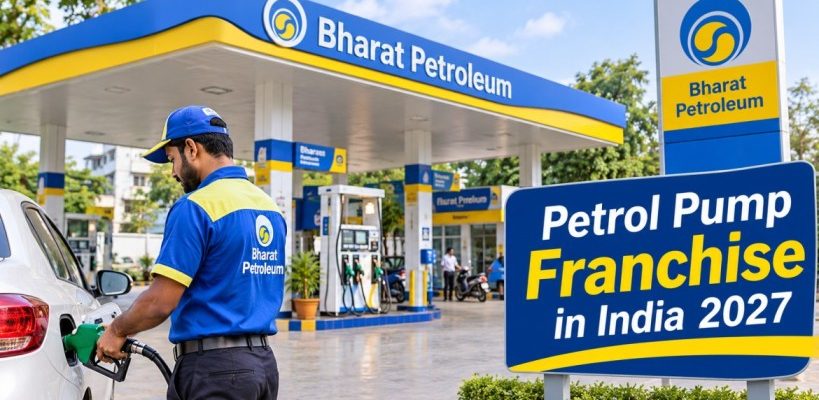
Petrol Pump Franchise in India 2027: The Real Investment, Return, and What Your Budget Can Actually Buy
A standard petrol pump dealership in India requires ₹35 lakh to ₹3 crore in project investment (excluding land), and dealers earn a fixed commission of roughly ₹3–₹4 per litre on petrol and ₹2.5–₹3 per litre on diesel. If your budget is ₹2–₹25 lakh, a conventional petrol pump dealership is not a viable path in 2027 — but there are honest alternatives inside the automotive sector that fit your capital.
This guide does not sell you a dream. It gives you the real cost structure, the actual commission numbers, the land rules, and a clear-eyed comparison so you can decide whether to wait, partner, or pivot.
Petrol Pump Franchise Investment Reality: Why ₹2–₹25 Lakh Is Not Enough for a Standard Dealership in 2027
HPCL’s own cost breakdown shows that even a rural outlet needs ₹35–₹65 lakh excluding land, while a regular urban outlet runs ₹75 lakh to ₹1.20 crore. IOCL and BPCL sit in the same range. The ₹2–₹25 lakh figure you may have seen in franchise listings usually refers to a **security deposit component or a CODO entry point**, not the total project cost.
What a Petrol Pump Actually Costs (Excluding Land)
For a dealer-owned, dealer-operated (DODO) outlet, you fund the land, tanks, dispensers, canopy, and working capital. HPCL lists the non-refundable dealership fee at ₹15 lakh for a regular outlet and ₹5 lakh for rural, with infrastructure at ₹30–₹50 lakh (urban) and working capital at ₹15–₹30 lakh. Nayara Energy states that construction alone costs ₹70 lakh to ₹1 crore, before land.[reference:2][reference:3]
Where Your ₹2–₹25 Lakh Budget Does Fit — and Where It Does Not
At the very bottom of the range, a **rural CODO (Company-Owned, Dealer-Operated) format with Nayara** has been listed around ₹15–₹25 lakh for the dealer-side investment. Shell’s CODO entry is listed at ₹15 lakh. But CODO means the oil company owns the infrastructure — you operate it, and your control over the asset is limited. A standard PSU DODO outlet is simply outside this budget.[reference:4][reference:5]
Why this matters to you: Knowing the true number prevents you from paying a consultant for an application you cannot fund. If ₹25 lakh is your ceiling, focus on CODO rural or pivot to a different automotive category.
Petrol Pump Dealer Commission and Real Return: What You Actually Earn Per Litre in 2027
The commission is set by the Oil Marketing Companies (OMCs) and is not negotiable. For PSU pumps, PPAC-regulated commission is approximately ₹3.5 per litre on petrol and ₹2.5 per litre on diesel. HPCL’s published dealer commission is ₹2.58 on petrol and ₹1.65 on diesel — among the lower end of the range. Private players like Shell and Nayara offer different structures.[reference:6][reference:7]
The ₹3–₹4 Commission Reality
Most credible 2025–2026 sources place petrol commission at ₹3.4–₹4.4 per litre and diesel at ₹2.4–₹2.9 per litre. A pump selling 5,000 litres per day at ₹3.5 average commission earns ₹17,500 per day in fuel commission — roughly ₹5.25 lakh per month in gross fuel income. But this is **gross**, before rent, staff, electricity, and credit-card/UPI charges.[reference:8][reference:9]
Table 1: Monthly Earning Scenarios Based on Daily Volume
| Daily Volume (litres) | Avg. Commission (₹/litre) | Gross Monthly Fuel Commission (₹) | Realistic Net After Operating Costs (₹) |
|---|---|---|---|
| 3,000 | 3.50 | 3,15,000 | 1,20,000–1,80,000 (estimated) |
| 5,000 | 3.50 | 5,25,000 | 2,00,000–3,00,000 (estimated) |
| 8,000 | 3.50 | 8,40,000 | 3,50,000–5,00,000 (estimated) |
| 12,000 (highway) | 3.50 | 12,60,000 | 5,50,000–8,00,000 (estimated) |
Net figures are estimates after staff, utilities, and maintenance; they exclude land cost and loan EMI. Actual returns vary by location.
Why Ancillary Income Decides Profitability
Fuel is 60–75% of a pump’s revenue but contributes only about 3.5% margin. The real profit sits in ancillary services: convenience stores (25–35% margin), lubricants (18–25%), EV charging (25%), and financial services (50%). A pump without ancillary income is a volume business with thin returns.[reference:10]
Why this matters to you: If a franchisor promises “₹5 lakh monthly profit” without explaining daily volume and ancillary mix, ask for the underlying assumptions in writing.
IOCL vs BPCL vs HPCL vs Nayara: Petrol Pump Franchise Comparison 2027
The three PSU OMCs (IOCL, BPCL, HPCL) use newspaper advertisements and a draw-of-lots or bidding process on the official portal petrolpumpdealerchayan.in. Nayara and Shell accept direct applications year-round. The selection method matters as much as the investment.[reference:11][reference:12]
Table 2: Investment and Selection Comparison Across Fuel Brands
| Brand | Entry Model | Indicative Dealer Investment (₹) | Selection Method |
|---|---|---|---|
| Shell | CODO | ~15 lakh | Direct application (site-dependent) |
| BPCL | CODO | ~25 lakh | Portal advertisement + lottery/bidding |
| Nayara | CODO / DODO | ~30 lakh (CODO) / ~80 lakh (DODO) | Direct application, stricter site inspection |
| HPCL | CODO / DODO | ~40 lakh (CODO) / ~1.5 crore (DODO) | Portal advertisement + lottery/bidding |
| IOCL | CODO / DODO | ~50 lakh (CODO) / ~1.5 crore (DODO) | Portal advertisement + lottery/bidding |
CODO = Company-Owned, Dealer-Operated; DODO = Dealer-Owned, Dealer-Operated. Figures are indicative entry points and vary by site category and state. Sources: BizFit comparison, brand disclosures, and industry estimates.[reference:13]
PSU Lottery vs Private Direct Application
PSU dealerships are allocated by lottery or bidding. There has been no fresh nationwide round since June 2023, though location-specific advertisements appear through the year. Nayara’s direct application route avoids the lottery, but the commercial viability assessment is stricter. If you have land on a viable highway or town location, Nayara’s DODO model is the only private path that allows you to own the asset.[reference:14][reference:15]
Petrol Pump Franchise Eligibility and Land Requirements in 2027
Who Can Apply (Age, Education, Residency)
The current rules (2023 brochure, still operative in 2026) require Indian citizenship, residency of 182+ days in the previous financial year, age 21–60, and minimum 10th pass for both urban and rural categories. There is no requirement of prior fuel-industry experience.[reference:16]
Land: 800 sq m in Town, 1,200 sq m on Highway — Minimum
Nayara’s published land criteria require more than 800 sq m in a town area and more than 1,200 sq m on a highway, with minimum frontage and depth of 25 m (town) or 35 m (highway). The land must be road-touching, levelled, and developed. Other sources cite 1,200–1,600 sq m for highway locations. You can use owned or leased land, but the title must be clear and ideally in the franchisee’s name.[reference:17][reference:18]
The Official Portal Is the Only Legitimate Route
Every PSU location is advertised on petrolpumpdealerchayan.in. Any consultant or agent promising a “confirmed dealership” for a fee is running a scam. The application fee is ₹10,000, and the fixed dealership fee is ₹15 lakh for a regular dealer-owned site and ₹5 lakh for rural. There is no shortcut.[reference:19]
How to Apply for a Petrol Pump Dealership in 2027: Step-by-Step
Step 1: Watch petrolpumpdealerchayan.in (Not a Consultant)
Create an alert habit. Location-specific advertisements appear without a fixed nationwide schedule. When a suitable location in your district is advertised, apply immediately with the prescribed form and fee.
Step 2: Prepare Land and Financial Documents Before the Advertisement
If you are applying for a dealer-owned site, have your land title, mutation certificate, and a bank sanction letter for working capital ready before the advertisement appears. The selection window is short, and incomplete documentation disqualifies you.
Step 3: Understand Draw of Lots vs Bidding
Dealer-owned (“B”/DC) and Corpus Fund sites are allocated by draw of lots. Corporation-owned (“A”/CC) sites are allocated by bidding, with a minimum bid of ₹30 lakh for regular and ₹10 lakh for rural. Bidding means you can pay more to improve your chance — but only on company-owned land.[reference:20]
Checklist: 7 Documents You Need Ready Before You Apply
- ☐ Indian citizenship and residency proof (182+ days)
- ☐ Age proof (21–60) and 10th-pass certificate
- ☐ Land title deed, mutation, and encumbrance certificate (for dealer-owned sites)
- ☐ Bank sanction letter or proof of funds for working capital (₹15–₹30 lakh)
- ☐ PESO licence application readiness (after selection)
- ☐ GST registration (fuel is outside GST, but you run a dual VAT+GST business)
- ☐ No-objection certificate from local municipal/road authority for access
Why this matters to you: The lottery does not wait for you to arrange funds. Being document-ready is the only advantage you control.
Petrol Pump ROI and Payback: What the Numbers Actually Look Like
Payback Estimates by Format (Rural CODO vs Urban DODO)
Nayara dealership guides estimate monthly profits of ₹2–₹4 lakh and an ROI payback period of 2–3 years for a functioning outlet. Shell states indicative earnings of ₹8.5–₹10.2 lakh per year per site for its retailership model. A high-volume highway pump can pay back faster; a low-volume rural outlet may take longer.[reference:21][reference:22]
Why Fuel Retail Is a Volume Business, Not a Margin Business
At ₹3.5 per litre, you need 5,000 litres per day just to reach ₹5.25 lakh in monthly gross commission. After operating costs, a single pump may net ₹2–₹3 lakh. The economics only work when daily throughput is high and ancillary income is layered on top. This is why location selection — not brand selection — is the single biggest determinant of ROI.[reference:23]
If Your Budget Is ₹2–₹25 Lakh: Smarter Automotive Franchise Alternatives for 2027
The honest answer is that a conventional petrol pump is not designed for a ₹2–₹25 lakh budget. But the automotive aftermarket has formats that are.
Tyre and Battery Service Franchise
CEAT franchise options start at ₹10–₹20 lakh. A multi-brand tyre and battery studio can be built in the ₹10–₹20 lakh range. Replacement demand is tied to vehicles already on the road, not new-car sales cycles.
Car Wash Franchise (₹3 Lakh Entry)
Doorstep and waterless car wash franchises list investments of ₹2–₹5 lakh, with Wash4Sure specifically at ₹3 lakh + GST. Owner-operated doorstep models can net ₹50,000–₹80,000 per month at 6–8 cars per day. This is a realistic service business inside your budget.
Battery Dealership / Distributorship
Exide distributor-level associations can start very low, and a visible battery retail outlet can be set up within ₹10–₹20 lakh. Battery margins are thinner than tyres (8–12% automotive), but the format is compact and the customer repeat cycle is predictable.
Why this matters to you: Your capital is better deployed in a format designed for it than stretched into a petrol pump application that may never convert.
Risks and Hard Truths About Petrol Pump Franchising in India
Working Capital Is the Real Barrier, Not the Fee
The ₹15 lakh dealership fee gets you into the process. The ₹15–₹30 lakh working capital requirement is what keeps the pump running. Fuel is purchased daily, and credit cycles with fleet customers can stretch to 30–45 days. A pump that runs out of working capital cannot buy stock, and an empty pump loses customers within days.
The Lottery Can Take Years — and You Cannot “Buy” Your Way In
PSU dealerships are allocated by lottery or bidding. There is no application fee that guarantees consideration, and no consultant who can “confirm” a site. The 2023 nationwide round is closed, and fresh rounds are location-specific and irregular. If you need a business operational within 6–12 months, the petrol pump lottery is not a reliable route.[reference:24]
Frequently Asked Questions
Q1: Can I open a petrol pump with ₹25 lakh in India?
Not a standard dealership. A rural CODO format with Nayara or Shell may list dealer-side investment around ₹15–₹25 lakh, but this excludes land and offers limited asset ownership. A conventional DODO outlet needs ₹35 lakh to ₹3 crore excluding land.
Q2: How much commission does a petrol pump dealer earn per litre?
PSU-regulated commission is approximately ₹3.5 per litre on petrol and ₹2.5 per litre on diesel, though HPCL publishes lower figures (₹2.58 petrol, ₹1.65 diesel). Actual earnings depend on daily volume; a 5,000-litre/day pump grosses roughly ₹5.25 lakh per month in fuel commission.
Q3: Is petrol pump dealership given by lottery or interview?
Dealer-owned sites are allocated by draw of lots. Corporation-owned sites are allocated by bidding. There is no interview for standard retail outlet dealerships under the current PSU process. All legitimate applications go through petrolpumpdealerchayan.in.
Q4: How much land is required for a petrol pump in India?
Nayara’s published criteria require more than 800 sq m in a town area and more than 1,200 sq m on a highway, with minimum frontage of 25 m (town) or 35 m (highway). The land must be road-touching, levelled, and developed. Owned or leased land is acceptable.
Q5: What is the profit margin of a petrol pump?
Fuel margin is about 3.5% of revenue, not 30–40%. Net profit depends on volume and ancillary income. Nayara guides estimate ₹2–₹4 lakh monthly profit for a functioning outlet, with 2–3 year payback. Without a convenience store or lubricant sales, net margins are thinner.
Q6: Can I get a petrol pump dealership without land?
Yes, through corporation-owned (CC/“A”) sites, but these are allocated by bidding with a minimum bid of ₹30 lakh (regular) or ₹10 lakh (rural). You do not need to own land, but you need capital for the bid and the project. Dealer-owned sites require land.
Final Verdict: Who Should Actually Pursue a Petrol Pump Franchise in 2027?
Pursue a petrol pump dealership in 2027 only if you have ₹35 lakh or more in deployable capital beyond land, a road-touching plot of 800–1,200+ sq m, and the patience to wait for a location advertisement and lottery outcome. If your budget is ₹2–₹25 lakh, the honest path is to enter the automotive aftermarket through tyre, battery, or car wash formats that are designed for that capital range. The petrol pump is a durable asset — but it is not a small-business starter.