


Solar Energy Installation Franchise in India
November 12, 2026
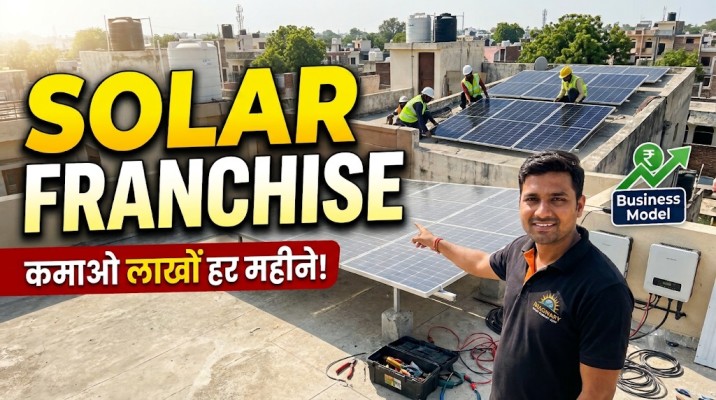
Solar Energy Installation Franchise in India: The Government Subsidy Advantage (2027 Guide)
A solar energy installation franchise in India can be started with ₹46,000–₹2 lakh for a lead-partner or low-inventory dealer model, or ₹10–40 lakh for an installer dealer (EPC) that handles full rooftop systems and subsidy paperwork. The real advantage in 2027 is not the franchise brand — it is PM Surya Ghar: Muft Bijli Yojana, which offers your customers up to ₹78,000 in central subsidy and has a target of 1 crore households by March 2027.
India’s rooftop solar capacity is projected to grow from 17 GW in FY2025 to 30 GW by FY2027 at a 33% annual growth rate, according to CareEdge Advisory & Research. Over 50 lakh homes had already installed rooftop systems under PM Surya Ghar by August 2026, with installations running at more than 16,000 a day in July 2026. This guide breaks down the real costs, the subsidy rules, the margins, and the brands that fit a ₹2–25 lakh budget.
One-Line Answer: What Does a Solar Franchise Cost in 2027?
₹46,000–₹2 lakh (lead partner / low-inventory dealer): You generate leads or sell from an existing shop; the company handles survey, installation, and subsidy execution. APN Solar starts at ₹46,000 + GST and goes up to ₹5.5 lakh + GST depending on the level. Gama Era Energies operates at ₹50,000–₹2 lakh with a ₹50,000 franchise fee. Loom Solar’s franchise/dealer model is indicatively ₹1–5 lakh and is positioned for small and micro dealers in Tier-2 cities.
₹2–25 lakh (dealer / retailer with stock): You sell panels, inverters, and kits, and often handle local installation. Tata Power Solar’s small dealer format starts around ₹2 lakh; its larger EPC format runs ₹25 lakh–₹1 crore with no franchise fee or royalty. UTL Solar is indicatively ₹2–10 lakh; Vikram Solar ₹3–15 lakh; Adani Solar ₹5–15 lakh; Waaree’s dealer/channel partner route is ₹5–20 lakh.
₹10–40 lakh (installer dealer / EPC): You sell and install complete rooftop systems, handle net metering and subsidy claims, and manage a crew. Credence Solar estimates this format at ₹10–40 lakh, with panel margins of around 8–12% and much better earnings from full installations and service.
₹50 lakh–₹1 crore (large franchise): A showroom-and-warehouse format. Waaree’s current franchise enquiry form asks applicants whether they can invest ₹50 lakh–₹1 crore; older ₹10–15 lakh estimates should not be treated as confirmed 2027 pricing.
Why this matters to you: The ₹2 lakh budget is real — but it buys a dealer or lead-partner model, not an EPC business. The subsidy does not care about your franchise fee; it cares about whether the installation is executed by an MNRE-empanelled vendor.
Why 2027 Is the Best Year to Enter Solar in India
Rooftop Capacity Growing 33% Annually to 30 GW by FY2027
India’s installed rooftop solar capacity is set to rise from 17 GW in FY2025 to 30 GW by FY2027, growing at an average of 33% annually, according to CareEdge Advisory & Research. The Indian Solar Manufacturers Association has projected annual rooftop installations of 9–15 GW between 2026 and 2030 and has called for clarity on the next phase of PM Surya Ghar by December 2026.
At the same time, India added a record 44 GW of solar in FY2026, and total installed solar capacity crossed 165 GW by mid-2026. This is not a pilot market. It is a scale market with a local sales and installation gap that dealers are filling.
PM Surya Ghar: 1 Crore Homes by March 2027
PM Surya Ghar: Muft Bijli Yojana, launched on 15 February 2024, is the world’s largest domestic rooftop solar initiative. It aims to install rooftop solar in 1 crore households by March 2027. By August 2026, over 50 lakh homes had installed rooftop systems under the scheme, with 14.8 GW of capacity commissioned. The scheme offers a subsidy of up to 40% to households and is expected to save the government an estimated ₹75,000 crore annually in electricity costs.
The Scheme Closes March 31, 2027 — The Urgency Is Real
The PM Surya Ghar portal lists a closing date of March 31, 2027**. MNRE has also clarified that the ALMM List-II exemption for PM Surya Ghar consumers opting for the “Give It Up” scheme remains valid **only until March 31, 2027**, which is the current end date of the scheme. Whether the scheme is extended is a policy decision — but as of 2027, the deadline is the single strongest sales argument a solar dealer has.
Why this matters to you: Your customer has a financial reason to act now, not next year. A ₹78,000 subsidy plus a ~7% collateral-free loan is a compelling offer that a local dealer can convert into an installation.
The Government Subsidy Explained: What Your Customer Actually Gets
PM Surya Ghar Subsidy Slabs
| Average Monthly Consumption | Suitable Rooftop Capacity | Central Subsidy |
|---|---|---|
| 0–150 units | 1–2 kW | ₹30,000–₹60,000 |
| 150–300 units | 2–3 kW | ₹60,000–₹78,000 |
| Above 300 units | Above 3 kW | ₹78,000 |
Source: Ministry of New and Renewable Energy, PM Surya Ghar scheme document (PIB).
State Top-Ups Make the Offer Stronger
The central subsidy is not the only benefit. Delhi has increased its state capital subsidy for a 3 kW rooftop system from ₹30,000 to ₹78,000**, in addition to the Centre’s ₹78,000. West Bengal offers **₹35,000 for 1 kW**, **₹70,000 for 2 kW**, and **₹93,000 for 3 kW**, including ₹15,000 in state support. Households also get access to **collateral-free, low-interest loans at around 7%** for systems up to 3 kW.
The Empanelment Catch — A Franchise Does Not Make You Subsidy-Eligible
This is the most important point in this guide. Joining a brand does not automatically make you eligible for the subsidy.** Your customer gets assistance only if the project is executed via an **MNRE-empanelled vendor** under PM Surya Ghar. A brand dealership and an MNRE empanelment are two separate things. You must get empanelled separately, even if you hold a brand dealership, to be eligible for PM Surya Ghar subsidy projects.
Why this matters to you: If you sign a franchise agreement and skip empanelment, you can still sell solar — but you cannot offer your customer the subsidy. That is a massive competitive disadvantage in 2027.
The Four Solar Franchise Models Under ₹1 Crore
Lead Partner / Commission Model (₹46,000–₹2 Lakh)
You generate qualified leads; the company does the survey, sales, and execution; you earn a commission based on installed capacity. This model has no inventory and the lowest capital requirement. APN Solar’s packages start at ₹46,000 + GST** and go up to **₹5.5 lakh + GST**, depending on the business level and support selected. Gama Era Energies operates at **₹50,000–₹2 lakh** with a **₹50,000 franchise fee**. Best for first-timers, part-time operators, and anyone testing the market before committing capital.
Dealer / Retailer (₹2–5 Lakh with Existing Shop; ₹5–25 Lakh with Stock)
You sell panels, inverters, and kits to end customers and small installers from a shop. If you already run an electrical or hardware shop, the incremental investment can be as low as ₹2–5 lakh** for low inventory. A standalone dealer with stock typically invests **₹5–25 lakh**. Tata Power Solar’s small dealer format starts around ₹2 lakh; UTL Solar is indicatively ₹2–10 lakh; Loom Solar is ₹1–5 lakh. Best for electrical shops, hardware traders, and established local businesses.
Installer Dealer / EPC (₹10–40 Lakh)
You sell and install complete rooftop systems, handle the subsidy claim and net metering paperwork, and manage an installation crew. Credence Solar estimates the total at ₹10–40 lakh**, broken into shop/display (₹1–5 lakh), opening stock (₹3–20 lakh), tools and a small vehicle (₹1–6 lakh), registrations and the PM Surya Ghar bank guarantee (₹2.5 lakh+ for one state), and three months of working capital (₹3–10 lakh). Best for electrical contractors and engineers — and this is the model that captures the best margins.
Distributor / Large Franchise (₹25 Lakh–₹1 Crore+)
You buy in bulk, stock in a warehouse, and supply dealers across a district or region. Credence Solar puts the distributor range at ₹25 lakh to ₹1 crore+**. Waaree’s franchise enquiry form asks about **₹50 lakh–₹1 crore** and whether you can manage a showroom and warehouse. Best for established traders with working capital and warehouse space.
Comparison Table: Investment, Margin, Payback
| Model | Investment | Primary Margin | Payback | Best For |
|---|---|---|---|---|
| Lead Partner | ₹46,000–₹2 lakh | Commission on installed capacity | 3–6 months (estimate) | First-timers, no inventory |
| Dealer (existing shop) | ₹2–5 lakh | Panel margin 8–12%; kit margin higher | 6–12 months (estimate) | Electrical/hardware shops |
| Installer Dealer / EPC | ₹10–40 lakh | 18–30% on full installation (estimate) | 18 months (industry reported) | Contractors, engineers |
| Distributor | ₹25 lakh–₹1 crore+ | Volume-led; 8–12% (estimate) | 18–30 months (estimate) | Established traders |
Sources: FranchiseBazar 2027 guide, Credence Solar (Sep 2026), APN Solar (Sep 2026), SolarCalculators (Jun 2026). Payback figures marked “estimate” are industry estimates; the 18-month figure is the reported dealer+installer payback.
The Real Investment: Where Your ₹2–40 Lakh Goes
What the Franchise Fee Does Not Cover
FranchiseBazar’s 2027 guide is blunt about this: total business cost is not just the fee. Their illustration is worth memorising: ₹2 lakh fee + ₹8 lakh inventory + ₹3 lakh showroom + ₹2 lakh working capital = ₹15 lakh total**. A ₹2 lakh franchise fee is not a ₹2 lakh business.
The Bank Guarantee Most People Miss
To execute PM Surya Ghar projects as an empanelled vendor, you need a bank guarantee of ₹2.5 lakh+ for one state**, according to Credence Solar’s cost breakdown. This is a cash-blocked cost that most first-time dealers do not budget for. Without it, you cannot bid for subsidy-linked installations.
Investment Breakdown Table
| Cost Head | Indicative Range | Why It Matters |
|---|---|---|
| Franchise / dealer fee | ₹46,000–₹5 lakh | Brand access; does not cover stock |
| Opening stock | ₹3–20 lakh | Panels, inverters, structures, cables |
| Shop / showroom | ₹1–5 lakh | Deposit, fit-out, signage |
| Tools and vehicle | ₹1–6 lakh | Installation crew mobility |
| Bank guarantee (PM Surya Ghar) | ₹2.5 lakh+ | Required for empanelled vendor status |
| Working capital (3 months) | ₹3–10 lakh | Subsidy jobs pay out weeks later |
| Total (EPC model) | ₹10–40 lakh | Dealer models sit at ₹2–25 lakh |
Source: Credence Solar (Sep 2026) and FranchiseBazar (Sep 2026) cost frameworks. Ranges are indicative and vary by city, brand, and minimum order.
Why this matters to you: Subsidy-linked jobs mean you pay for material and labour first and receive part of the money weeks later. A dealer doing 20 residential systems a month may have ₹10 lakh or more locked up at any time. Working capital is the part most people underestimate.
Profit Margins and ROI: The Real Numbers
8–12% on Panels, 18–30% on Installation and Subsidy Paperwork
Panel margins are thin — around 8–12%** — according to Credence Solar. The real money is in the complete installation and service**, where earnings are described as “much better.” The most successful dealers today combine selling and installing, because customers want one party to take responsibility for the full system, including the subsidy claim and the net meter.
3–6 Month Payback for Lean Models; 18 Months for EPC
Kalptaru Renewable Power reports a payback period of 3–6 months** on its ₹2–5 lakh model. Credence Solar reports many dealers achieving a payback of around **18 months** for the dealer-plus-installer format. Lead-partner models can pay back in 3–6 months because the capital outlay is tiny and the commission is on installed capacity.
Monthly Profit Scenarios Table
| Model | Monthly Revenue (Est.) | Net Margin | Monthly Net Profit (Est.) |
|---|---|---|---|
| Lead Partner | ₹30,000–₹80,000 | 60–80% (commission, low cost) | ₹20,000–₹60,000 |
| Dealer (existing shop) | ₹2–5 lakh | 12–18% | ₹25,000–₹90,000 |
| EPC / Installer Dealer | ₹5–15 lakh | 15–22% | ₹75,000–₹3 lakh |
| Distributor | ₹15–40 lakh | 8–12% | ₹1.2–4.8 lakh |
Industry estimates based on Credence Solar (Sep 2026), Kalptaru Renewable Power / ForeFind (Jun 2026), and FranchiseBazar (Sep 2026). Actual figures vary by city, DISCOM, and installation volume.
Why this matters to you: A ₹2 lakh dealer at ₹3 lakh monthly revenue and 15% net margin can earn ₹45,000 per month. An EPC at ₹10 lakh revenue and 18% margin can earn ₹1.8 lakh per month. The higher investment buys a higher income ceiling, but the lean models deliver the fastest percentage return.
Top Solar Franchise Brands in India (2027)
Loom Solar (₹1–5 Lakh)
A franchise/dealer model positioned for small and micro dealers in Tier-2 cities**. Indicative investment: **₹1–5 lakh**. Best for: electrical shops adding solar to an existing counter.
UTL Solar (₹2–10 Lakh)
A dealer model focused on off-grid and hybrid systems**. Indicative investment: **₹2–10 lakh**. Best for: dealers in areas with unreliable grid supply.
Vikram Solar (₹3–15 Lakh)
A channel partner model for high-efficiency rooftop projects**. Indicative investment: **₹3–15 lakh**. Best for: dealers targeting premium residential and C&I buyers.
Adani Solar (₹5–15 Lakh)
An authorised dealer model for the premium residential segment**. Indicative investment: **₹5–15 lakh**. Best for: dealers with access to high-ticket housing societies and villas.
Waaree (₹5–20 Lakh Dealer; ₹50 Lakh–₹1 Crore Large)
Waaree’s dealer/channel partner route is indicatively ₹5–20 lakh**. Its **current franchise enquiry form asks applicants whether they are prepared to invest **₹50 lakh–₹1 crore** and whether they can manage a showroom and warehouse. Older ₹10–15 lakh estimates should not be treated as confirmed 2027 pricing.
Tata Power Solar (₹2 Lakh Dealer to ₹1 Crore EPC)
Tata Power Solar’s dealership ranges from ₹2 lakh for a small dealer to ₹1 crore for a large EPC business**, with **no franchise fee or royalty**. Small-scale dealership: **₹2–10 lakh**; large EPC: **₹25 lakh–₹1 crore**. Best for: operators who want a national brand and a clear upgrade path.
Brand Comparison Table
| Brand | Model | Indicative Investment | Best For |
|---|---|---|---|
| APN Solar | Franchise | ₹46,000 + GST to ₹5.5 lakh + GST | Lowest entry, tiered support |
| Gama Era | Franchise | ₹50,000–₹2 lakh (₹50,000 fee) | Micro-dealer |
| Loom Solar | Franchise/Dealer | ₹1–5 lakh | Tier-2 micro dealers |
| UTL Solar | Dealer | ₹2–10 lakh | Off-grid/hybrid |
| Vikram Solar | Channel Partner | ₹3–15 lakh | High-efficiency rooftop |
| Adani Solar | Authorised Dealer | ₹5–15 lakh | Premium residential |
| Waaree | Dealer / Large Franchise | ₹5–20 lakh / ₹50 lakh–₹1 crore | Scale operators |
| Tata Power Solar | Dealer / EPC | ₹2–10 lakh / ₹25 lakh–₹1 crore | National brand, upgrade path |
Sources: SolarCalculators (Jun 2026), FranchiseBazar (Sep 2026), ForeFind (Jun 2026), Adwin Power (Jul 2026). Figures are indicative and change frequently.
What ₹2 Lakh Cannot Buy: The Large-Format Reality
Waaree’s ₹50 Lakh–₹1 Crore Enquiry Range
Waaree’s current franchise enquiry form mentions an investment range of ₹50 lakh–₹1 crore**. The ₹2 lakh budget cannot cover this format, and it cannot cover the ₹25 lakh–₹1 crore distributor model either. But the ₹2–5 lakh dealer model lets you learn the business — DISCOM rules, net metering, subsidy paperwork — before committing ₹25 lakh.
Why the Dealer-First Route Is Smarter
A dealer or lead-partner model lets you build customer relationships and understand local DISCOM processes with limited capital. If it works, you upgrade to an EPC or distributor format using accumulated profits. If it does not, the loss is manageable. Starting with a distributor format on a ₹2 lakh budget is not possible without underfunding the business — and underfunded solar dealers lose subsidy jobs because they cannot float the working capital.
Why this matters to you: The ₹2 lakh budget is a learning budget. It buys a dealership, not a warehouse. Treat it as your entry into solar, not your final destination.
Tier-2 City Advantage: Why Indore, Jaipur, and Patna Work
Lower Competition, DISCOM Relationships, 16,000 Installations a Day
India is installing more than 16,000 rooftop systems a day**, and the target is 1 crore homes. Manufacturers cannot reach every district on their own — they rely on dealers and distributors who understand local buyers, DISCOM rules, and installation crews. In Tier-2 cities like Indore, Jaipur, and Patna, the competition from organised solar dealers is still lower than in metros, and the DISCOM relationship is often the real moat.
A dealer or EPC in a Tier-2 city can generate ₹2–5 lakh in monthly revenue** within 6–9 months if the location has steady residential and housing-society demand, generating **₹30,000–₹90,000 in monthly net profit** at a 12–18% net margin. The first organised dealer in a district often becomes the default empanelled vendor for subsidy jobs.
Why this matters to you: The same ₹5–10 lakh that barely covers a metro showroom deposit can fund a complete dealer setup with stock and working capital in a Tier-2 city. Lower rent and lower competition mean faster break-even.
7-Point Checklist Before Choosing a Solar Franchise
- Does the all-in investment (fee + stock + working capital + bank guarantee) fit my budget?
- Is the model a lead partner, dealer, EPC, or distributor? Does it match my location and skills?
- Will the franchisor help me get MNRE-empanelled for PM Surya Ghar, or must I do it separately?
- What is the exact panel margin and installation margin? Are they fixed or negotiable?
- Have I budgeted ₹3–10 lakh for working capital, since subsidy jobs pay weeks later?
- Have I spoken to 3 existing dealers about actual monthly installations and net profit?
- Is the territory protected in writing, and does the brand have ALMM-listed modules for subsidy projects?
If the answer to questions 1, 3, or 5 is unclear, do not sign yet.
Final Verdict
If your budget is ₹46,000–₹2 lakh: Start with a lead-partner or micro-dealer model (APN Solar, Gama Era, Loom Solar). Lowest capital, fastest payback, and no inventory risk. Best for first-time operators testing the market.
If your budget is ₹2–5 lakh and you already have a shop: Add solar to your existing electrical or hardware counter (Tata Power Solar small dealer, UTL Solar). The incremental investment is low, and your existing customers are the first pipeline.
If your budget is ₹10–40 lakh: Go for the installer dealer / EPC model. This is where the real margins are — full installations, subsidy paperwork, and service. Credence Solar’s breakdown is the most honest cost guide available.
If your budget is ₹50 lakh–₹1 crore: A Waaree or Tata Power Solar large format makes sense only if you can manage a showroom, warehouse, and working capital. Do not stretch to this level without 6 months of cash buffer.
See verified solar franchise options:
View solar franchise list on free-franchise.com →
Or fill this 2-minute form and get 5 franchise options with full cost and subsidy-eligibility breakdowns for your city.
Frequently Asked Questions (FAQ)
What is the best solar franchise for a ₹2 lakh budget?
APN Solar starts at ₹46,000 + GST, Gama Era at ₹50,000–₹2 lakh, and Loom Solar at ₹1–5 lakh. Tata Power Solar’s small dealer format starts around ₹2 lakh with no franchise fee or royalty. These are lead-partner or low-inventory dealer models, not EPC businesses.
How much does a solar installation franchise cost in India?
It ranges from ₹46,000 for a lead-partner model to ₹2–5 lakh for a dealer with an existing shop, ₹10–40 lakh for an installer dealer (EPC), and ₹25 lakh–₹1 crore+ for a distributor. Waaree’s 2027 enquiry form asks about ₹50 lakh–₹1 crore for its large format.
Does a solar franchise automatically make me eligible for PM Surya Ghar subsidy?
No. Franchise membership and MNRE empanelment are separate. Your customer gets the subsidy only if the project is executed via an MNRE-empanelled vendor. You must apply for empanelment separately, even if you hold a brand dealership.
What is the profit margin in a solar dealership?
Panel margins are around 8–12%, but the real money is in complete installation and service, where margins are much better (estimated 18–30%). Dealers who only sell panels earn thin margins; dealers who install and handle subsidy paperwork earn significantly more.
How long does it take to break even in a solar franchise?
Lean dealer and lead-partner models can pay back in 3–6 months (Kalptaru reports 3–6 months). A dealer-plus-installer (EPC) format typically pays back in around 18 months (Credence Solar). Distributors take 18–30 months (estimate).
Is a solar franchise profitable in Tier-2 cities?
Yes. Tier-2 cities like Indore, Jaipur, and Patna have lower rent, lower organised competition, and a DISCOM relationship advantage. With 16,000+ rooftop installations a day nationally and a 1 crore target, a local dealer can capture steady residential and housing-society demand.