

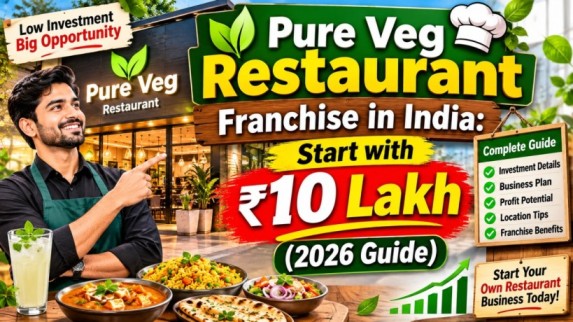
Pure Veg Restaurant Franchise in India: Start with ₹10 Lakh (2026 Guide)
November 6, 2026
Pure Veg Restaurant Franchise in India: Start with ₹10 Lakh (2026 Guide)
A pure veg restaurant franchise in India can be started with ₹5–10 lakh for a compact QSR, kiosk, or cloud kitchen format — not a full dine-in restaurant. Full-service pure veg dine-in franchises like Sagar Ratna and Kamat’s require ₹30–60 lakh, so the ₹10 lakh budget is realistic only for smaller formats. Net margins range from 5–15% for standalone outlets to 18–25% for efficient franchise models in good locations.
Pure veg is not a niche in India. It is the largest consumer segment. A pure veg kitchen has no cold-chain complexity, lower spoilage risk, and no religious objections from a large share of the customer base. This guide breaks down what ₹10 lakh actually buys, which brands fit the budget, and why the smaller format is the smarter first move.
One-Line Answer: What Does ₹10 Lakh Actually Buy?
Pure veg cloud kitchen: ₹5–10 lakh for a 200–300 sq ft delivery-only kitchen with equipment, branding, and aggregator onboarding. No dine-in space. Break-even in 12–18 months.
Compact QSR / kiosk: ₹5–10 lakh for a 250–400 sq ft takeaway-focused outlet. Limited seating, high footfall. Break-even in 12–20 months.
Small-format café: ₹10–15 lakh for a 400–600 sq ft café with limited seating and a broader menu. This sits at the upper edge of the budget.
Why this matters to you: The ₹10 lakh budget is real, but it buys a format, not a full dine-in restaurant. A full-service pure veg restaurant like Sagar Ratna or Kamat’s costs ₹30–60 lakh. Choose the compact format first, then upgrade once you have cash flow.
Why Pure Veg Is a Structural Advantage in India
No Cold Chain, Lower Spoilage, Wider Customer Base
A pure veg kitchen has a structural advantage that non-veg does not: no cold-chain complexity for meat, lower spoilage risk, and no religious objections from a large share of the potential customer base. A pure veg menu also has unlimited SKUs across cuisines, while non-veg menus are limited in comparison. This is not a marketing claim — it is an operational advantage that shows up in food cost, wastage, and customer reach.
The 40%+ Vegetarian Population
A large share of Indian adults prefer vegetarian food, and the pure veg tag expands the customer base significantly. A pure veg franchise serves families, religious communities, and health-conscious consumers who would otherwise avoid a mixed-menu outlet. In Tier-2 and Tier-3 cities, the pure veg tag is not just a preference — it is often a purchase requirement.
Why this matters to you: Pure veg is not a compromise. It is a larger addressable market with lower operational complexity. The same kitchen, the same staff, and the same marketing budget reach more customers.
The Three Franchise Models That Fit ₹10 Lakh
Pure Veg Cloud Kitchen (₹5–10 Lakh)
A delivery-only kitchen operating under a franchise brand. Space requirement: 200–300 sq ft. No dine-in, no front-of-house staff. Veganic operates in this model with a ₹5–10 lakh investment, ₹2 lakh franchise fee, 6% royalty, and 250 sq ft space requirement. Payback is estimated at 1–2 years. The model suits Tier-2 and Tier-3 cities where rent is low and delivery demand is growing.
Compact QSR / Kiosk (₹5–10 Lakh)
A takeaway-focused outlet with a small seating area. GRUB’S by BJS Foods operates a Jain and pure vegetarian QSR with an investment of ₹5–10 lakh, ₹2.5 lakh franchise fee, and 250–300 sq ft space requirement. The brand reports an expected payback of 14 months and 70%+ ROI, with bank financing available up to 70% of the project cost. Capital investment can be as low as ₹4 lakh after bank funding.
Small-Format Café (₹10–15 Lakh)
A 400–600 sq ft café with limited seating and a broader menu (snacks, beverages, and meals). This sits at the upper edge of the ₹10 lakh budget and often requires stretching to ₹12–15 lakh for a comfortable working capital buffer. Best for operators who want a dine-in experience but cannot commit ₹30 lakh+ for a full restaurant.
Comparison Table: Investment, Space, Payback
| Model | Investment | Space | Payback | Best For |
|---|---|---|---|---|
| Pure Veg Cloud Kitchen | ₹5–10 lakh | 200–300 sq ft | 12–24 months | Delivery-first, low rent |
| Compact QSR / Kiosk | ₹5–10 lakh | 250–400 sq ft | 12–20 months | High-footfall takeaway |
| Small-Format Café | ₹10–15 lakh | 400–600 sq ft | 15–24 months | Dine-in with limited seating |
Sources: Veganic / ForeFind (2026), GRUB’S / FranchiseMart (2026), Chaatkachaska (2026). Figures are estimates and vary by city, brand, and format.
The Real Investment: Where Your ₹10 Lakh Goes
Franchise Fee, Kitchen Equipment, Interiors, Licences, Working Capital
| Cost Component | Estimated Amount (₹) | What It Covers |
|---|---|---|
| Franchise fee | ₹2–2.5 lakh | Brand licence, recipes, training, territory |
| Kitchen equipment | ₹1.5–2.5 lakh | Commercial range, refrigerator, prep tables, exhaust |
| Interiors and branding | ₹1.5–2.5 lakh | Signage, counters, seating (if QSR), lighting |
| Security deposit | ₹50,000–₹1 lakh | 2–3 months rent (Tier-2 vs metro) |
| Licences (FSSAI, GST, trade) | ₹15,000–₹30,000 | FSSAI, GST, fire NOC, shop & establishment |
| Initial inventory | ₹30,000–₹50,000 | First 10–14 days of stock and packaging |
| Working capital (2–3 months) | ₹1–1.5 lakh | Rent, staff, raw material, utilities |
| Total | ₹5–10 lakh | Depends on format, city, and brand |
Sources: Veganic / ForeFind (2026), GRUB’S / FranchiseMart (2026), Chaatkachaska (2026). Figures are estimates and vary by city and agreement.
Why this matters to you: The franchise fee is only 20–30% of the total cost. The kitchen equipment, interiors, deposit, and working capital make up the rest. A ₹2 lakh franchise fee with no working capital buffer is not a ₹2 lakh business — it is a ₹6–8 lakh business waiting to run out of cash.
Profit Margins and Break-Even: Real Numbers
5–15% Net Margin for Standalone; 18–25% for Efficient Franchises
A well-run veg restaurant typically sees net profit margins of 5–15%**, with efficient franchise models in good locations pushing closer to **18–25%. The variance is driven by rent, staff cost, food cost (COGS), and daily footfall. A franchise with standardised recipes and supply-chain support usually runs leaner than an independent outlet because wastage and portion inconsistency are controlled.
Monthly Profit Scenarios
| Scenario | Monthly Revenue (Est.) | Net Margin | Monthly Net Profit (Est.) |
|---|---|---|---|
| Cloud kitchen, moderate volume | ₹2–3 lakh | 10–15% | ₹20,000–₹45,000 |
| Compact QSR, stable footfall | ₹3–5 lakh | 12–18% | ₹36,000–₹90,000 |
| Small café, good location | ₹5–8 lakh | 15–22% | ₹75,000–₹1.76 lakh |
Source: Industry estimates based on LinkedIn / vegetarian restaurant margin data (2025), Veganic / ForeFind (2026), and GRUB’S / FranchiseMart (2026). Figures assume 30–35% COGS and controlled rent.
Break-Even in 12–24 Months
Veganic estimates a payback of 1–2 years. GRUB’S reports an expected payback of 14 months with 70%+ ROI. Industry benchmarks for low-investment veg food franchises place ROI in the 12–18 month window for focused operators, with a 12-month recovery being possible in high-footfall Tier-2 and Tier-3 locations. The first 3 months are a gestation period; months 4–8 are growth; months 9–12 are recovery.
Why this matters to you: A 12-month ROI is not a guarantee. It is a realistic target for a lean format, controlled rent, and consistent footfall. If the location is weak, the same model can take 24 months. Location is the single biggest variable.
Top Pure Veg Franchise Brands Under ₹10 Lakh (2026)
Veganic (₹5–10 Lakh)
A cloud kitchen and online food ordering franchise offering vegan cuisine in Tier-1 cities and vegetarian home-style meals in Tier-2 and Tier-3 cities. Investment: ₹5–10 lakh. Franchise fee: ₹2 lakh. Royalty: 6% of gross revenue. Space: 250 sq ft. Payback: 1–2 years. 10–20 franchise outlets. Best for delivery-first operators in Tier-2/3 cities.
GRUB’S by BJS Foods (₹5–10 Lakh)
India’s first Jain and pure vegetarian QSR. Investment: ₹5–10 lakh**. Franchise fee: **₹2.5 lakh. Space: 250–300 sq ft**. Expected payback: 14 months. Expected ROI: 70%+. Bank financing available up to 70%, reducing the effective capital investment to as low as ₹4 lakh. Menu spans paranthas, vada pav, wraps, and burgers. Best for compact QSR and takeaway formats.
Punjabi Chaap Corner (₹11–14 Lakh)
A vegetarian chaap and fast-food franchise with a ₹13.5–14.5 lakh total investment** (including franchise fee, setup, and interiors) and a **₹5.5 lakh franchise fee. Space: 250–300 sq ft. Some listings quote a lower investment of ₹11.33 lakh. The brand markets an “under ₹5 lakh” entry for compact formats, but the full setup runs higher. Best for operators who can stretch slightly above ₹10 lakh for a chaap-focused QSR.
Brand Comparison Table
| Brand | Investment | Franchise Fee | Royalty | Payback |
|---|---|---|---|---|
| Veganic | ₹5–10 lakh | ₹2 lakh | 6% | 1–2 years |
| GRUB’S | ₹5–10 lakh | ₹2.5 lakh | Not specified | 14 months |
| Punjabi Chaap Corner | ₹11–14.5 lakh | ₹5.5 lakh | Not specified | Not specified |
Sources: Veganic / ForeFind (2026), GRUB’S / FranchiseMart (2026), Punjabi Chaap Corner / BharatFranchise (2025). Figures are estimates and vary by city and agreement.
What ₹10 Lakh Cannot Buy: The Full Dine-In Reality
Sagar Ratna (₹30–60 Lakh)
Sagar Ratna is one of India’s most recognised pure veg restaurant chains, with 175+ outlets and a 40+ year legacy. The estimated investment is ₹30–60 lakh**, with a **₹10 lakh franchise fee and **₹15 lakh working capital**. Royalty runs 5–8% of gross monthly sales. This is a full dine-in format, not a ₹10 lakh business.
Kamat’s (₹40–50 Lakh)
Kamat’s and Vithal Kamats operate pure veg and multi-cuisine restaurants with an investment of ₹40–50 lakh for a 1,000–2,000 sq ft outlet. The franchise fee is ₹15–25 lakh**. Profit margins are reported at around **25%** for well-run outlets. This is a full-service restaurant, outside the ₹10 lakh budget.
Kadhi Patta (₹1 Crore)
A pure veg multi-cuisine restaurant expanding across East India, with a ₹1 crore investment** for a 4,000–5,000 sq ft format. The FOCO model offers a **15% revenue share** and an 18-month payback; the FOFO model carries a **7% royalty**. This is a large-format restaurant, not a ₹10 lakh entry.
Why the ₹10 Lakh Budget Must Choose a Smaller Format
A full dine-in restaurant requires prime real estate, a larger kitchen, more staff, and a longer working capital runway. The ₹10 lakh budget cannot cover these costs without compromising on location, equipment, or working capital. The smarter move is to start with a cloud kitchen or compact QSR, build cash flow, and upgrade to a dine-in format later.
Why this matters to you: Trying to open a full dine-in restaurant with ₹10 lakh will leave you undercapitalised and over-leveraged. Choose a format that fits the budget, not a format that requires the budget to double.
Pure Veg vs Non-Veg Franchise: The Real Trade-Off
Cost, Complexity, Customer Base, and Risk
| Factor | Pure Veg | Non-Veg |
|---|---|---|
| Cold chain | None required | Required for meat |
| Spoilage risk | Low | Higher |
| Customer base | Wider (includes vegetarians) | Narrower |
| Menu SKUs | Unlimited across cuisines | Limited |
| Operational complexity | Lower | Higher |
| Raw material cost | Lower and more stable | Higher and volatile |
Why Pure Veg Scales Easier
A pure veg kitchen is easier to operate at scale — not harder. No cold-chain complexity, no meat spoilage, no religious restrictions on who can eat your food. The menu can span South Indian, North Indian, Chinese, and continental without the operational burden of managing separate meat and veg lines. This is why pure veg franchises can standardise faster and expand into smaller cities with less capital.
Why this matters to you: Pure veg is not a limitation. It is an operational and marketing advantage that compounds as you scale from one outlet to multiple.
FSSAI and Licensing in 2026: What Changed
Basic Registration Up to ₹1.5 Crore Turnover
From 1 April 2026**, FSSAI Basic Registration applies to any food business with annual turnover up to **₹1.5 crore, up from the previous ₹12 lakh threshold. This means a new pure veg QSR or cloud kitchen can operate under Basic Registration for longer before upgrading to a State Licence. The State Licence applies to turnover between ₹1.5 crore and ₹50 crore, and the Central Licence applies above ₹50 crore or for multi-state operations.
State Licence and Kitchen Layout Requirements
For a pure veg outlet, the FSSAI application requires a kitchen layout plan showing veg-only zoning**, a food safety management plan, PAN and Aadhaar of the proprietor, address proof, and a list of vegetarian food categories. A State Licence requires a water test report and a more detailed layout. The licence must be displayed on all food delivery platforms and at the outlet.
Why this matters to you: The April 2026 FSSAI change makes it easier and cheaper to start a small pure veg outlet. You can begin with Basic Registration and upgrade as turnover grows, instead of paying for a State Licence on day one.
Tier-2 City Advantage: Why Indore, Jaipur, and Patna Work
Lower Rent, Lower Competition, Faster ROI
Tier-2 and Tier-3 cities are proving to be more lucrative for pure veg franchises than saturated metros. Lower operational costs — rent, staff, and utilities — often lead to faster ROI than in expensive markets like Mumbai or Delhi**. A 250–400 sq ft space in Indore or Jaipur costs **₹10,000–₹25,000 per month, versus ₹40,000–₹80,000+ in a metro. Competition from organised pure veg brands is lower, and demand is growing as families seek clean, branded vegetarian food.
A pure veg cloud kitchen or compact QSR in a Tier-2 city can generate ₹2.5–5 lakh in monthly revenue within 6–9 months if the menu is focused and aggregator ratings stay above 4.0, generating ₹30,000–₹75,000 in monthly net profit at a 12–18% net margin.
Why this matters to you: The same ₹10 lakh that buys a bare-bones metro outlet can fund a complete Tier-2 setup with working capital buffer. Lower rent means faster break-even and higher net margin on the same revenue.
7-Point Checklist Before Choosing a Pure Veg Franchise
- Does the investment fit my budget, or does it require stretching to ₹15–30 lakh?
- Is the format a cloud kitchen, QSR, or full dine-in? Does it match my skills and location?
- What is the exact royalty — 6%, 7%, or a revenue share?
- Does the franchise fee include equipment, training, and aggregator onboarding, or are they separate?
- Have I budgeted ₹1–1.5 lakh for working capital and 2–3 months of operating costs?
- Have I spoken to 3 existing franchisees about actual monthly revenue and net profit?
- Is the territory protected in writing, and is the FSSAI licence tier correct for my turnover?
If the answer to questions 1, 4, or 5 is unclear, do not sign yet.
Final Verdict
If your budget is ₹5–10 lakh: A pure veg cloud kitchen (Veganic) or compact QSR (GRUB’S) is the realistic entry point. Focus on a delivery-first or takeaway format in a Tier-2 city with controlled rent. Break-even in 12–18 months is achievable.
If your budget is ₹10–15 lakh: A small-format café with limited seating is viable, but requires a stronger location and a broader menu. Do not stretch to ₹15 lakh without a working capital buffer.
If you want a full dine-in restaurant: Sagar Ratna (₹30–60 lakh), Kamat’s (₹40–50 lakh), or Kadhi Patta (₹1 crore) are the brands to evaluate. The ₹10 lakh budget is not enough — do not try to force it.
If you want the lowest-risk first business: Start with a cloud kitchen. It has the lowest rent, the fewest staff, and the fastest path to understanding the food business before committing to a dine-in format.
See verified pure veg franchise options:
View franchise list on free-franchise.com →
Frequently Asked Questions (FAQ)
Can I start a pure veg restaurant franchise with ₹10 lakh?
Yes, but only for a compact format — a cloud kitchen or small QSR. A full dine-in pure veg restaurant like Sagar Ratna or Kamat’s requires ₹30–60 lakh. The ₹10 lakh budget is realistic for Veganic (₹5–10 lakh) or GRUB’S (₹5–10 lakh).
What is the profit margin in a pure veg restaurant franchise?
Net margins range from 5–15% for standalone outlets, with efficient franchise models in good locations reaching 18–25%. Food cost (COGS) typically runs 30–35%, and rent, staff, and utilities consume the rest. A compact QSR with ₹3–5 lakh monthly revenue can generate ₹36,000–₹90,000 in net profit.
Which pure veg franchise brands fit a ₹10 lakh budget?
Veganic (₹5–10 lakh, ₹2 lakh fee, 6% royalty, 250 sq ft) and GRUB’S by BJS Foods (₹5–10 lakh, ₹2.5 lakh fee, 14-month payback) are the closest fits. Punjabi Chaap Corner starts around ₹11–14 lakh, slightly above the budget.
Is a pure veg franchise more profitable than a non-veg franchise?
Pure veg has structural advantages: no cold chain, lower spoilage, wider customer base, and unlimited menu SKUs. These advantages reduce operational complexity and food cost, which can translate into more stable margins. A well-run pure veg QSR can reach 18–25% net margin in a good location.
What FSSAI licence do I need for a pure veg restaurant in 2026?
From 1 April 2026, Basic Registration applies to turnover up to ₹1.5 crore. A State Licence applies from ₹1.5 crore to ₹50 crore. The application requires a kitchen layout showing veg-only zoning, a food safety management plan, and address proof. The licence must be displayed on delivery platforms.
Is a pure veg franchise profitable in Tier-2 cities?
Yes. Tier-2 cities like Indore, Jaipur, and Patna have lower rent (₹10,000–₹25,000 for 250–400 sq ft), lower competition, and growing demand. A compact QSR can generate ₹2.5–5 lakh in monthly revenue and break even in 12–18 months, faster than a metro outlet with higher fixed costs.