

Tea Kiosk Franchise in India: Start Your Own Business with ₹1.5–2 Lakh (2026)
November 5, 2026
Tea Kiosk Franchise in India: Start Your Own Business with ₹1.5–2 Lakh (2026)
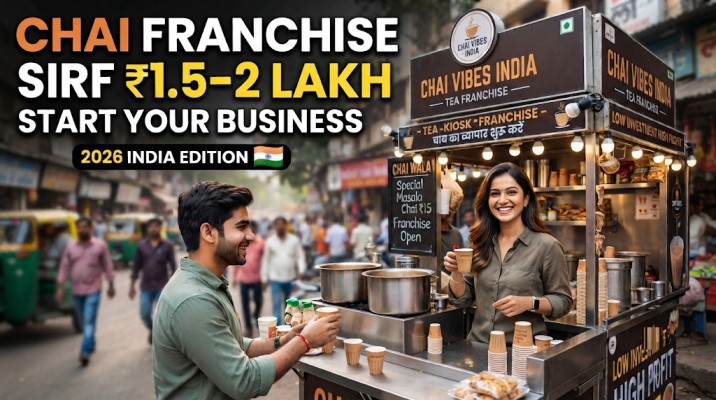
A tea kiosk franchise in India can be started with ₹1.5–2 lakh for a chef-less, 100 sq ft model, or ₹3–5 lakh for a branded kiosk with equipment and training. Net margins range from 35–50% on tea, and break-even typically takes 4–10 months depending on location, daily footfall, and brand.
India’s tea market was valued at USD 11.5 billion in 2024 and is projected to reach USD 15 billion by 2033, growing at 3.1% annually. Nearly 88% of Indian families drink tea regularly — it is not a trend, it is a daily habit. This guide gives you the real costs, margins, and brand options for the lowest-capital entry into the tea business.
One-Line Answer: What Does ₹1.5–2 Lakh Actually Buy?
Chef-less kiosk model: ₹1–3 lakh for a 100 sq ft kiosk with a premix-based menu, equipment, training, and initial stock. No experienced chef required. Break-even in 4–9 months.
Branded kiosk with full setup: ₹3–5 lakh for a branded tea kiosk with a wider menu, better location, and stronger brand recall. Break-even in 6–10 months.
Full tea café: ₹10–30 lakh for a sit-down format with seating, a broader menu, and higher operational costs. Not in the ₹2 lakh budget.
Why this matters to you: The ₹1.5–2 lakh budget is the realistic entry point for a chef-less kiosk. The ₹10–30 lakh café is a different business. Choose the kiosk model if you want low capital, low staff cost, and fast break-even.
Why Tea Kiosks Work in India
India’s Tea Market: USD 11.5 Billion and Growing
India’s tea market was valued at USD 11.50 billion in 2024 and is projected to reach USD 15.0 billion by 2033, growing at 3.10% annually. The organised tea retail segment is growing even faster, at 12–15% annually. India is the second-largest tea producer in the world, and the industry is valued at over ₹50,000 crore.
88% of Indian Families Drink Tea Regularly
Nearly 88% of Indian families drink tea regularly. That is not a market you need to create — it is a habit you need to capture. Offices, colleges, railway stations, highways — anywhere people pause and breathe, they want chai. A tea kiosk positions itself inside that daily routine.
The Recession-Proof Daily Habit
Tea is the most affordable indulgence in India. A cup costs ₹10–₹30 at a kiosk. Even in a slow economy, people do not stop drinking chai. The low ticket size and high repeat frequency make tea kiosks one of the most resilient small-business models in the country.
Why this matters to you: You are not betting on a fad. You are building a business around a daily, non-negotiable habit that cuts across income levels and city tiers.
The Real Investment: Where Your ₹1.5–2 Lakh Goes
Franchise Fee, Equipment, Initial Stock, Working Capital
| Cost Component | Estimated Amount (₹) | What It Covers |
|---|---|---|
| Franchise fee (one-time) | ₹50,000–₹2,00,000 | Brand licence, training, territory protection |
| Equipment | ₹40,000–₹75,000 | Tea boiler, induction/gas, stainless tables, POS, signage |
| Initial stock | ₹15,000–₹30,000 | Tea premix, milk, sugar, cups, consumables |
| Security deposit | ₹20,000–₹40,000 | 1–2 months rent (Tier-2 vs metro) |
| Licences (FSSAI, GST, trade) | ₹5,000–₹15,000 | FSSAI registration, GST, local permits |
| Working capital (2 months) | ₹20,000–₹40,000 | Rent, staff, raw material buffer |
| Total | ₹1.5–₹4.0 lakh | Depends on brand, city tier, and inclusions |
Sources: Maa Ki Chai (2026), Nagori Chai / FranchiseBazar (2026), FranchiseBazar (Feb 2026). Figures are estimates and vary by brand, city, and format.
The Hidden Costs Nobody Budgets For
The quoted franchise fee is rarely the whole bill. Ask each brand to price these in writing before you sign: interiors and signage (often separate), staff training beyond the first 3 days, POS or billing software, and monthly maintenance fees (some brands charge ₹1,000/month instead of a percentage royalty).
Why this matters to you: A ₹1.5 lakh franchise fee sounds manageable. But if the total all-in cost is ₹2.5 lakh and you only have ₹2 lakh, you will run out of working capital before month three. Budget for the all-in number, not the headline fee.
Profit Margins and Break-Even: Real Numbers
35–50% Gross Margin on Tea
Tea kiosk gross margins range from 35–50%. Maa Ki Chai reports a ~35% profit margin on its core chai. Premium tea and cold beverages carry 35%+ margins. The margin is lower than a full café because the kiosk model is volume-driven — you sell more cups at a lower price point.
Daily Sales and Monthly Profit Scenarios
| Scenario | Daily Cups | Monthly Revenue (Est.) | Monthly Net Profit (Est.) |
|---|---|---|---|
| Low footfall | 150–200 | ₹25,000–₹50,000 | ₹10,000–₹20,000 |
| Moderate footfall | 250–350 | ₹50,000–₹80,000 | ₹20,000–₹35,000 |
| High footfall (college/market) | 400–600 | ₹80,000–₹1,50,000 | ₹35,000–₹60,000 |
Sources: Maa Ki Chai (2026), Tea Time / FranchiseBazar (2026). Figures are estimates and vary by location, pricing, and operating efficiency.
Break-Even in 4–10 Months
Maa Ki Chai reports a 4–9 month break-even (location dependent). Tea Time reports 5–10 months. Industry benchmarks place tea kiosks at 10–14 months on average, with strong locations achieving faster payback. The difference is almost always daily footfall and rent-to-revenue ratio.
Why this matters to you: A tea kiosk in a college zone or busy market can break even in 4–6 months. A kiosk in a low-footfall residential lane may take 10–12 months. Location is the single biggest variable.
Top Tea Kiosk Franchise Brands Under ₹2 Lakh (2026)
Maa Ki Chai
A chef-less, 100 sq ft kiosk model with a one-time franchise fee of ₹2 lakh for the standard plan (high-traffic plan at ₹2.25 lakh). Zero royalty. Investment range: ₹1–3 lakh across three plans. Break-even: 4–9 months. Monthly revenue: ₹25,000–₹1,00,000. Monthly profit: ₹20,000–₹30,000 after expenses. Best for: first-time operators in Tier-2/3 cities who want a low-cost, no-chef model.
Nagori Chai
A low-investment tea café franchise with an estimated investment of ₹1 lakh for a 100–150 sq ft space. Payback: 4–6 months. 20–40 outlets operational. Best for: entrepreneurs who want the lowest possible entry with a proven, small-format brand.
Chai Sutta Bar (Kiosk Model)
India’s largest tea franchise by brand recall, with 550+ outlets. The kiosk model is the entry point, but the full franchise investment is ₹16–25 lakh (FOFO). Royalty: 4% of monthly gross revenue. ROI: 12–18 months. Best for: operators with a larger budget who want a nationally recognised brand and a kulhad chai format.
Brand Comparison Table
| Brand | Investment | Royalty | Break-Even | Best For |
|---|---|---|---|---|
| Maa Ki Chai | ₹1–3 lakh | 0% | 4–9 months | Lowest entry, chef-less model |
| Nagori Chai | ₹1 lakh | Not specified | 4–6 months | Ultra-low entry, small format |
| Chai Sutta Bar | ₹16–25 lakh | 4% | 12–18 months | Brand recall, larger budget |
Sources: Maa Ki Chai (2026), Nagori Chai / FranchiseBazar (2026), The Founder Nation (2026). Figures are estimates and vary by city, format, and agreement.
Tea Kiosk vs Tea Café: Which Model Fits ₹2 Lakh?
Investment, Space, Revenue, and Risk Comparison
| Factor | Tea Kiosk | Tea Café |
|---|---|---|
| Investment | ₹1.5–5 lakh | ₹10–30 lakh |
| Space required | 100–200 sq ft | 400–1,000 sq ft |
| Staff required | 1–2 per shift | 3–6 per shift |
| Monthly revenue potential | ₹25,000–₹1,50,000 | ₹2–₹8 lakh |
| Break-even | 4–10 months | 8–18 months |
| Risk level | Low | Medium–high |
| Best for | First-time operators, ₹2 lakh budget | Experienced operators, ₹10 lakh+ budget |
Why the Kiosk Wins for First-Timers
The kiosk model requires less capital, less space, fewer staff, and breaks even faster. It is the lowest-risk way to learn the tea business — menu, pricing, staffing, and daily operations — before committing to a larger café. If the kiosk works, you can reinvest profits into a café later. If it does not, the loss is manageable.
Why this matters to you: With a ₹2 lakh budget, the kiosk is the only realistic entry. The café is a ₹10 lakh+ decision. Start with the kiosk, learn the business, then scale.
Tier-2 City Advantage: Why Indore, Jaipur, and Patna Work
Lower Rent, Lower Competition, Growing Demand
A 100–150 sq ft kiosk space in a Tier-2 city costs ₹8,000–₹20,000 per month, versus ₹25,000–₹50,000+ in a metro. Competition from organised tea brands is lower, and demand is growing as young people seek affordable hangout spots and branded chai experiences.
A tea kiosk in Indore or Jaipur can generate ₹50,000–₹1,00,000 in monthly revenue within 4–6 months if the location has steady footfall (college zone, market, bus stand, or railway station). At a 35–50% gross margin, the owner can expect ₹20,000–₹40,000 in monthly net profit after rent, staff, and raw material costs.
Why this matters to you: In Tier-2 cities, a ₹2 lakh tea kiosk can break even in 4–6 months because rent and staff costs are lower. The same investment in a metro buys more competition and higher fixed costs.
7-Point Checklist Before Choosing a Tea Kiosk Franchise
- Does the ₹1.5–2 lakh budget cover all-in costs, or only the franchise fee?
- Is the royalty a percentage of revenue, a flat monthly fee, or zero?
- Does the brand provide a chef-less premix model, or do I need experienced staff?
- What is the minimum space requirement, and does it fit my target location?
- Have I budgeted ₹20,000–₹40,000 for working capital and 2 months of operating costs?
- Have I spoken to 3 existing franchisees about actual daily sales and monthly profit?
- Is the territory protected in writing?
If the answer to questions 1, 2, or 5 is unclear, do not sign yet.
Final Verdict
If your budget is ₹1–2 lakh: Maa Ki Chai or Nagori Chai are the realistic entry points. Both offer 100–150 sq ft kiosk models, chef-less operations, and break-even in 4–9 months. Focus on a college zone, market, or transit hub.
If your budget is ₹3–5 lakh: A branded kiosk with a wider menu and better location is viable. Tea Time offers a ₹5 lakh unit franchise with a 5–10 month break-even and a 4,000+ outlet network.
If you want a nationally recognised brand: Chai Sutta Bar is the benchmark, but the ₹16–25 lakh investment is outside the ₹2 lakh budget. Start with a smaller kiosk, learn the business, and scale later.
If you want the lowest-risk entry: A chef-less premix kiosk (Maa Ki Chai) removes the biggest operational risk — finding and retaining an experienced chai maker.
See verified tea kiosk franchise options:
View franchise list on free-franchise.com →
Frequently Asked Questions (FAQ)
Can I start a tea kiosk franchise with ₹1.5–2 lakh?
Yes. Maa Ki Chai offers a 100 sq ft chef-less kiosk with a ₹2 lakh one-time fee and zero royalty. Nagori Chai offers a ₹1 lakh entry for a 100–150 sq ft space. Both are realistic within a ₹2 lakh budget, including working capital.
What is the profit margin in a tea kiosk franchise?
Gross margins range from 35–50% on tea. After rent, staff, and raw material costs, a kiosk with 250–350 daily cups can generate ₹20,000–₹35,000 in monthly net profit. High-footfall locations (400–600 cups/day) can reach ₹35,000–₹60,000.
How long does it take to break even in a tea kiosk?
Break-even typically takes 4–10 months. Maa Ki Chai reports 4–9 months (location dependent). Tea Time reports 5–10 months. Industry benchmarks place tea kiosks at 10–14 months on average. Location footfall is the biggest variable.
Do I need a chef to run a tea kiosk franchise?
Not for a chef-less premix model like Maa Ki Chai. The premix ensures consistent taste, and staff can be trained in 3 days. A traditional tea café with a full menu may require an experienced chai maker. The chef-less model reduces staffing cost and operational risk.
Is a tea kiosk franchise profitable in Tier-2 cities?
Yes. Tier-2 cities like Indore, Jaipur, and Patna have lower rent (₹8,000–₹20,000 for 100–150 sq ft), lower competition, and steady demand. A kiosk with 250–350 daily cups can generate ₹20,000–₹35,000 in monthly net profit and break even in 4–6 months.
What licences are required for a tea kiosk in India?
You need FSSAI registration (₹100–₹5,000 per year depending on turnover), GST registration if turnover exceeds the threshold, shop and establishment registration, and local municipal permits. Total licensing cost is typically ₹5,000–₹15,000.