


Cardiac-Diabetic PCD Franchise in India: The Monopoly Business Opportunity (2026)
November 2, 2026
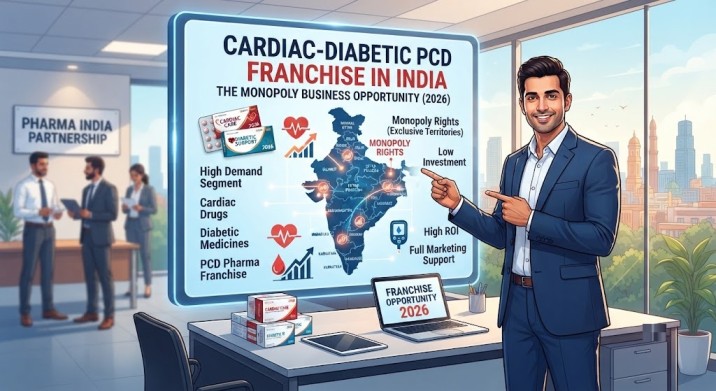
Cardiac-Diabetic PCD Franchise in India: The Monopoly Business Opportunity (2026)
A cardiac-diabetic PCD franchise in India can be started with ₹30,000–₹1.5 lakh for a small district or mid-sized city territory, with margins ranging from 25% to 65% and most partners recovering their investment in 3–5 months. The model works because cardiac and diabetic patients refill the same prescription every 30 days — for life — creating a monthly repeat rate of 85–95% versus 40–60% for general medicines.
This is not a general PCD franchise with a different product list. It is a monopoly-based chronic care business where territory protection and doctor loyalty decide your income. This guide breaks down the real costs, margins, monopoly verification steps, and doctor activation math.
One-Line Answer: Why Cardiac-Diabetic Is Different
General PCD: You sell antibiotics, painkillers, and antacids. A patient buys a strip for five days and may not return for months. Monthly repeat rate: 40–60%. Margins: 15–30%.
Cardiac-diabetic PCD: You sell metformin, glimepiride, telmisartan, and atorvastatin. A patient buys the same medicines every month, often for decades. Monthly repeat rate: 85–95%. Margins: 25–65%.
Why this matters to you: The chronic refill model means your income compounds with every doctor you activate. You are not chasing new customers every month — you are maintaining a prescription base that reorders automatically.
What Is a Cardiac-Diabetic PCD Franchise?
Propaganda Cum Distribution Explained
PCD stands for Propaganda Cum Distribution. A pharma company owns the brand and manufactures the medicines. You get the exclusive right to promote and distribute that cardiac-diabetic range in a defined territory — usually a district, a city, or a taluk. You buy at the company’s net rate and sell to chemists and stockists at PTS or PTR. The difference is your margin.
The Product Portfolio: Anti-Diabetics, Cardiac, Lipid, Neuropathy
A cardiac-diabetic PCD portfolio typically covers four groups:
- Anti-diabetic: Metformin, Glimepiride, Vildagliptin, Teneligliptin, Dapagliflozin, Sitagliptin
- Cardiac / hypertension: Telmisartan, Amlodipine, Losartan, Ramipril, Metoprolol
- Lipid / cholesterol: Atorvastatin, Rosuvastatin, Clopidogrel combinations
- Neuropathy / supplements: Alpha Lipoic Acid, Methylcobalamin, Pregabalin combinations
Most portfolios are tablet- and capsule-heavy because oral solids are shelf-stable and easy to stock at the chemist level[reference:19].
Why this matters to you: The product range is not exotic. These are molecules every physician, diabetologist, and cardiologist prescribes daily. Your job is not to create demand — it is to capture prescriptions that already exist.
Why the Cardiac-Diabetic Segment Is a Monopoly Opportunity
Lifetime Prescriptions = Predictable Monthly Income
Cardiac and diabetic medicines are prescribed for life. A doctor who trusts your brand keeps writing it every 30 days, indefinitely. Amplec Healthcare notes that partners earn steady monthly income from just 8–10 active doctors**[reference:20]. The revenue does not reset every month — it compounds.
12–15% CAGR vs 8–10% for General Pharma
The Indian cardiac-diabetic drug segment is growing at 12–15% CAGR**, significantly faster than the general pharma market. Cardiac therapy is the largest IPM segment at roughly **14% share**, with July 2026 sales of **₹3,299 crore (up 14.7%)**. Anti-diabetics recorded **₹2,237 crore (up 17.6%)**[reference:21]. Together, cardiac and anti-diabetic cover about **23% of total pharmaceutical spending**[reference:22].
85–95% Monthly Repeat Rate
Unlike acute medicines where the repeat rate is 40–60%, cardiac-diabetic prescriptions see **85–95% monthly repeat rates**[reference:23]. This is the structural reason the segment is more predictable and more profitable per active doctor.
India’s Disease Burden: 101 Million+ Diabetics
India has over 101 million diabetic patients**, cardiovascular disease accounts for nearly **28% of all deaths annually**, and **35.5% of Indian adults** have hypertension[reference:24]. The patient base is not a trend — it is a permanent, growing healthcare reality.
Why this matters to you: You are not betting on a fad. You are building a distribution business on the two largest chronic disease categories in India, both growing at double digits.
The Real Investment: Where Your ₹30,000–₹3 Lakh Goes
Small District vs Mid-City vs Metro Cost Breakdown
| Cost Component | Small Town / District | Mid-Sized City | Metro / Large Territory |
|---|---|---|---|
| Initial cardiac-diabetic stock | ₹20,000–₹40,000 | ₹50,000–₹80,000 | ₹80,000–₹1,50,000 |
| Wholesale drug licence | ₹5,000–₹15,000 | ₹10,000–₹20,000 | ₹15,000–₹25,000 |
| GST registration | ₹500–₹2,000 | ₹500–₹2,000 | ₹500–₹2,000 |
| Promotional materials | ₹5,000–₹10,000 | ₹10,000–₹20,000 | ₹20,000–₹40,000 |
| Working capital (2 months) | ₹10,000–₹20,000 | ₹20,000–₹40,000 | ₹40,000–₹80,000 |
| Total estimated investment | ₹30,000–₹70,000 | ₹80,000–₹1,50,000 | ₹1,50,000–₹3,00,000 |
Source: Amplec Healthcare (2026)[reference:25]. Seclis Labs quotes ₹25,000–₹1,00,000 for a single territory and ₹1–2 lakh+ for wider multi-category ranges[reference:26].
The Monthly Running Cost Nobody Budgets For
Your investment does not stop at the first stock order. Every month, you need ₹8,000–₹20,000 for doctor detailing visits, samples, visual aids, prescription pads, and travel[reference:27]. Keep two months of this amount as a reserve. That buffer is what keeps the business alive during the slow early phase when prescriptions are still building[reference:28].
Why this matters to you: A ₹30,000 stock order is not a ₹30,000 business. A small-district cardiac-diabetic franchise is realistically a ₹40,000–₹70,000 investment once you include licence, promotion, and two months of running costs.
Profit Margins: Gross vs Net (What You Actually Keep)
The Four Numbers: Net Rate, PTS, PTR, MRP
Your margin is the gap between the net rate** (what the company charges you) and the price at which you sell — **PTS** to stockists or **PTR** to retailers. The **MRP** sets the ceiling; the stockist and retailer each take a slice before the patient pays.
Margin by Product Category
| Product Category | Net Margin Range | Why Higher |
|---|---|---|
| Anti-diabetic tablets (Gliptins, SGLT2) | 35–55% | Branded generics with higher MRPs and growing demand |
| Cardiac combination medicines (FDCs) | 30–50% | Complex formulations and premium pricing potential |
| Statins (Atorvastatin, Rosuvastatin) | 25–40% | High prescription volume and consistent demand |
| Antihypertensives (ARBs, ACE inhibitors) | 28–45% | Long-term therapy with strong physician preference |
| Neuropathy range (Alpha Lipoic Acid) | 40–60% | Specialty segment with lower competition |
| Diabetic supplements & nutraceuticals | 45–65% | Premium positioning and higher profit potential |
Source: Amplec Healthcare (2026)[reference:29]. Overall segment margins run 25–65%, versus 15–30% for general PCD[reference:30].
Gross Margin vs Net Profit
A 55% gross margin on a gliptin combination does not mean 55% net profit. After doctor detailing, samples, travel, and credit cycle delays, your real net margin is typically 25–45% of monthly turnover. Plan your personal income around net, not gross.
Why this matters to you: The cardiac-diabetic margin advantage is real — but it is an operating advantage. It only shows up if you actually do the doctor visits and keep stock available at chemists.
Monopoly Rights: How to Verify Before You Sign
What Monopoly Actually Means
Monopoly (exclusive territory) rights mean the company will not appoint another franchise partner for the same product range in your defined area. You are not competing internally with another partner of the same company for the same chemists and prescriptions[reference:31].
The 5-Point Monopoly Checklist
- Named territory:** District, city, or taluk — written into the agreement, not “as discussed.”
- Product range:** Which cardiac-diabetic SKUs are covered. A company may have monopoly and open divisions.
- Duration:** Is exclusivity annual, permanent, or tied to minimum order conditions?
- Non-appointment clause:** A written commitment that the company will not appoint another partner for the same range in your area.
- Breach consequences:** What happens if the company violates the monopoly? What is your remedy?
Red Flags in Cardiac-Diabetic Franchise Agreements
- Verbal monopoly promises.** If it is not written, it is not enforceable. “Spoken promises fade fast once your area starts doing well”[reference:32].
- Vague territory descriptions.** “Your area” is not a territory.
- No breach clause.** A monopoly without consequences is a suggestion.
- Unilateral MOQ increases.** Check whether the company can raise minimum order quantities after year one.
Why this matters to you: Monopoly rights are the entire reason the cardiac-diabetic PCD model works. Without written exclusivity, you are just another distributor competing on price against your own brand’s other partners.
Realistic Income: Doctor Activation Math
How Many Active Doctors to Break Even
In a small district, 3–5 active cardiologists or diabetologists can generate ₹15,000–₹30,000 monthly revenue in months 1–3, growing to ₹40,000–₹70,000 by months 6–9[reference:33]. A mid-city franchise with 10–15 active doctors can reach ₹1,00,000–₹1,80,000 monthly revenue by months 9–12.
The key insight: you do not need 100 doctors. You need a focused set of 8–15 prescribers who trust your brand and write it habitually.
City-Wise Income Table
| Territory Type | Active Doctors Needed | Monthly Revenue (Month 6–9) | Net Profit (Est.) |
|---|---|---|---|
| Small district | 3–5 | ₹40,000–₹70,000 | ₹15,000–₹30,000 |
| Mid-sized city (Indore, Jaipur, Patna) | 10–15 | ₹1,00,000–₹1,80,000 | ₹40,000–₹80,000 |
| Metro / large territory | 20+ | ₹2,00,000+ | ₹80,000+ |
Source: Industry estimates based on Amplec Healthcare (2026) and Seclis Labs (2026) data. Net profit assumes 25–45% net margin after running costs.
Why this matters to you: Your income is a direct function of how many doctors you activate and how consistently you visit them. There is no passive income here — but the income you build does not reset every month.
Cardiac-Diabetic vs General PCD: A Side-by-Side Comparison
| Factor | Cardiac-Diabetic PCD | General PCD |
|---|---|---|
| Prescription frequency | Monthly (lifetime medication) | Weekly / acute (short-term) |
| Revenue predictability | Very high | Moderate |
| Profit margins | 30–65% | 15–30% |
| Doctor loyalty | Very high | Low to medium |
| Market growth (CAGR) | 12–15% | 8–10% |
| Competition level | Moderate | Very high |
| Minimum investment | ₹30,000–₹1.5 lakh | ₹20,000–₹1 lakh |
| Monthly repeat rate | 85–95% | 40–60% |
Source: Amplec Healthcare (2026)[reference:34].
Why this matters to you: Cardiac-diabetic requires slightly more upfront investment in doctor-facing promotion, but the recurring revenue model makes it significantly more profitable within 6–12 months.
Tier-2/3 City Advantage: Why Indore, Jaipur, and Patna Work
Lower Competition, Fewer Specialists, Faster Activation
A district with 5 active cardiologists and low cardiac-diabetic PCD competition will make you more money than a metro city where 20 operators fight over the same doctors**[reference:35]. In Tier-2 cities, the number of PCD partners competing for the same specialists is lower, and the patient base is growing.
Tier-2 cities also have lower rent and lower staff costs. A small office or godown in Indore or Jaipur costs a fraction of a Mumbai or Delhi equivalent, which improves net margin on the same revenue.
Why this matters to you: The “best” territory is not the biggest city. It is the district where you can activate 5–10 doctors with minimal competition and keep them supplied consistently.
7-Point Checklist Before Choosing a Cardiac-Diabetic PCD Franchise
- Is the company WHO-GMP certified and are its products DCGI-approved?
- Is the monopoly territory written with named districts and product ranges?
- What is the exact net rate, PTS, PTR, and MRP for each product?
- What is the minimum order value, and can it be increased unilaterally after year one?
- Have I budgeted ₹8,000–₹20,000 monthly running cost and two months of reserve?
- Have I spoken to 3 existing franchise partners about actual doctor activation and monthly income?
- Do I have a wholesale drug licence (Form 20B/21B) and GST registration before signing?
If the answer to questions 1, 2, or 6 is unclear, do not sign yet.
Final Verdict
If your budget is ₹30,000–₹70,000: A small-district cardiac-diabetic franchise is the most realistic entry point. Focus on 3–5 cardiologists and diabetologists, not the entire district.
If your budget is ₹80,000–₹1.5 lakh: A mid-sized city territory gives you enough product range and working capital to activate 10–15 doctors and reach ₹1–1.8 lakh monthly revenue by month 9–12.
If you have medical representative experience: Cardiac-diabetic is a natural fit. Your existing relationships with cardiologists and diabetologists are the single biggest factor in early activation.
If you want the highest per-doctor income: Cardiac-diabetic beats general PCD on repeat rate, margin, and doctor loyalty. The trade-off is higher upfront promotion spend and the need for written monopoly protection.
See verified cardiac-diabetic PCD franchise options:
View franchise list on free-franchise.com →
Frequently Asked Questions (FAQ)
What is a cardiac-diabetic PCD pharma franchise?
It is a PCD (Propaganda Cum Distribution) franchise focused on heart, blood pressure, cholesterol, and diabetes medicines. The company manufactures and owns the brand; you get exclusive rights to promote and distribute that range in a defined territory and keep the margin between the net rate and your selling price.
How much investment is needed for a cardiac-diabetic PCD franchise?
A small-district territory needs ₹30,000–₹70,000, including initial stock, drug licence, promotional material, and two months of working capital. A mid-sized city needs ₹80,000–₹1,50,000. A metro or large territory can run ₹1,50,000–₹3,00,000.
What is the profit margin in a cardiac-diabetic PCD franchise?
Margins range from 25% to 65% depending on the product category. Anti-diabetic gliptins and SGLT2 inhibitors earn 35–55%; cardiac FDCs 30–50%; statins 25–40%; neuropathy combinations 40–60%; nutraceuticals 45–65%. Net profit after running costs is typically 25–45% of monthly turnover.
How do monopoly rights work in a cardiac-diabetic PCD franchise?
Monopoly rights mean the company will not appoint another franchise partner for the same product range in your defined territory. They must be written into the agreement with a named district, product range, duration, and breach consequences. Verbal exclusivity is not enforceable.
Is a cardiac-diabetic PCD franchise more profitable than a general PCD franchise?
Yes, per active doctor. Cardiac-diabetic prescriptions refill monthly for life, with an 85–95% repeat rate and 25–65% margins, versus 40–60% repeat rate and 15–30% margins in general PCD. The trade-off is slightly higher upfront promotion spend and the need for written monopoly protection.
Can I start a cardiac-diabetic PCD franchise in a small town?
Yes — and small towns often offer better ROI than metros. A district with 3–5 active cardiologists and diabetologists and low PCD competition can generate ₹40,000–₹70,000 monthly revenue within 6–9 months of consistent field work.