

Fastest-Growing Franchise Industries in India: 2026 Data & ROI Guide
October 19, 2026
Fastest-Growing Franchise Industries in India: 2026 Data & ROI Guide
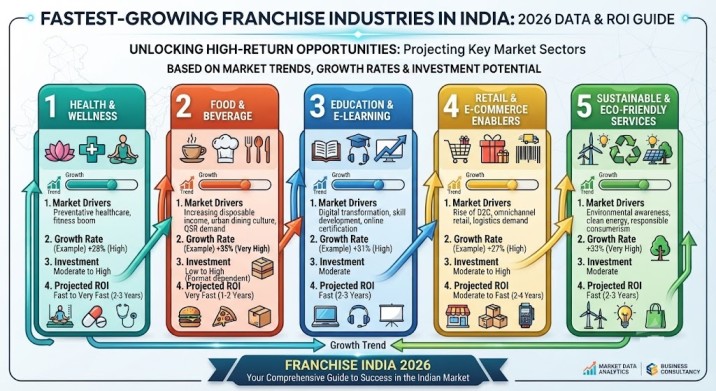
The fastest-growing franchise industries in India for 2026 are education and skill development (ROI 30–60%, payback 12–24 months), cloud kitchens (18% yearly growth), beauty and wellness (23% organised CAGR), and laundry services (15%+ CAGR). Food and beverage remains the largest sector, but education delivers the fastest payback.
India’s overall franchise market is growing at 30–35% CAGR, but sector-level performance varies sharply. This guide gives you the real growth rates, investment ranges, and ROI benchmarks — without the brochure hype.
One-Line Answer: Which Sector Is Growing Fastest?
Fastest payback: Education franchises (12–24 months, ROI 30–60%).
Fastest sub-segment growth: Cloud kitchens (18% yearly).
Largest sector: Food and beverage (35% of all franchises).
Highest organised growth: Beauty and wellness (23% CAGR).
Most underpenetrated: Fitness (India penetration under 1%).
Why this matters to you: The “fastest-growing” sector is not always the most profitable for you. Education grows fast because it is asset-light and recurring, but it requires patience and academic credibility. Food grows fast because demand is universal, but rent and royalty can crush margins.
India’s Franchise Market in 2026: The Big Numbers
India has 4,600+ active franchisors operating 2 lakh+ outlets across sectors. The market is valued at approximately USD 100 billion (2023–24) and is projected to reach USD 140–150 billion by 2028.
Growth is driven by rising disposable incomes in Tier-2 and Tier-3 cities, demand for branded experiences, and government support for MSME entrepreneurship.
Market Snapshot
| Metric | Data (2026) |
|---|---|
| Active franchisors | 4,600+ |
| Franchise outlets | 2,00,000+ |
| Market value | USD 100 billion (2023–24) |
| Growth rate | 30–35% CAGR |
| F&B share of franchises | ~35% |
| Jobs created | 1 million+ |
Why this matters to you: A 30–35% CAGR means the sector is expanding fast, but it also means competition is rising. Choosing a growing sector is step one; choosing the right location and format within that sector is what decides profitability.
1. Education & Skill Development — Fastest Payback (ROI 30–60%)
Why Asset-Light Education Franchises Grow Fastest
Education franchises — preschools, tutoring centres, test-prep, STEM/coding, and skill development — require smaller premises, lower inventory, and generate recurring fee revenue. This makes them asset-light and faster to break even.
India has roughly 246.9 million school students and a K-12 education market valued at USD 103 billion (2025). Demand is expanding beyond metros into Tier-2 and Tier-3 cities.
Investment Range and Tier-2 City Opportunity
Most education franchises fall in the ₹5–25 lakh band. ROI benchmarks are 30–60%, with payback in 12–24 months — the fastest among major sectors.
In Indore, Jaipur, or Patna, rent is 50–70% lower than Mumbai, which compresses the payback timeline further. A preschool franchise in Patna can recover capital faster than an equivalent QSR in a metro.
Why this matters to you: If you want the fastest capital recovery and can build trust with parents, education is the strongest sector in 2026. It is less glamorous than food, but the maths is better.
2. Food & Beverage (QSR + Cloud Kitchens) — Largest Sector, Fastest Sub-Segment
QSR Growth vs. Cloud Kitchen Growth
F&B is the largest franchise sector, accounting for roughly 35% of all franchises. The QSR market alone is valued at USD 30.37 billion in 2026, growing at 9.25% CAGR.
But the fastest-growing format within F&B is the cloud kitchen, growing at approximately 18% yearly (2026–2031). Entry cost is ₹6–20 lakh, with margins of 25–35% before aggregator commissions.
Investment and Break-Even Comparison
| Format | Investment | Break-Even |
|---|---|---|
| Cloud Kitchen | ₹6–20 lakh | 6–18 months |
| QSR (Dine-In / Takeaway) | ₹30 lakh–₹2 crore | 18–36 months |
Source: FranchiseBazar (Feb 2026).
Why this matters to you: Cloud kitchens grow fastest because they avoid dine-in rent. But they depend heavily on Swiggy and Zomato, which take 15–30% of every order. If you cannot absorb that commission, a QSR with a strong brand may be safer despite the slower growth.
3. Beauty, Wellness & Grooming — 23% Organised Growth
Why Franchise Chains Are Replacing Local Parlours
The Indian beauty and wellness market is projected to reach USD 48.5 billion by 2033. The organised sector is growing at roughly 23% CAGR, significantly outpacing the unorganised sector (~15%).
Consumers are shifting from local parlours to branded chains because of hygiene, standardised pricing, and trust. Franchise chains currently hold only about 10% of the market but are the fastest-growing segment.
Investment and ROI Profile
Mid-sized salon franchises typically require ₹15–40 lakh, with ROI in the 25–45% range and payback of 18–30 months, depending on location and brand strength.
Why this matters to you: Beauty is a trust business. A branded salon in Indore or Jaipur can capture share from dozens of unorganised parlours because customers want consistency. The growth is real, but it depends on hiring and retaining skilled stylists.
4. Laundry & Garment Care — The Convenience Economy Play
Asset-Light Model, Recurring Revenue
India’s laundry sector is formalising rapidly. Startups like UClean, Tumbledry, DhobiLite, and LaundryMate are using asset-light franchise models that combine local entrepreneurship with centralised branding and technology.
The broader laundry and dry-cleaning market is projected to break the ₹1.5 lakh crore mark by 2030, growing at 15%+ CAGR (industry estimates).
Investment Range and Growth Drivers
Laundry franchise investments typically range from ₹7–25 lakh, with recurring revenue from households and businesses. The model benefits from urbanisation, dual-income households, and app-based convenience habits.
Why this matters to you: Laundry is a “boring” business with steady demand. It does not have the glamour of a café, but it has lower raw material costs and predictable repeat customers — a strong combination for first-time franchisees who value stability.
5. Fitness & Preventive Healthcare — Underpenetrated, High Growth
India’s Fitness Penetration Under 1%
India’s fitness penetration remains under 1%, compared with over 20% in the US. Cult.fit alone operates 700+ centres, of which nearly 400 are franchise-operated.
The fitness industry is shifting from “event fitness” (wedding prep, weight loss) to identity fitness — longevity, preventive health, and community. This shift increases retention and makes fitness a more stable franchise category.
Franchise Models and Investment Ranges
Fitness franchise investments vary widely. Boutique studios and functional training centres may start at ₹30–80 lakh, while larger gym formats can exceed ₹1 crore. The high end is capital-intensive, but the underpenetration means long-term growth headroom is large.
Why this matters to you: Fitness is not a low-investment category. If your budget is ₹2–25 lakh, a boutique studio or a smaller-format franchise may be out of reach. But if you have ₹30 lakh+, the growth story is compelling because penetration is so low.
6. B2B Services (Logistics, IT Support, Compliance) — The “Golden Quadrant”
Why B2B Franchising Is Accelerating
B2B services franchising is growing through four sub-sectors: digital transformation and IT support, logistics and supply chain, skill development and B2B training, and professional compliance/legal-tech.
These models are less consumer-facing, which reduces brand marketing costs and footfall dependency. They rely on contracts and recurring business relationships.
Lower Consumer-Facing Risk
B2B franchises often require smaller retail spaces and have lower rent exposure than QSR or retail. They are suited to investors with corporate or operational experience.
Why this matters to you: If you have a corporate background and prefer dealing with businesses rather than daily retail customers, B2B services may be a better fit than food or beauty — even though these sectors get less media attention.
7. Healthcare & Diagnostics — Trust-Driven Growth
Collection Centres and Diagnostic Franchises
Diagnostic collection centres and healthcare retail formats are growing because of rising health awareness, insurance penetration, and demand for accessible testing. These are typically asset-light (small collection centres) with brand trust as the primary driver.
Investment and Regulatory Considerations
Investment ranges vary from ₹5–25 lakh for collection centres to higher amounts for imaging or full diagnostics. Regulatory requirements (NABL accreditation, clinical protocols) are stricter than in food or beauty, but the trust barrier also protects established brands.
Why this matters to you: Healthcare is a “trust-first” category. A strong brand reduces customer acquisition cost, but compliance and quality failures carry higher reputational risk. Choose a franchisor with a clean regulatory record.
Sector Comparison Table: Growth Rate vs. Investment vs. ROI
| Sector | Growth Rate (2026) | Typical Investment | ROI / Payback |
|---|---|---|---|
| Education & Skill | 15–20% CAGR (sector); fastest payback | ₹5–25 lakh | ROI 30–60%; payback 12–24 months |
| F&B — Cloud Kitchen | ~18% yearly (2026–2031) | ₹6–20 lakh | Margins 25–35%; break-even 6–18 months |
| F&B — QSR | 9.25% CAGR | ₹30 lakh–₹2 crore | Margins 15–22%; break-even 18–36 months |
| Beauty & Wellness | ~23% organised CAGR | ₹15–40 lakh | ROI 25–45%; payback 18–30 months |
| Laundry & Garment Care | 15%+ CAGR (industry estimate) | ₹7–25 lakh | Recurring revenue; model-dependent |
| Fitness | High growth from low base | ₹30 lakh+ | Penetration under 1%; long-term growth |
Sources: FranchiseBazar (2026), Sparkleminds (2026), BW Businessworld (2026), IMARC/VF Franchise (2026).
7-Point Checklist Before Choosing a Sector
- Does this sector match my budget band (₹2–25 lakh, or higher)?
- Is the sector’s growth driven by real demand — not just franchisor marketing?
- Have I calculated total investment including working capital and royalty?
- Is my target city (Mumbai, Indore, Patna, Jaipur) suited to this sector’s cost structure?
- Have I spoken to 3 existing franchisees in this sector about actual ROI?
- Does the sector depend heavily on aggregators (Swiggy/Zomato) or a single platform?
- Am I choosing this sector because it fits my skills — or because it is “trending”?
If the answer to questions 1, 3, or 5 is unclear, wait.
Final Verdict
For fastest payback: Education and skill development franchises lead with 12–24 month payback and 30–60% ROI.
For largest market size: F&B (QSR + cloud kitchens) remains dominant, but cloud kitchens are the fastest-growing format within it.
For organised growth: Beauty and wellness (23% CAGR) is replacing unorganised parlours at scale.
For stable, low-glamour returns: Laundry and garment care offer recurring revenue and asset-light operations.
See verified franchise options in the fastest-growing sectors:
View franchise list on free-franchise.com →
Frequently Asked Questions (FAQ)
Which franchise industry is growing fastest in India?
Education and skill development franchises deliver the fastest payback (12–24 months, ROI 30–60%). Within food, cloud kitchens are the fastest-growing format (~18% yearly). Beauty and wellness is the fastest-growing organised consumer sector (~23% CAGR). Growth rate and payback are different metrics.
Is the food franchise industry still growing in 2026?
Yes. F&B remains the largest franchise sector (35% of all franchises), with the QSR market at USD 30.37 billion and 9.25% CAGR. Cloud kitchens within F&B are growing much faster (~18% yearly). The sector is growing, but competition and rent pressure are also rising.
Which franchise sector gives the fastest ROI in India?
Education franchises offer the fastest ROI, with 30–60% returns and 12–24 month payback. Cloud kitchens also deliver quick break-even (6–18 months) but carry aggregator risk. QSR and beauty have longer payback (18–36 months) but can deliver strong long-term returns.
Why are education franchises growing so fast in Tier-2 cities?
Education franchises are asset-light, have recurring fee revenue, and require lower rent than food or retail. Tier-2 cities (Indore, Jaipur, Patna) offer lower costs and rising demand from dual-income families. This combination compresses payback timelines.
Is a cloud kitchen more profitable than a QSR franchise?
Cloud kitchens can be more profitable per rupee invested because they avoid dine-in rent and start at ₹6–20 lakh. But they depend heavily on Swiggy/Zomato, which take 15–30% per order. QSR franchises have higher investment (₹30 lakh+) but stronger brand pull and lower platform dependence.
What is the “Golden Quadrant” of B2B franchising?
The “Golden Quadrant” refers to four fast-growing B2B sub-sectors: digital transformation & IT support, logistics & supply chain, skill development & B2B training, and professional compliance/legal-tech. These are less consumer-facing and rely on business contracts rather than footfall.