

When Does Break-Even Happen in a Franchise Business?
October 19, 2026
When Does Break-Even Happen in a Franchise Business? Real Case Studies (2026)
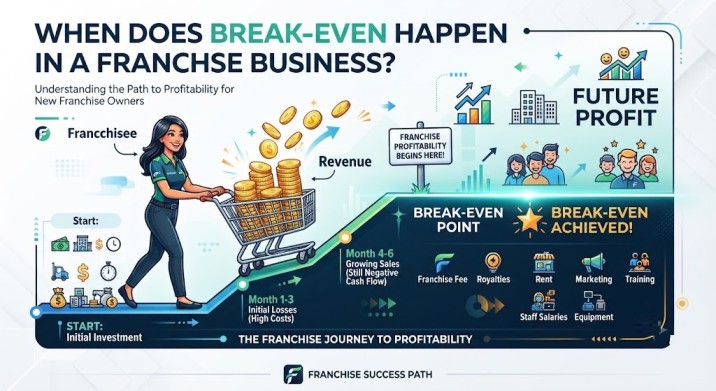
In India, most low-investment franchises (₹2–10 lakh) break even in 6–14 months, while mid-tier QSR and retail franchises (₹15–40 lakh) typically take 18–36 months. Premium formats (₹50 lakh+) often need 3–5 years to recover the initial investment.
Break-even is not a magic number. It depends on rent, royalty, working capital, and daily footfall. This guide gives you real case studies with actual rupee numbers so you can plan your own timeline.
One-Line Answer: What Is a Realistic Break-Even Timeline?
₹2–10 lakh (kiosks, tea, dairy): 6–14 months.
₹10–25 lakh (compact QSR, laundry, service): 12–24 months.
₹25–50 lakh (mid-tier QSR, retail): 18–36 months.
₹50 lakh+ (premium dine-in, large formats): 3–5 years.
Why this matters to you: If a franchisor promises break-even in 6 months for a ₹30 lakh outlet, ask for their working capital maths. Most such claims ignore rent, royalty, and aggregator commissions.
What Does “Break-Even” Actually Mean in a Franchise?
Break-even means your monthly revenue equals your total monthly costs — rent, salaries, raw materials, royalty, marketing fee, utilities, and loan EMIs. After break-even, every rupee of revenue adds to profit.
Most franchisors quote break-even based only on operating costs, not total investment recovery. The real question is: when will I recover my full investment (setup + working capital + franchise fee)? That is called the payback period. Break-even comes before payback.
Break-Even vs. Payback: The Difference That Matters
| Term | What It Means | Example |
|---|---|---|
| Break-Even | Monthly revenue = monthly operating costs | You stop losing money every month |
| Payback | Total profit earned = total investment made | You recover the ₹10 lakh you invested |
Why this matters to you: A franchise can break even in 8 months but take 24 months to pay back your full investment. Ask about both numbers before signing.
The 5 Factors That Decide Your Break-Even Timeline
1. Rent-to-Revenue Ratio
Rent must stay below 15% of monthly revenue. In Mumbai (Bandra, Andheri), prime rent can be ₹1–2 lakh/month for a small space. In Indore or Patna, the same space costs ₹25,000–₹50,000. Lower rent = faster break-even.
2. Royalty and Marketing Fee
Royalty (4–8%) and marketing fee (1–3%) together take 5–11% of sales before rent. On ₹8 lakh monthly sales, that is ₹40,000–₹88,000 every month. Zero-royalty brands like Maa Ki Chai and Amul break even faster because they keep this money with the franchisee.
3. Working Capital Buffer
You need 3–6 months of rent, salaries, and stock before revenue stabilises. Most franchisees who “fail” actually ran out of cash, not customers. A well-funded kiosk may take 8 months to break even; an underfunded one may close in month 4.
4. Daily Footfall and Average Bill
A kiosk with 150 daily customers at ₹80 average bill = ₹12,000/day = ₹3.6 lakh/month. If monthly costs are ₹2.5 lakh, break-even happens quickly. If the same kiosk gets only 80 customers/day, it may never break even.
5. Aggregator Commissions (For Delivery)
Swiggy and Zomato take 15–30% of every delivery order. If delivery is 40% of sales and you earn 20% margin, commission can wipe out most of it. Franchises that rely heavily on delivery need longer break-even timelines.
Why this matters to you: Break-even is not decided by the brand — it is decided by your location, rent, and daily sales volume. The brand is only one part of the equation.
Real Case Study 1: ₹2 Lakh Chai Kiosk in Indore
The Setup
Franchise: Maa Ki Chai (zero royalty). Location: Indore, near a college coaching hub. Area: 100 sq ft kiosk. Total investment: ₹2 lakh (franchise fee) + ₹60,000 (setup and equipment) + ₹50,000 (working capital) = ₹3.10 lakh.
Monthly Numbers
Daily customers: 120. Average bill: ₹60. Monthly revenue: ₹2.16 lakh. Rent: ₹15,000. Staff (2): ₹24,000. Raw materials: ₹65,000. Electricity and misc: ₹8,000. Royalty: ₹0. Total monthly cost: ₹1.12 lakh.
The Break-Even
Monthly profit: ₹2.16 lakh − ₹1.12 lakh = ₹1.04 lakh. Break-even (recovering the ₹3.10 lakh investment) happens in ~3 months at this run rate. Even with slower initial months, actual break-even was reported in 4–5 months.
Source: Industry estimate based on Maa Ki Chai partner data (2026) and local Indore rent averages.
Why this matters to you: A kiosk with zero royalty and low rent can recover the full investment in 4–5 months. The same kiosk in Mumbai with ₹80,000 rent would take 12+ months.
Real Case Study 2: ₹8 Lakh QSR in Bangalore
The Setup
Franchise: The Burger Company PICO. Location: HSR Layout, Bangalore. Area: 90 sq ft. Total investment: ₹7.89 lakh + taxes + ₹1.50 lakh working capital = ₹9.80 lakh (estimated).
Monthly Numbers
Daily customers: 90. Average bill: ₹140. Monthly revenue: ₹3.78 lakh. Rent: ₹45,000. Staff (3): ₹45,000. Raw materials: ₹1.10 lakh. Electricity and misc: ₹15,000. Royalty (assumed 5%): ₹19,000. Total monthly cost: ₹2.34 lakh.
The Break-Even
Monthly profit: ₹3.78 lakh − ₹2.34 lakh = ₹1.44 lakh. Full investment recovery: ₹9.80 lakh ÷ ₹1.44 lakh = ~7 months in a strong sales scenario. In a moderate scenario (60 customers/day), break-even stretches to 14–18 months.
Source: Indian Retailer (2025) claims 8–12 month payback; this estimate factors in Bangalore rent and working capital.
Why this matters to you: A QSR’s break-even swings massively based on daily footfall. At 90 customers/day, break-even is 7 months. At 60 customers/day, it is 18 months. Location is the deciding factor.
Real Case Study 3: ₹25 Lakh Laundry Franchise in Mumbai
The Setup
Franchise: DhobiLite / Laundry. Location: Andheri West, Mumbai. Area: 400 sq ft. Total investment: ₹15 lakh (setup) + ₹3 lakh (working capital) + ₹2 lakh (deposit) = ₹20 lakh (estimated).
Monthly Numbers
Daily orders: 60. Average order value: ₹350. Monthly revenue: ₹6.30 lakh. Rent: ₹85,000. Staff (4): ₹80,000. Supplies and utilities: ₹1.20 lakh. Royalty (7%): ₹44,000. Total monthly cost: ₹3.29 lakh.
The Break-Even
Monthly profit: ₹6.30 lakh − ₹3.29 lakh = ₹3.01 lakh. Investment recovery: ₹20 lakh ÷ ₹3.01 lakh = ~7 months. However, laundry franchises typically see slower ramp-up in the first 6 months, so real-world break-even is 12–18 months.
Source: DhobiLite official data (2026) and industry estimates.
Why this matters to you: Service franchises like laundry have recurring revenue and lower raw material costs. Their break-even is more predictable than food franchises — but only if you secure a high-footfall residential location.
Break-Even Comparison Table (By Budget and Format)
| Format | Investment Range | Typical Break-Even | Best For |
|---|---|---|---|
| Chai kiosk / Dairy outlet | ₹2–5 lakh | 4–10 months | Tier-2 cities, metro stations |
| Compact QSR (80–100 sq ft) | ₹7–12 lakh | 8–15 months | Food courts, tech parks |
| Laundry / Service franchise | ₹10–25 lakh | 12–18 months | Residential areas, metros |
| Mid-tier QSR (200–400 sq ft) | ₹15–40 lakh | 18–36 months | High streets, malls |
| Premium dine-in / Large format | ₹50 lakh+ | 3–5 years | Metro prime locations only |
Sources: FranchiseBazar (Feb 2026), Indian Retailer (2026), industry estimates.
City-Wise Impact: Why Your Break-Even Changes Across India
The same franchise model has a very different break-even timeline depending on the city. Rent is the biggest variable.
| City | Rent (300 sq ft) | Kiosk Break-Even | QSR Break-Even |
|---|---|---|---|
| Mumbai | ₹80,000–1,50,000/month | 12–18 months | 24–36 months |
| Bangalore | ₹40,000–75,000/month | 10–15 months | 18–30 months |
| Indore | ₹20,000–45,000/month | 7–12 months | 14–24 months |
| Jaipur | ₹20,000–50,000/month | 8–14 months | 16–26 months |
| Patna | ₹15,000–35,000/month | 6–11 months | 12–22 months |
Source: FranchiseBazar rent data and industry estimates (2025–2026).
Why this matters to you: A ₹2 lakh kiosk in Patna can break even in 6 months. The same kiosk in Mumbai might take 18 months. Tier-2 cities offer faster recovery because rent and staff costs are significantly lower.
How to Calculate Your Own Break-Even (Before You Invest)
Use this simple formula before signing any franchise agreement:
- Estimate monthly revenue: Daily customers × Average bill × 30.
- List monthly costs: Rent + Staff + Raw materials + Electricity + Royalty + Marketing fee + Loan EMI (if any).
- Calculate monthly profit: Revenue − Costs.
- Add total investment: Franchise fee + Setup + Security deposit + Working capital.
- Divide: Total investment ÷ Monthly profit = Break-even months.
If the answer is under 12 months, you have a strong opportunity. If it is over 36 months, the risk is high unless the brand has strong recurring demand.
5 Signs Your Break-Even Estimate Is Too Optimistic
- The franchisor’s projection does not include royalty, GST, or marketing fees.
- Daily customer estimates assume “peak day” traffic every day.
- Working capital is not factored into the investment figure.
- Rent is assumed at rates from 2 years ago.
- Delivery commissions (Swiggy/Zomato 15–30%) are ignored.
7-Point Checklist Before You Commit to a Franchise
- Have I calculated break-even using real rent and staff costs in my specific city?
- Is my rent below 15% of projected monthly revenue?
- Have I factored royalty + marketing fee into monthly costs?
- Do I have 6 months of working capital saved separately?
- Have I spoken to 3 existing franchisees about their actual break-even?
- Does the franchisor’s projection include GST and aggregator commissions?
- Am I prepared to wait 18+ months if sales ramp up slower than expected?
If the answer to questions 1, 4, or 5 is “no,” do not invest yet.
Final Verdict
Budget ₹2–5 lakh: Choose a zero-royalty kiosk or dairy outlet. Break-even in 6–12 months is realistic in Tier-2 cities.
Budget ₹10–25 lakh: Compact QSR and service franchises offer 12–24 month break-even. Prioritise low-rent locations.
Budget ₹25 lakh+: Mid-tier QSR and retail demand 18–36 months. Do not invest without 6 months of working capital buffer.
See verified franchise options with transparent break-even data:
View franchise list on free-franchise.com →
Frequently Asked Questions (FAQ)
How long does it take to break even in a franchise business in India?
Low-investment kiosks (₹2–5 lakh) break even in 6–12 months. Compact QSR (₹7–15 lakh) takes 8–18 months. Mid-tier QSR and retail (₹15–40 lakh) typically need 18–36 months. Premium formats (₹50 lakh+) may take 3–5 years.
What is the difference between break-even and payback in a franchise?
Break-even means monthly revenue equals monthly operating costs. Payback means your total profit has recovered the full investment (franchise fee + setup + working capital). A franchise can break even in 8 months but take 24 months to fully pay back.
Can a franchise break even in 6 months?
Yes, but only in specific cases: a low-rent location in a Tier-2 city, a zero-royalty brand, and daily sales volume that matches or exceeds projections. A ₹2 lakh chai kiosk in Indore or Patna can realistically break even in 4–6 months.
Why do most franchises take longer to break even than promised?
Franchisor projections often exclude GST, aggregator commissions, working capital, and rent inflation. They may also assume peak-day footfall every day. Real break-even is usually 30–50% longer than the brochure claim.
Does a zero-royalty franchise break even faster?
Yes, in most cases. Zero royalty means 100% of your sales revenue stays with you after the one-time fee. On ₹8 lakh monthly sales, a 6% royalty brand pays ₹48,000/month — ₹5.76 lakh per year. A zero-royalty brand keeps that money.
How much working capital should I keep beyond the investment?
Keep 3–6 months of total operating costs (rent + salaries + stock) as working capital. For a kiosk, this is ₹1–3 lakh. For a QSR, ₹5–10 lakh. This buffer prevents cash-flow failure during the ramp-up period.